For over 30 years, people have turned to to declutter their homes, capitalize on collections of old baseball cards and Beanie Babies, and sell vintage t-shirts their parents asked them to discard decades earlier.
But eBay isn’t just an online marketplace and auction platform. The e-commerce company is considered one of many counter-cyclical recession indicators. During economic downturns or bouts of elevated inflation, the company—which often features discounted, second-hand, or refurbished items—sees increased activity as consumers look to find value amid tightening budgets or to generate income from unneeded goods.

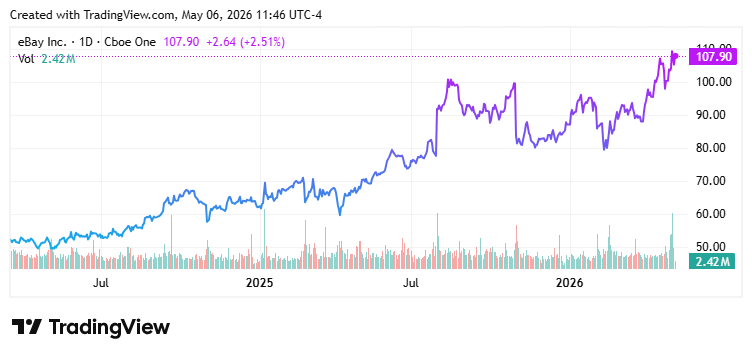
While the consumer discretionary sector has been the fourth-worst performer among the ’s 11 sectors this year, eBay has bucked that trend. The stock is up around 20% in 2026, easily outperforming the index’s 5% gain, and over the past year, shares of EBAY have climbed more than 50%.
The company recently reported Q1 FY2026 earnings, providing insights into the state of the broader economy and clues about how investors could position their portfolios in preparation for a protracted slowdown.
More Sellers Are Turning to eBay as Economy Shows Signs of Weakness
The uptick in eBay activity is most notable in its gross merchandise volume (GMV) gauge. In Q1, that figure was 18% higher year over year (YOY).
Specifically, GMV saw the largest gains in the company’s consumer-to-consumer transactions and recommerce—buying and reselling of pre-owned, used, or refurbished goods.
According to eBay, those categories saw GMV growth accelerate to 24% in the first quarter.
In his earnings call comments, CEO Jamie Iannone highlighted other short-term catalysts, including the 30th anniversary of Pokemon in late February, which “fueled significant enthusiasm that translated into strong demand on [the] platform.” Iannone also noted that trading cards, collectible coins, toys, action figures, and comic books all fueled GMV growth.
Perhaps most interestingly, the CEO said that eBay “also saw a transitory benefit to GMV growth from and bullion in response to precious metal prices.” Both of those precious metals reached all-time highs early in Q1, and Iannone noted that by the end of the quarter, demand normalized and the company expects it to revert to historical levels in Q2. That could be offset by the acquisition of Depop, which is expected to be completed in the second quarter.
Still, eBay enjoyed plenty of tailwinds for GMV growth that should sustain this year as economic uncertainty and elevated prices are expected to continue. The silver lining, at least for investors, is that shares of EBAY are reflecting the increase in its platform use, which the company just underscored in its latest earnings.
eBay Beats on Top and Bottom Lines, Revises Full-Year Guidance
Those strong gains in GMV translated into strong earnings when the company reported Q1 financials on April 29. Earnings per share (EPS) of $1.66 beat the consensus forecast of $1.58 by eight cents. The company hasn’t missed earnings for 14 consecutive quarters.
But the standout figure was quarterly revenue, which was driven by the aforementioned surge in GMV. eBay saw a YOY revenue increase of 19.5%, reaching $3.09 billion and surpassing analyst expectations of $3.04 billion.
Better-than-expected Q1 sales figures resulted in upward revisions to Q2 revenue and full-year GMV. eBay forecasts quarterly revenue in the range of $2.97 billion to $3.03 billion, good for an 8% to 10% YOY increase, while full-year GMV growth was lifted to 7% to 7.5%.
Additionally, the company reiterated its plan to repurchase approximately $2 billion of its shares this year. That is part of a stock buyback authorization announced in February and includes $625 million for Q2.
With an improved forward price-to-earnings ratio, eBay’s EPS is expected to grow by 11.25% over the next year from $4.89 per share to $5.44 per share.
Wall Street Remains Cautious Despite Upgraded Expectations
While the company’s first-quarter performance was noteworthy and eBay remains a valuable counter-cyclical recession indicator, analysts are taking a wait-and-see approach. After a notable run-up in share prices so far this year, the consensus 12-month price target of around $105 suggests moderate downside from where the stock is currently trading.
At the same time, more than half of the analysts covering the stock (18 of 33) rate EBAY a Hold. However, it’s worth mentioning that one year ago, Wall Street’s price target for EBAY was $67.12, nearly 39% lower than the stock’s current price, and analysts were forecasting more than 2% downside rather than the more than 50% upside it has rewarded shareholders with.
Institutional ownership remains above average at more than 87%, but outflows of more than $7 billion have outnumbered inflows of nearly $5 billion, with selling outnumbering buying for four consecutive quarters. Meanwhile, short interest of 2.95% of the float, or $1.31 billion, is down nearly 39% from its one-year high of $2.14 billion in May 2025.
5 Stocks Our Experts Predict Could Double In the Next Year
By submitting your email, you'll also get a free pivot & flow membership. A free daily market overview. You can unsubscribe at any time.