I’ll explain the connection between Bessent and Warsh – and why I think it’s good news for investors…
Listen to the audio version of this article (generated by AI).
On September 16, 1992, the British government was fighting for its financial life.
For months, currency traders had been circling the British pound. The pound was pegged to European currencies at a rate most believed was indefensible. Britain’s economy was weakening. Inflation was high due to economic growth in Europe after the fall of the Berlin Wall.
The math didn’t work. And one man – George Soros – decided to bet on it.
What followed was one of the most spectacular days in the history of global finance.
Soros shorted $10 billion worth of the British pound. The Bank of England fought back – buying pounds by the billions, raising interest rates twice – from 10% to 12%, then to 15% – in a single day in a desperate attempt to defend the currency.
But it didn’t work. By the evening, it was over.
The British government surrendered. It unpegged the pound from Europe and later began a series of cuts, bringing its interest rate down to 6% by early 1993, leading to an economic recovery.
As for Soros, he made more than a billion dollars in a single day. The date went down in history as Black Wednesday.
Most people know that story. Fewer people know who was in the room.
You see, two of the men connected to that trade are about to be in charge of American monetary and fiscal policy simultaneously.
I’m talking, of course, about Treasury Secretary Scott Bessent and Kevin Warsh, the incoming Federal Reserve Chair.
I don’t think most investors understand what that means for their portfolios right now.
I do. I’ve been at this for nearly five decades. I’ve seen every market cycle and I’ve seen every Fed regime come and go.
In today’s Market 360, I’ll explain the connection between Bessent and Warsh – and why I think it’s good news for investors. I’ll also give you my prediction for the Fed’s next move and how to be positioned before everyone else catches on.
I’ll also be going deeper at my Fed Shock event this Wednesday, May 13, at 1 p.m. Eastern, where I’ll share my highest-conviction picks and a free stock recommendation just for attending. (Click here to reserve your spot now.)
What the Market Is Missing
Our Treasury Secretary – Scott Bessent – was part of the team that pulled off the Bank of England trade for Soros.
Kevin Warsh comes from the same world. After leaving the Fed in 2011, he went to work with Stanley Druckenmiller, the trader who actually executed the Black Wednesday trade. Druckenmiller and Bessent have remained close ever since.
These two men know each other, they trust each other, and they appear to be operating from a shared framework.
Warsh has been a big critic of the Fed for years. He doesn’t like quantitative easing – the money printing that has ballooned the Fed’s balance sheet to nearly $7 trillion. But he also believes AI-driven productivity gains are fundamentally deflationary (meaning they’ll lower prices).
This means he thinks the economy can absorb more aggressive rate cuts than the old models suggest.
Bessent, meanwhile, is one of the most capable economic minds in Washington. And he has publicly called for 150 basis points in reductions (1.5%).
He is also fully aware of the U.S.’s mounting debt problems. And I believe he and Warsh will work together to lower rates, unleash growth and tackle the debt.
How We Can Profit From the New Fed Regime
I believe the new Fed regime is going to cut rates more aggressively than the market expects.
I’ve seen this happen four times before.
The primary beneficiaries of rate cuts are going to be smaller, domestically focused companies – the ones that are most sensitive to borrowing costs and most leveraged to U.S. economic growth.
Each time the Fed opened a sustained cycle of rate cuts, a specific group of smaller stocks delivered extraordinary gains:
- 1995 Fed pivot: Cisco +2,062%. Ascend +2,800%. AOL +2,900%.
- 2001 rate cuts: Frontline +1,513%. Hansen Natural +1,125%.
- 2008 rate cuts: Lithia Motors +475%. IPG Photonics +665%.
- 2020 COVID cuts: MARA Holdings +1,800%. Moderna +1,200%.
Different stocks. Different sectors. Same dynamic every time.
Now, I realize there’s a war on. I know inflation is still a factor. I know the Fed moves more slowly than anyone wants. This isn’t going to happen overnight. Warsh will need to build consensus on a 12-person committee.
But the direction is clear. The players are in place. And history says this is how it plays out.
The Exclusion List
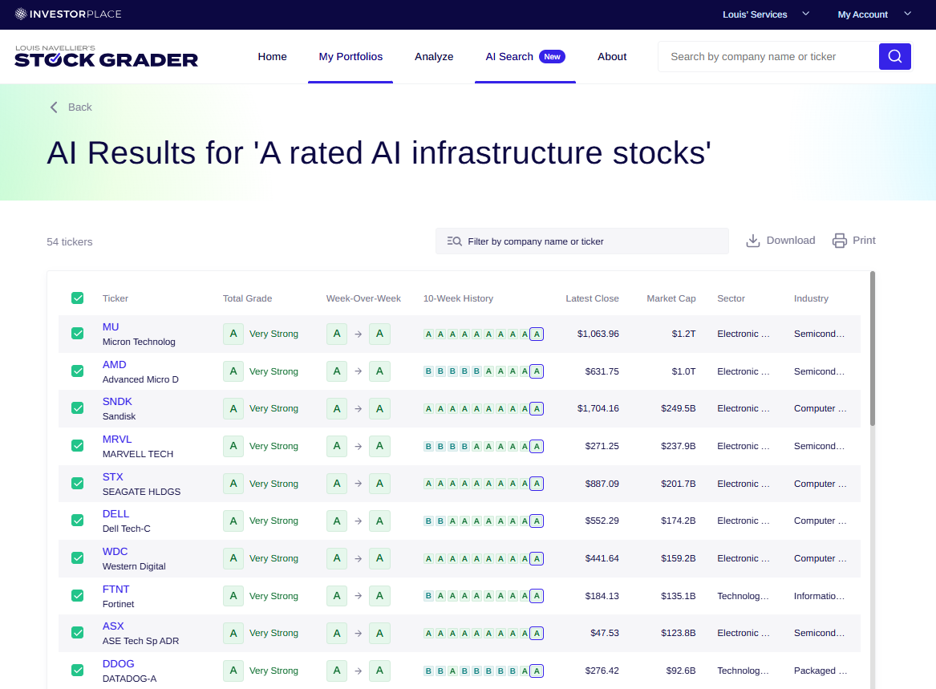
My Stock Grader system has already been running throughout this early phase of the cutting cycle – and it has flagged 53 stocks showing the same early signals I’ve described in every prior window.
Strong fundamentals. Building institutional buying pressure. Consistent top rankings month after month.
I call it the Exclusion List. These are stocks that are too small for Wall Street to touch. But not too small for my system – and not too small for you.
This Wednesday, May 13, at 1 p.m. Eastern, I’m going live to share my highest-conviction picks from that list. The are the names I believe are best positioned for what’s coming. I’ll also give away a free stock recommendation just for attending.
Click here to reserve your spot now. I’ll see you there.
Sincerely,

Louis Navellier
Editor, Market 360
5 Stocks Our Experts Predict Could Double In the Next Year
By submitting your email, you'll also get a free pivot & flow membership. A free daily market overview. You can unsubscribe at any time.