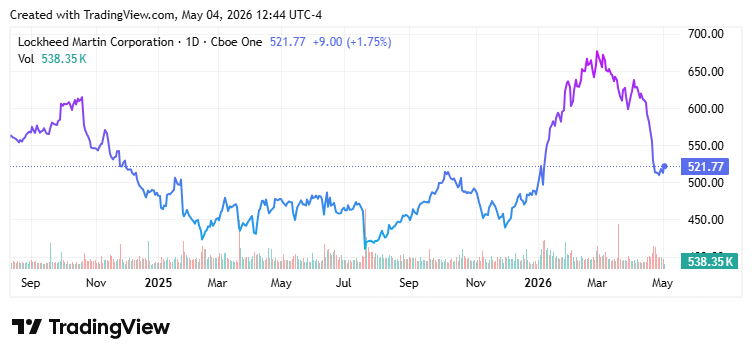
Shares of aerospace and defense giant took a heavy hit following the release of its Q1 2026 earnings report on April 23, extending a sharp pullback that has now seen the stock fall as much as 27% since early March highs.
That makes the setup especially important heading into the new trading week, as investors look for signs that the post-earnings selling pressure has finally started to fade.
On the surface, the reaction makes sense. The company missed expectations, cash flow disappointed, and the headlines were far from encouraging. The drop was made all the steeper given how much the stock had rallied through the first two months of the year. It’s now all but completely given up those gains to trade back to where it was in the first week of January.
However, in this case, the bigger story may be that the earnings miss actually reset a stock that had become too stretched. What initially looked like yet another setback could turn out to be the exact catalyst needed to set up the next move higher.
A Messy Quarter, but Not a Broken Story
From a pure numbers perspective, there’s no point sugar-coating Lockheed’s Q1 results.
The company missed expectations for both headline numbers, continuing a dodgy-looking track record of inconsistent results. Revenue growth was basically flat year over year (YOY), earnings declined YOY, and free cash flow was negative, all of which contributed to the subsequent selloff in the stock.
Some of the pressure was concentrated in key segments, such as Aeronautics and Rotary and Mission Systems, which underperformed expectations. Those are important parts of the business, and weakness there is not something investors can ignore.
However, context matters. Not all segments were under pressure, with areas like Missiles and Fire Control and Space showing greater resilience. More importantly, management reaffirmed its full-year guidance for revenue, earnings, and cash flow. For investors looking for the silver lining, that’s a critical point.
If the issues in Q1 were structural, you would expect guidance to be revised lower. The fact that it wasn’t suggests that management views the poor quarter as a temporary issue rather than a sign of a more long-term problem. Now, that doesn’t exactly make the miss irrelevant, but it does make the stock’s recent drop look heavily oversold.
The Selloff Has Reset the Setup
Technically, the setup is looking very different from what it was like even just a month ago. Lockheed stock has moved into extremely oversold territory, with the pace and one-directional shape of the decline catching investors’ attention.

However, there are early signs of stabilization heading into the new week. Bears have failed twice to push the stock below $503, suggesting some buyers may be stepping back in after the drop. This hints that some buyers may be stepping back in after the drop. If that momentum carries into this week, it wouldn’t take much for a recovery rally to begin to take shape.
This is often how these setups work. A strong trend becomes overextended, a negative catalyst triggers a sharp correction, and the reset creates a new, more attractive entry point for investors who missed the initial move but who believe in the long-term potential.
Analyst Targets Suggest the Market Has Gone Too Far
Backing up the thesis that Lockheed stock is extremely oversold is the fact that even the more cautious voices on the Street are giving it price targets well above current levels.
Morgan Stanley, for example, recently gave Lockheed an Equal Weight rating with a price target of $653. At the same time, more bullish firms such as BNP Paribas and Susquehanna have targets of $680 and $700, respectively.
Considering the stock’s currently trading around $510, that’s quite a bit of potential upside being called out. These targets are obviously not guarantees, but they do reflect a view that the underlying business remains stronger than the recent price action would suggest. Combined with management’s reaffirmed guidance, they support the idea that the selloff may have gone too far, too fast.
A Bounce That Could Quickly Build
The setup from here is relatively straightforward. If Lockheed can hold recent lows and continue to build on these early signs of stabilization, the conditions are in place for a recovery rally. The stock is no longer overbought, expectations have been reset, and sentiment has shifted from overly optimistic to overly cautious in a short period.
That kind of swing often creates opportunity. Of course, there are still risks. Lockheed will need to demonstrate that the issues observed in Q1 were indeed temporary and that performance will improve as the year progresses. Any further disappointment could delay the recovery.
But based on what we know today, the bigger picture hasn’t changed. Lockheed remains a high-quality business operating in a sector with strong long-term demand, and it is still guiding to a solid full-year performance. For investors willing to look past a single messy quarter, the current setup suggests the best opportunity may now be ahead, not behind.
5 Stocks Our Experts Predict Could Double In the Next Year
By submitting your email, you'll also get a free pivot & flow membership. A free daily market overview. You can unsubscribe at any time.