Get the latest insights on Bitcoin, Ether and altcoins, along with a round-up of key cryptocurrencymarket news
Here’s a quick recap of the crypto landscape for Friday (September 25) as of 11:00 p.m. UTC.
Bitcoin price update
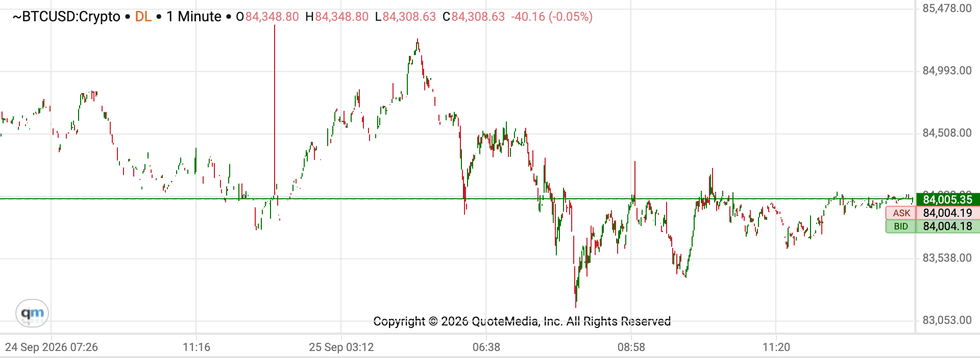
Bitcoin (BTC) was priced at US$84,005.87, trading 0.1 percent lower over the past 24 hours.
Simon-Peter Massabni, head of business development at XS.com, argues that Bitcoin holding up because big investors keep buying through funds and the US economy is stronger than expected. That strength helps offset the risk from Middle East conflict, which is keeping oil prices volatile and adding to inflation worries.
The catch is that a hot economy may push the Fed to raise interest rates again, which traders increasingly expect before year-end. Massabni’s view is that steady fund buying can absorb that pressure for now.
Bitcoin price chart
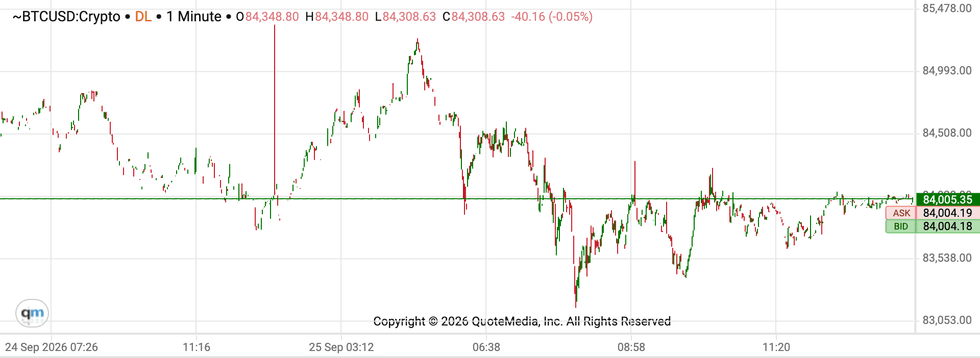
Chart via the Investing News Network.
Bitcoin price performance, September 25, 2026.
Ether and altcoin price update
Bitcoin price performance, August 19, 2026.
- Ethereum (ETH) was priced at US$2,692.64, trading 0.9 percent higher over the last 24 hours.
- XRP (XRP) was priced at US$1.57, up 2.1 percent over the past 24 hours.
- Solana (SOL) was trading at US$121.78, trading 4.5 percent higher over the past 24 hours.
Today’s crypto news to know
Read on for a round-up of the biggest cryptomarket news
- CoinMarketCap acquires Coinglass
- Fed unveils proposed stablecoin issuer rules
- Hackers drain over US$350 million from Bitget
- New York sues Polymarket US over unlicensed gambling
CoinMarketCap acquires Coinglass
Crypto price tracker CoinMarketCap announced that it has acquired Coinglass, a platform that tracks crypto derivatives data such as leverage, funding rates and liquidations across major exchanges. The deal has closed, and terms weren’t disclosed.
Derivatives are where most of the market’s risk is taken, and Coinglass is where most people go to see it,” said Rush Lu, CEO of CoinMarketCap. “Coinglass built the most trusted view of positioning in crypto by doing one thing very well. Our job is to make that view available to many more people, not to change it. Coinglass stays Coinglass, and nothing changes for its users.”
“Coinglass led the way in showing traders worldwide why derivatives matter to market movements,” said David Salamon, chief product officer at CoinMarketCap. “Open interest, funding and liquidations are where the market’s risk is actually taken, and Coinglass made that visible to everyone.”
“Coinglass will continue to operate as an independent business under the Coinglass brand,” Coinglass said in a statement. “Our website, app, free tools, API and pricing are unchanged, and our team continues to build the product our users rely on every day.”
Fed unveils proposed stablecoin issuer rules
The US Federal Reserve opened two regulatory proposals for public comment on Thursday (September 24) to establish capital and reserve requirements for stablecoin issuers under the GENIUS Act.
President Donald Trump signed the GENIUS Act into law in July 2025 to create the first federal regulatory framework for dollar-pegged stablecoins.
The first proposal requires Board-supervised payment stablecoin issuers to back their tokens entirely with high-quality, liquid assets like short-term Treasury bills. It also sets standardized capital requirements to cover credit and operational risks, establishes risk-management standards, and outlines custody rules for backing assets.
Meanwhile, the second proposal creates a tailored application process for Board-supervised banks seeking to issue payment stablecoins, requiring business plans and financial disclosures.
The public comment period will remain open for 60 days following publication in the Federal Register. The Office of the Comptroller of the Currency is racing to finalize its own stablecoin rules by November, while the Treasury Department proposed rules barring platforms from selling noncompliant tokens to US customers.
Hackers drain over US$350 million from Bitget
Hackers drained more than US$350 million in crypto assets from hot wallets belonging to cryptocurrency exchange Bitget in a confirmed exploit late Thursday (September 24).
Bitget CEO Gracy Chen confirmed that company cold wallets held offline remain fully secure and that the security breach affected only internet-connected trading wallets.
“User funds are safe. The full amount of this loss falls within the coverage of Bitget’s User Protection Fund, which currently holds over $464 million,” Chen wrote on X.
On-chain analysts at Bubblemaps and Arkham initially flagged suspicious outflows as a newly created wallet address withdrew US$19.67 million in USDT0 and swapped it for 7,111 ETH in six minutes. The attacker subsequently executed swaps through UniswapX and 1inch Fusion at a 5 percent premium over market rate.
The hacker then transferred additional wallet reserves containing ETH, AVAX, BNB, USDC, USDT, and gold-backed XAUT tokens to the same address. Outflows from Bitget’s labeled wallets stopped six minutes after the initial trade, indicating that the exchange froze withdrawals to investigate the intrusion.
The US$464 million User Protection Fund will absorb all losses from the breach, which ranks among the largest exchange hacks following Bybit’s US$1.4 billion loss in February 2025.
Roman Prudnikov, co-founder of Rubin, a financial infrastructure platform for the onchain economy, pointed out in an email to INN that the latest hack is the second nine-figure hack of centralized infrastructure in three weeks, after attackers drained Blockstream’s Liquid Network, a Bitcoin sidechain, on September 6. In that case, most of the funds were returned.
He expects the withdrawal freeze to run longer than first announced, since restoring confidence “requires an overhaul of the entire internal transaction verification model — a process that could take weeks.”
If the internal spoofing is confirmed, he said, “it will set an alarming precedent for any exchange using a similar withdrawal-verification architecture, which applies to most of the market.”
New York sues Polymarket US over unlicensed gambling
New York Attorney General Letitia James sued Polymarket US on Thursday (September 24) for allegedly operating an unlicensed gambling business within the state. The state lawsuit seeks a court order prohibiting Polymarket from operating in New York, demanding fines, asset forfeiture, and user restitution.
Governor Kathy Hochul backed the action, stating, “Polymarket has done more than just knowingly violate state law, they have put New Yorkers at risk, especially those underage who are most vulnerable to problem gaming,”
Polymarket counter-sued New York hours later in federal court, alleging that state enforcement oversteps federal authority because the CFTC oversees its US operations.
CFTC Chairman Michael Selig has actively defended federal preemption over prediction markets, suing states that attempt to enforce local gaming laws against CFTC-regulated venues.
Don’t forget to follow us @INN_Technology for real-time news updates!
Securities Disclosure: I, Giann Liguid, hold no direct investment interest in any company mentioned in this article.
Securities Disclosure: I, Meagen Seatter, hold no direct investment interest in any company mentioned in this article.
5 Stocks Our Experts Predict Could Double In the Next Year
By submitting your email, you'll also get a free pivot & flow membership. A free daily market overview. You can unsubscribe at any time.