Get the latest insights on Bitcoin, Ether and altcoins, along with a round-up of key cryptocurrencymarket news
Here’s a quick recap of the crypto landscape for Wednesday (July 29) as of 10:00 p.m. UTC.
Bitcoin price update
Bitcoin (BTC) was priced at US$63,580.04, up by 1.2 percent over the past 24 hours.
Simon-Peter Massabni, head of business development at XS.com, noted that the price of Bitcoin has been holding above US$64,000 and maintaining an upward trend since late June.
Its recovery may benefit from capital rotating out of cooling artificial intelligence (AI) and chip stocks, provided there is sustained inflow into spot Bitcoin funds rather than the current volatile pattern.
Bitfinex analysts, in an email to the Investing News Network, maintained that Bitcoin’s near-term price direction is currently constrained by an absence of buyer demand rather than interest rate sensitivities. A US$68,000 ceiling has held firm, and market behavior suggests investors have been de-risking ahead of the recent US Federal Reserve interest rate decision. Post-Fed meeting flow data will be the true test of whether exchange-traded fund (ETF) demand returns.
Bitcoin price chart
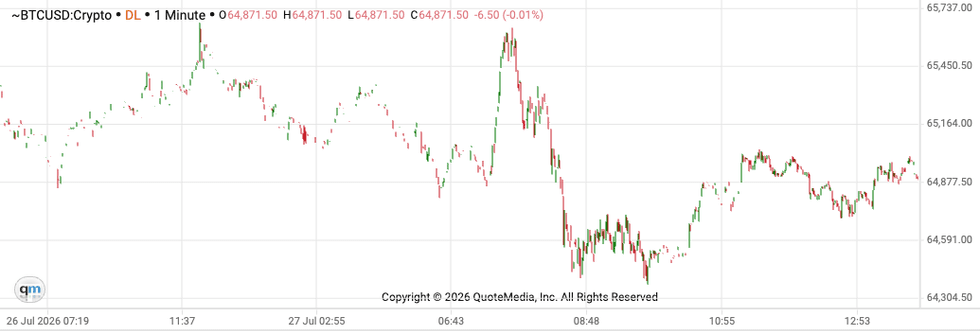
Chart via the Investing News Network.
Bitcoin price performance, July 29, 2026.
Ether and altcoin price update
- Ether (ETH) was priced at US$1,888.51, trading 0.9 percent higher over the last 24 hours.
- XRP (XRP) was priced at US$1.07, trading 2.7 percent higher over the past 24 hours.
- Solana (SOL) was trading at US$72.91, trading 0.5 percent higher over the past 24 hours.
Today’s crypto news to know
Read on for a round-up of the biggest cryptomarket news
- Blockaid: Crypto exploits hit record in H1, total losses top US$1 billion
- Saylor rejects Bitcoin protocol changes
- Ionic Digital debuts on Nasdaq
- Emirates, Crypto.com launch digital payment service
- Morgan Stanley launches Ether, Solana staking ETPs
- FDATA white paper outlines policy framework for agentic fintech and write access
Blockaid: Crypto exploits hit record in H1, total losses top US$1 billion
Blockchain security firm Blockaid reported that crypto projects lost over US$1 billion to hacks during H1 2026.
The firm verified more individual exploit incidents in the first six months of 2026 than in all of 2025 combined. North Korea-linked hackers stole nearly US$600 million of the total, leading attacks through social engineering schemes against multisig signers. North Korea-linked actors also carried out both the US$285 million Drift exploit and the US$292 million KelpDAO exploit. Ether projects suffered the highest losses at US$332 million due to protocol code vulnerabilities, while Solana projects lost US$326 million through signer infrastructure attacks.
Alternative security reports from Immunefi and Quill Audits place total H1 losses slightly lower at US$972 million and $935.3 million, respectively. Blockaid projects a rise in AI-related exploits for the second half of the year following the US$216,000 exploit of Bankr.
Saylor rejects Bitcoin protocol changes
Strategy (NASDAQ:MSTR) founder Michael Saylor is warning Bitcoin developers against altering the protocol’s core consensus rules. In a Tuesday (July 28) X post he wrote, “Bitcoin has won. Now it must survive victory. Its gravest threat is not an enemy at the gates, but corruption from within: factions that invent pretexts, rewrite the rules, and seize economic rights until freedom becomes permission and law becomes loot.”
Continuing in a thread of posts, Saylor criticized proposals like BIP-110, covenant mechanisms and larger block sizes for risking network stability and transaction censorship. He defined the consensus rules as Bitcoin’s constitution and urged developers to build complex features on voluntary higher layers.
Meanwhile, Strategy expanded its cash reserves by US$525 million to reach US$3.75 billion as of July 26. The company generated US$544.5 million in net proceeds through a Class A common stock sale during the week of July 20.
Strategy also spent US$25 million to repurchase shares of its Variable Rate Series A Perpetual Stretch Preferred Stock. The increased dollar reserves provide approximately 2.1 years of dividend and interest coverage while the firm maintains its 843,775 BTC stash.
Ionic Digital debuts on Nasdaq
Ionic Digital (NASDAQ:IOND), a US-based digital infrastructure and Bitcoin-mining company that was created in January 2024 out of the Celsius Network bankruptcy, made its Nasdaq debut on Tuesday (July 28), when its Class A common stock commenced trading under the ticker IOND via a direct listing, the exchange’s largest since 2021.
Shares opened at US$50 and closed at US$62.90, 19 percent above the US$53 reference price set by Nasdaq (NASDAQ:NDAQ), valuing the company at US$2.8 billion. Ionic Digital is transitioning from pure-play Bitcoin mining to leasing powered data center infrastructure for AI and high-performance computing workloads.
Emirates, Crypto.com launch digital payment service
Emirates and Crypto.com have launched Crypto.com Pay, allowing customers to use the digital payment solution on the airline’s website and app platforms. Crypto.com Pay is available to eligible United Arab Emirates residents for bookings priced and settled in Emirati dirham.
The launch marks the implementation of a partnership between Crypto.com and Emirates announced in July 2025.
Morgan Stanley launches Ether, Solana staking ETPs
Morgan Stanley Investment Management has expanded its digital asset offerings by launching Ether and Solana exchange-traded products (ETPs). The Morgan Stanley Ethereum Trust (ARCA:MSSE) and Morgan Stanley Solana Trust (ARCA:MSOL) now trade on NYSE Arca with expense ratios of 0.14 percent. Both funds track asset prices, stake a portion of their holdings and distribute the resulting rewards directly to investors.
“Since introducing our first ETFs in 2023, we’ve built a diversified suite of ETFs and ETPs that now exceed US$14 billion in assets under management,” Ally Wallace, global head of ETFs for Morgan Stanley Investment Management, said in the announcement. “The addition of MSSE and MSOL reflects the natural evolution of our product suite, which seeks to provide simplified access to digital assets through the ETP wrapper.”
This dual launch follows the April introduction of the Morgan Stanley Bitcoin Trust ETF (ARCA:MSBT), which had over US$381 million in assets by mid-July. Morgan Stanley now manages over US$14 billion across 22 products in its broader ETF and ETP suite. Eligible E*TRADE clients can also do spot crypto trading via a partnership with Zero Hash.
FDATA white paper outlines policy framework for agentic fintech and write access
As Canada moves toward implementing write access as part of its Consumer-Driven Banking Framework, a new white paper by the Financial Data and Technology Association (FDATA) outlines a conceptual policy framework and provides actionable recommendations for governing “agentic fintech” applications in the US and Canada.
Specifically, the authors focus on how AI and write access capabilities allow fintech applications to move beyond just providing information to executing financial tasks directly on a customer’s behalf. These tools can help users overcome behavioral inertia and time constraints; however, they pose significant risks if an agent makes a costly mistake or acts against the interest of the user, forcing policymakers to address loss liability and alignment of judgment.
The paper structures agentic activities into three categories. The first focuses on managing customer data access through consent, minimization and revocation rights. The second category addresses how to ensure an agent’s judgment is aligned with the customer’s best interest using record keeping and fiduciary-style duties. The last category, payment liability, deals with executing payments and managing who bears the loss if a transaction goes wrong.
Rather than reinventing the wheel, the report outlines how policymakers can build upon existing regulatory traditions, such as the Investment Advisers Act in the US, and the Retail Payment Activities Act and Consumer-Driven Banking Act in Canada, as well as international precedents like the UK’s Variable Recurring Payments.
Ultimately, it offers guidance for US and Canadian regulators to avoid open finance delays, lower barriers to entry, establish clear boundaries for fiduciary conduct and record keeping and properly allocate liability and safeguards for agent-initiated transactions. It recommends keeping agent instructions within current frameworks, while issuing specific guidance to accommodate agentic workflows and held-away accounts, as well as scaling an agent’s legal duties in proportion to the level of discretion they exercise, backed by detailed recordkeeping of delegated authorities.
Don’t forget to follow us @INN_Technology for real-time news updates!
Securities Disclosure: I, Meagen Seatter, hold no direct investment interest in any company mentioned in this article.
Securities Disclosure: I, Giann Liguid, hold no direct investment interest in any company mentioned in this article.
Editorial Disclosure: The Investing News Network does not guarantee the accuracy or thoroughness of the information reported in the interviews it conducts. The opinions expressed in these interviews do not reflect the opinions of the Investing News Network and do not constitute investment advice. All readers are encouraged to perform their own due diligence.
5 Stocks Our Experts Predict Could Double In the Next Year
By submitting your email, you'll also get a free pivot & flow membership. A free daily market overview. You can unsubscribe at any time.