Midland, Texas-based AST SpaceMobile has been a battleground for bulls and bears this year.
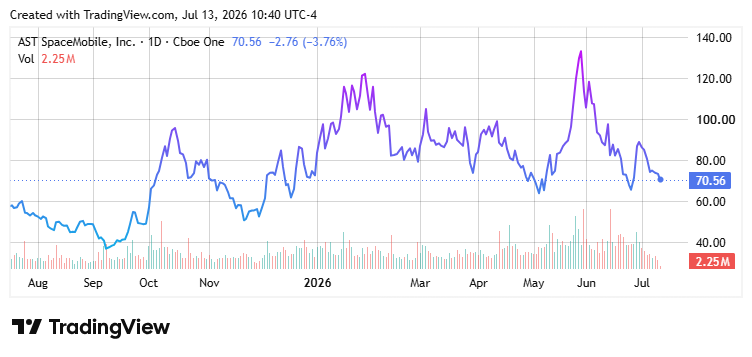
Among space stocks, it has been one of the most volatile, seeing its fair share of ups and downs throughout 2026 including a 59% run-up to its all-time high on May 28 and a series of double-digit peaks and troughs mixed in.
That trend has continued over the past month. Shares pushed up more than 35% from their one-month low June 25 through June 30. But since the calendar turned to July, the stock has given back nearly half of those gains, with now down more than 17% from that recent high.

With its beta now up to 2.69, the SpaceX rival and space-based direct-to-device (D2D) cellular broadband provider is likely positioned for more of the same as. But a combination of potential catalysts and inhibitors will ultimately decide whether AST SpaceMobile is able to break back into the green during the second half of the year.
Tailwinds: Strategic Partnerships, Bundled BlueBird Launches, and Increased Operating Efficiency
AST SpaceMobile’s bull case remains largely intact in large part due to maintaining its first-mover advantage in the space-based D2D market.
That has resulted in a myriad of formal strategic agreements that have cemented the company’s status.
Most recently, ASTS received a bump from Japan’s $912 million satellite communications push. That put AST SpaceMobile’s existing partnership with Tokyo-based Rakuten back into the spotlight while raising hopes for a major D2D rollout. The two companies are forming a joint venture that is targeting regulatory approval for D2D operations in Japan, with initial commercial services expected to begin later in 2026.
The company also has agreements with nearly 60 global mobile network providers, totaling more than three billion subscribers, and strategic partnerships in place with AT&T, Verizon, Vodafone, Rakuten, Alphabet, and real estate investment trust American Tower, among others. Over the long term, those relationships should continue to drive AST SpaceMobile’s top-line growth, translating into strong earnings for patient investors.
An accelerated launch schedule for the company’s low Earth orbit (LEO) BlueBird satellites—the largest commercial arrays currently in operation—serves as another catalyst. A simultaneous launch of the next three, including BlueBirds 11, 12, and 13, is scheduled for early August from Cape Canaveral, Florida, aboard a Falcon 9 rocket.
The bundled launches should go a long way in AST SpaceMobile meeting its 2026 launch target of having 45 BlueBirds in LEO. According to president Scott Wisniewski, the company is in the process of producing and assembling satellites through BlueBird 37.
Headwinds: Mounting Costs, Launch Targets, Earnings Misses
Scaling at the pace and size that the company is comes at a steep cost. AST SpaceMobile posted a net loss of $342 million in 2025, which was nearly 969% higher than its net loss in 2022 after its first full year of operation as a publicly traded company. However, in Q1, that loss significantly accelerated to $191 million.
As the company ramps up its launch production and launch schedule, analysts are forecasting a full-year cash burn rate between $1.5 billion and $1.8 billion.
Another potential headwind is AST SpaceMobile’s lofty BlueBird launch target. While that also serves as a near-term headwind, longer term, it could present issues. Unforeseen launch complications and mishaps—like the Blue Origin deployment of BlueBird 7 at an insufficient orbit back in April—could adversely impact AST SpaceMobile’s ability to meet its year-end launch target. BlueBird 7 was subsequently deorbited, yet the company has maintained that it can reach its goal of having 45 LEO satellites deployed by the end of 2026.
Meanwhile, sentiment has been negatively impacted by a series of consecutive earnings per share (EPS) misses. AST SpaceMobile remains unprofitable, but its negative EPS has missed the analyst mark for five straight quarters, with only two beats in the past 11 quarters. This has played a major role in outflows driven by impatient investors who have been waiting for the stock—which had its IPO in April 2021—to finally turn a corner.
Where Wall Street Stands
The smart money appears to be erring on the side of caution when it comes to ASTS.
Sentiment is tepid, with just one of the 10 analysts covering the stock assigning it a Buy rating.
Overall, it holds a consensus Reduce rating despite a 12-month price target implying about 16% potential upside from current levels.
In the past year, insider selling has muted insider buying by a ratio of more than $451 million to just over $187,000.
But institutional investors are evidently taking a longer-term approach, with buyers injecting $2.34 billion over the past 12 months compared to outflows of just over $487 million.
Still, as previously mentioned, more volatility is likely ahead, as reflected by current short interest of 21% of the float, which equates to $5.45 billion worth of shares.
5 Stocks Our Experts Predict Could Double In the Next Year
By submitting your email, you'll also get a free pivot & flow membership. A free daily market overview. You can unsubscribe at any time.