Listen to the audio version of this article (generated by AI).
The next Peter Thiel moment is here… AI’s price crash is rewriting the rules… tracking the usage/price “escalator”… a “real world” stock list that benefits from the AI takeover
In 1977, a semi-retired chip executive named Mike Markkula met two kids running a computer company out of a garage.
He liked what he saw enough to write a $250,000 check – cash and a loan guarantee combined – for a one-third stake in the business.
That company eventually became Apple (AAPL).
When Apple rang the opening bell on its first day as a public company in December 1980, Markkula’s shares were worth $203 million.
In 2004, a hedge fund manager named Peter Thiel wrote a $500,000 check to a Harvard dropout’s fledgling website. It was called “The Facebook” back then. Thiel’s money bought him a stake in a company valued at just $5 million.
Today? Meta Platforms (META) is worth about $1.4 trillion.
Run the numbers, and Thiel’s stake grew more than 280,000-fold. His eventual stock sales cleared north of $1 billion – making that half-million-dollar check one of the most lucrative angel investments in Silicon Valley history.
Then there’s Chris Sacca. In the late 2000s, his tiny venture fund, Lowercase Capital, invested $300,000 into a scrappy ride-hailing startup’s angel round – something called Uber (UBER).
By the time Uber went public in 2019, that early bet – combined with additional money Sacca put in later – was estimated to be worth more than $2 billion.
Three completely different industries, three completely different eras – but the same underlying story: a small, early check into the right company at the right moment can turn into a fortune.
So, how do you find your own story?
The door is no longer closed
Thiel, Markkula, and Sacca weren’t just early. They were insiders – the kind of people who got a seat at the table long before any of those companies ever considered going public.
For most of the last century, that’s exactly what kept everyday investors out of stories like these. Getting into a private company before its IPO meant you needed a venture fund behind you, serious money of your own, or the right people in your contacts list.
Recent changes to securities law have opened that door. But showing up isn’t the hard part anymore – knowing how to find the right opportunity is.
Private companies aren’t like public stocks. They’re younger, less public about their information, and carry a real risk of going to zero. That’s the gap tech expert Luke Lango recently built a private-investing framework to close. He walked through it live, step by step, last Thursday.
And it couldn’t come at a better time…
AI is moving fast enough to create a wave of potential 100X opportunities – the kind most investors won’t recognize until they’re already priced in.
Consider “physical AI” – something that Luke recently wrote about. These are the systems that let robots do real work in the real world, not just answer questions in a chat window.
Here’s Luke:
I think the next bottleneck is forming in robotics.
A language model can train on text because the text already exists, scattered across the internet, free for the scraping. A robot learning to fold laundry or bus a table has no equivalent shortcut.
Every skill must be demonstrated physically, recorded, and labeled one motion at a time, and that process remains slow and genuinely expensive even as the tools around it improve.
That bottleneck – teaching machines to function in physical space instead of just text – is exactly the kind of obstacle Luke built his framework to spot.
It makes sense. Invest in the company that clears a critical bottleneck, and you’re positioned for a windfall when the rest of the market comes rushing for your solution.
Back to Luke:
Those are exactly the kinds of AI businesses I want to investigate as private investment opportunities.
They’re solving a problem that I believe customers will become increasingly desperate to solve.
Luke unpacked this during last week’s 2026 AI Megadeal Event. He also gave away the name of a robotics startup that counts Nvidia (NVDA), Microsoft (MSFT), Salesforce (CRM), and the Mayo Clinic among its clients.
Here’s Luke:
Its one-of-a-kind “robot school” platform is rolling out now and I consider this to be the “ChatGPT moment” for artificially-intelligent robots.
I project this startup’s revenues could balloon from $18 million at the end of this year to as high as $360 billion by 2029.
But physical AI is just one bottleneck. AI is creating many more – and Luke built his framework specifically to spot them before the rest of the market catches on.
To learn more, you can catch a free replay of last Thursday’s presentation right here while it’s still available.
More on these opportunities later this week.
AI is becoming dirt cheap – and changing the investment math
Last Thursday, OpenAI did something that most investors missed – but it’s critical you know what happened.
It cut its AI software prices by up to 80%.
Here’s CNBC:
The company is facing pressure to cater to a more cost-sensitive customer base, where enterprises have been less inclined to deploy expensive models without a clear picture of the return on their investments.
AI software is becoming dirt cheap – and it’s happening at a breakneck pace. In last Friday’s issue of Investing Insider, I looked at this.
Consider this statistic from the issue…
Between November 2022 and October 2024, the cost of running an AI model with roughly GPT-3.5-level performance plunged from $20 to just $0.07 (per million tokens).
That’s a decline of more than 99.6% – or a 280-fold reduction – in less than two years. Stanford University reports that, depending on the task, AI inference prices have been falling by anywhere from ninefold to 900-fold per year.
OpenAI isn’t the only company driving costs lower. As our macro investing expert Eric Fry of Fry’s Investment Report noted last week, Chinese developers continue releasing increasingly capable AI models at dramatically lower prices.
Here’s Eric:
China’s progress shows that AI competition may become less about who builds the best model and more about who builds models that are “good enough” for most users.
That’s an important shift.
The AI race is no longer just about building the smartest model. Increasingly, it’s about building one that’s “good enough” at the lowest possible cost.
Now, this is a double-edged sword. While inexpensive AI could unleash an explosion in AI adoption, it also creates a brutal arithmetic problem.
If the price of intelligence falls 99% – as we just saw that it has done – demand must rise more than 100-fold merely to preserve the same amount of industry revenue.
For consumers, cheaper AI is unquestionably good news. But for investors, this cost crush requires us to evaluate our portfolio holdings with a new question:
Does this company benefit because AI is expensive…or because AI becomes ubiquitous?
The market is beginning to ask that question
Think about GPU rental companies.
Their business flourished because customers were willing to pay premium prices for scarce AI computing capacity. But as AI models become cheaper and more efficient – and as more computing capacity comes online – the premium attached to that scarcity could begin shrinking.
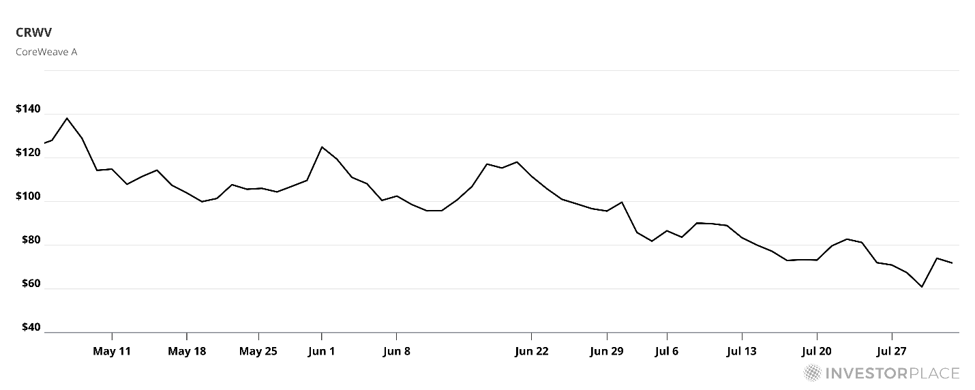
CoreWeave (CRWV) illustrates this debate.
As you can see below, since early May, the stock has fallen by more than 40% as investors have begun to question whether today’s premium AI infrastructure economics can last indefinitely.
The concern ties into our new evaluation question: If intelligence becomes dramatically cheaper, companies that rely on premium-priced AI compute may eventually face pricing pressure.
Of course, CoreWeave bulls see the story very differently. They argue that falling prices won’t matter if AI usage explodes even faster.
To their point, history is full of technologies whose prices collapsed while demand grew so rapidly that the industry’s biggest winners continued thriving.
But this usage/price escalator is the issue for many AI companies today.
I’ve used an analogy in recent Digests to explain this dynamic…
Imagine you’re climbing a descending escalator. Your upward climb represents exploding AI usage. The downward-moving escalator represents rapidly falling AI prices.
As long as you climb faster than the escalator descends, you still make net progress toward the top. In other words, total spending on AI compute continues rising – even if each individual AI query costs much less.
That’s CRWV’s bullish case. But if the escalator ever begins moving down faster than you can climb, the economics change.
Eric is zeroing in on this same “cost” issue but from a different direction
Writing about China’s rapidly improving AI ecosystem at significantly lower cost, he concludes:
We should pay closer attention to how quickly the competitive landscape is changing…
China continues to prove that the next phase of the AI race may be defined by efficiency, and who can achieve the most with the resources available.
To see where Eric believes investors should be positioned as AI becomes cheaper, more efficient, and increasingly “good enough,” click here to learn more about Fry’s Investment Report.
Bottom line: AI costs are crashing. The question now is whether AI adoption can keep climbing faster than prices keep falling.
So, keep this question in mind as you look at your current holdings and evaluate new ones:
Does this company benefit because AI is expensive…or because AI becomes ubiquitous?
One unexpected beneficiary of cheap AI
We just looked at falling AI costs from the perspective of investors. But let’s step back and think about falling AI costs from consumers’ perspective.
If intelligence becomes dramatically cheaper, we should all be able to accomplish more in less time. AI will increasingly handle routine tasks, summarize information, automate busywork, and free us to spend more time doing things we enjoy.
That doesn’t just change the technology industry. It changes how we spend our lives.
Senior analyst Brian Hunt, editor of Money & Megatrends, believes that’s creating an overlooked investment opportunity.
Here’s Brian:
As technological innovations such as AI programs and robots perform more “basic” tasks, people will have more time for leisure, entertainment, and wellness.
The more time we spend interacting with AI, the more we’ll crave experiences that no algorithm can replicate.
Brian calls these “real world experience” businesses – companies that benefit when people spend less time behind screens and more time living. And in last Thursday’s issue, he gave away seven of them.
Three names from his list resonated with me…
Vail Resorts (MTN)
Vail owns many of North America’s premier ski resorts, including Vail, Beaver Creek, Breckenridge, Park City, and Whistler Blackcomb. Brian believes destination travel and outdoor recreation stand to benefit as AI gives people more time to spend away from their screens.
VICI Properties (VICI)
VICI owns many of America’s premier entertainment destinations, including Caesars Palace, MGM Grand, The Venetian, and Mandalay Bay. It’s also expanding into wellness resorts and family entertainment, giving investors broad exposure to the growing demand for real-world experiences.
Live Nation Entertainment (LYV)
Live Nation is the world’s largest live entertainment company, promoting concerts, operating venues, and selling tickets through Ticketmaster. If consumers increasingly value experiences over digital consumption, live events could remain a powerful long-term growth story.
Here’s Brian’s bottom line:
Over the next 10 years, AI and robotics will take on many of the jobs and tasks humans perform now. This will free up our time to pursue leisure, entertainment, and wellness interests.
This trend will benefit the “real world experience” businesses detailed above.
To see his full list of companies positioned to benefit as AI gives us more time to spend in the real world, click here to learn more about joining him in Money & Megatrends.
Brian publishes every day the market is open, spotlighting and tracking opportunities like this. One of my favorite parts of these issues is that Brian gives away – totally free – loads of stocks positioned to benefit from his analysis.
We’ll keep tracking all these stories here in the Digest.
Have a good evening,
Jeff Remsburg
5 Stocks Our Experts Predict Could Double In the Next Year
By submitting your email, you'll also get a free pivot & flow membership. A free daily market overview. You can unsubscribe at any time.