Making money is only half the job. Here’s how I decide when to sell and keep more of the gains.
Listen to the audio version of this article (generated by AI).
Archie Karas was a Greek immigrant waiting tables at a Los Angeles restaurant. But in his spare time, he liked to hustle games of pool at the place next door.
In December 1992, with just $50 in his pocket, he began playing poker at the Mirage in Las Vegas.
That’s when his epic two-and-a-half-year run began.
Over the next several months, Karas took on five World Series of Poker Main Event champions – and beat most of them.
Eventually, the top players stopped playing him. So, Karas decided to try his hand at craps and baccarat – games of chance, not skill.
By early 1995, he had amassed a $40 million fortune.
But Karas didn’t walk away. He kept gambling, convinced his winning streak would continue.
By 1996, he’d lost it all. Every last dollar.
Karas fell victim to one of the most dangerous psychological traps: overconfidence.
And while investing is very different from gambling, I’ve seen plenty of investors fall into the same trap.
They buy a stock that doubles or triples in value. They become convinced it can only go higher. And even when the warning signs start flashing, they refuse to sell.
That’s how yesterday’s biggest winner can become tomorrow’s biggest loser.
In today’s Market 360, I’ll explain how I avoid this trap, why knowing when to sell will be especially important as we head into 2027 and how my Stock Grader system helps me make those decisions.
I’ll also show you how to put this approach to work in your own portfolio. In my recent Fed Warning 2027 presentation, I shared a new way to use Stock Grader to spot stronger opportunities as market leadership shifts. (You can watch the replay right here.)
But first, let’s look at how I avoided the same mistake that cost Karas his fortune…
How Do You Combat Overconfidence?
Imagine you bought a stock a few years ago for $50 a share.
Today, it’s trading for $150. You’ve tripled your money.
Naturally, you’re thrilled. But then the company’s earnings growth slows. Sales begin to disappoint. Big institutional investors start selling their shares.
Still, you’re convinced the stock will bounce back. After all, it’s been such a great investment. Why sell now?
Before you know it, your $150 stock has fallen to $100. Then $75.
And what was once a tremendous gain has nearly vanished.
I’ve seen this happen time and again during my more than 40 years in the markets. Investors become emotionally attached to their winners. They start relying on what a stock did in the past rather than what the numbers are telling them today.
That’s why I take a different approach.
The best way to combat overconfidence is to stay focused on the numbers. And one of the best examples of why this matters is Lululemon Athletica Inc. (LULU).
Years ago, Lululemon was a pioneer of the athleisure fashion movement. It differentiated itself by making some of the highest-quality, most comfortable workout clothing on the market.
Consumers loved Lululemon clothes, which translated into strong earnings and sales growth. That growth caught my attention, and after it earned an A-rating in Stock Grader, I recommended it in my Growth Investor service in June 2018.
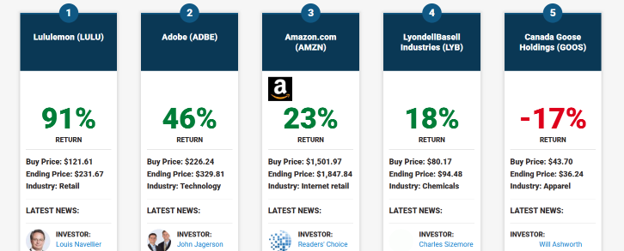
I liked the stock so much that I also made it my pick for the “Best Stock of 2019” InvestorPlace contest. (The stock gained 91% in 2019, and I came in first that year.)
How Stock Grader Helped Me Lock In a 156% Gain
But here’s the important part of the story: I didn’t fall in love with Lululemon.
As its growth began to lose momentum, its Stock Grader rating deteriorated. Eventually, it fell to a D-rating.
That told me the very things that made Lululemon such an attractive investment were beginning to change.
So, in February 2021, I recommended that my subscribers sell, locking in a 156% gain.
And I’m glad we did.
Lululemon’s business has struggled in recent years, particularly in North America. In 2024, U.S. comparable store sales began to fall. And in 2025, management repeatedly lowered its outlook, sending shares down about 45% for the year.
The trouble continued in 2025. After management lowered its earnings outlook in June, the stock plunged 20% in after-hours trading. By the end of the year, shares had lost about 45% of their value.
2026 hasn’t been much kinder. LULU shares remain under pressure and, as of this writing, are down about 47% year-to-date.
This weakness is also reflected in my Stock Grader. As you can see in the chart below, it’s held a D- or F-rating for all of this year.
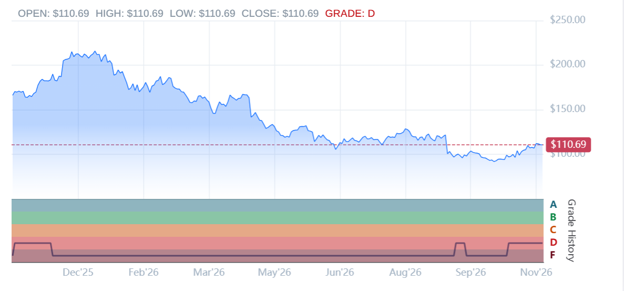
These days, LULU trades about 64% lower from where I recommended selling.
I didn’t need to predict exactly how far Lululemon would fall. Stock Grader helped me recognize that the company’s outlook had changed.
Now, a downgrade doesn’t automatically mean it’s time to sell. A stock can slip from an A-rating to a B-rating and still be an excellent investment.
But when earnings, sales and institutional buying pressure begin to deteriorate, I take notice. And when the evidence tells me it’s time to move on, I don’t hesitate.
Why This Lesson Matters More Than Ever
The bottom line: Just because a stock made you money yesterday doesn’t mean it deserves a place in your portfolio tomorrow.
And that’s especially important as we head into 2027.
You see, the market is changing. Money is rotating into new areas, and the stocks that led the charge over the past few years may not be the ones that lead the next rally.
That’s why I’m always looking for what’s working right now.
My Stock Grader system helps me spot companies with strong earnings, rising sales and persistent institutional buying pressure. And when those trends begin to fade, I know it’s time to take a closer look.
That’s how I knew when to move on from Lululemon. And it’s the same approach I’m using to find the next generation of market leaders.
In fact, that’s one of the main reasons I recently held my special Fed Warning 2027 presentation. During the event, I explained…
- How the Federal Reserve’s next moves could impact stocks in 2027
- The warning signs that could signal trouble ahead
- And how my new Prime Portfolio service can help you stay nimble and find stocks with the strongest potential to lead the market next year
I also reveal one stock I believe investors should consider buying right now – and another I believe they should avoid.
Click here to view my presentation right away.
Sincerely,
Louis Navellier
Editor, Market 360
5 Stocks Our Experts Predict Could Double In the Next Year
By submitting your email, you'll also get a free pivot & flow membership. A free daily market overview. You can unsubscribe at any time.