The issue is not that demand for AI is evaporating. It is that the price of intelligence is beginning to fall faster than many investors expected.
Takeaways
-
Token demand is not the same thing as token pricing power. AI usage can keep compounding while realised spend per token falls under free credits, aggressive discounting, smarter routing and cheaper open-weight alternatives. That is bullish for users of intelligence, but less comforting for companies valued on scarcity rents.
-
The AI trade is rotating from shovels to toll roads. Goldman’s preference for hyperscalers over neo-clouds makes sense: the platform owners control infrastructure, distribution, enterprise relationships and workload routing. Renting scarce compute is a great business until compute stops being scarce.
-
China is becoming the pressure valve on frontier-model economics. The relevant question is no longer whether Chinese models are universally superior. It is whether they are good enough, cheap enough and open enough for most enterprise workloads. That is a much more uncomfortable test for Western model pricing.
-
Momentum has lost its easy carry. Hardware is beginning to wobble, single-stock volatility is elevated and index calm is masking substantial dispersion beneath the surface. This is no longer a market to buy blindly on every AI headline; it is becoming a stock-picker’s market where crowded winners can still disappoint on excellent numbers.
Token Unmaxxing
The AI trade has spent the past year behaving as though every additional token produced another reason to buy the entire infrastructure stack. More models, more agents, more inference, more GPUs, more data centres, more power, more capex. It was a wonderfully simple market equation, and simplicity is usually what makes a crowded trade dangerous.
Now the equation is changing.
The issue is not that demand for AI is evaporating. It is that the price of intelligence is beginning to fall faster than many investors expected. Silicon Valley’s leading model makers are increasingly competing with discounts, free credits and heavily subsidised usage plans as they fight for enterprise share. The Wall Street Journal reported this week that some startups are receiving millions of dollars in credits from competing providers, enough in some cases to materially delay the need for another funding round.
That is not a demand problem. It is a monetisation problem.
When a $200 monthly subscription can potentially unlock thousands of dollars of equivalent usage at published API pricing, it tells you something important about the industry’s current economics. The providers are not simply selling software. They are subsidising adoption, defending ecosystem share and trying to secure future customers before the market settles into a more rational pricing structure.
That is a very different proposition from the old tokenmaxxing story, where every additional unit of model use looked like another brick in the AI capex wall.
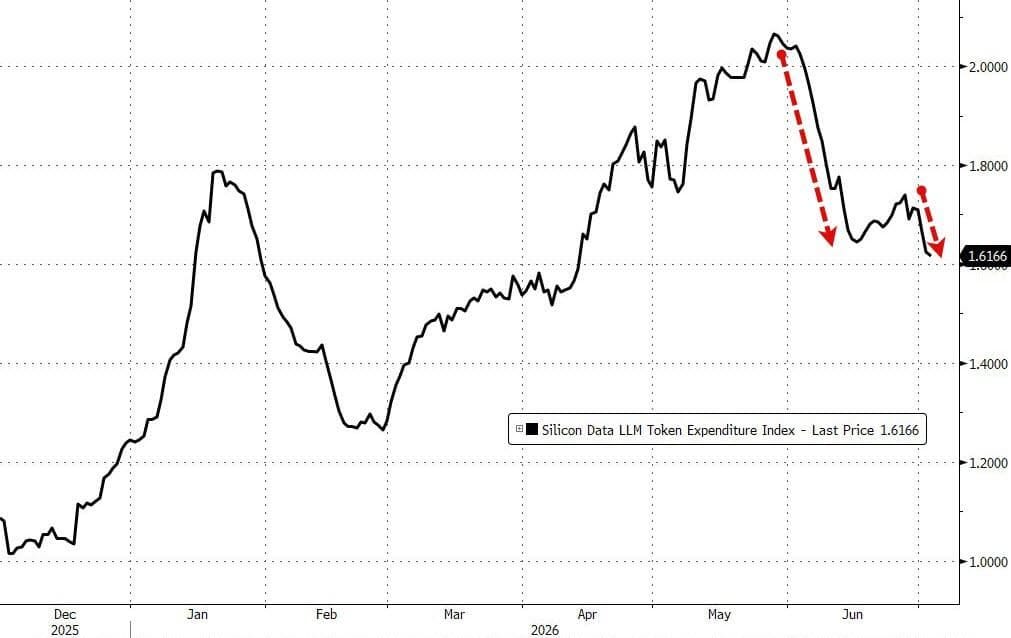
Token Spending Is Rolling Over as AI Economics Turn More Competitive
The Silicon Data LLM Token Expenditure Index surged through April and May before losing momentum sharply. The decline reinforces the concern that token usage may keep rising while realised spending per token falls under discounts, routing efficiencies and cheaper model competition.

Goldman Sachs’ Delta One desk head Rich Privorotsky has been making precisely this distinction. He remains constructive on AI, but is increasingly sceptical that investors have necessarily backed the right parts of the value chain. Scarcity rents are a tremendous business while scarcity lasts. But engineering bottlenecks have a habit of being solved, especially when the prize is measured in trillions.
The market has been treating scarce compute as though it were a permanent monopoly. It is more likely a temporary toll booth.
That is why the hyperscalers remain the cleaner expression of the theme. They own the infrastructure, the enterprise relationship, the software distribution and the balance sheet. They can absorb pricing pressure, route workloads across different models, monetise the broader cloud stack and still capture value even as the cost of inference falls.
AI Leadership Is Rotating: Hardware Momentum Fades as Hyperscalers Stabilize
US AI semiconductors rallied sharply into June before losing momentum, while hyperscalers have lagged less dramatically and are now beginning to recover. The divergence fits Goldman’s argument that the market is moving away from pure scarcity beneficiaries and back toward platform owners.

The neo-clouds and pure-play compute renters have a more awkward problem. Their economics look spectacular when GPU capacity is scarce and customers have few alternatives. But as supply expands, models become cheaper, open-weight systems improve and enterprise buyers become more sophisticated about routing workloads, the scarcity premium starts to leak.
The market does not need every task to run on the most expensive frontier model. In fact, it increasingly does the opposite.
Routine coding, summarisation, customer-service workflows, internal search and low-risk agentic tasks can often be handled by cheaper models. The frontier systems are still valuable, particularly for difficult reasoning, advanced research and high-value proprietary work. But the marginal token is no longer automatically worth frontier pricing.
That is where routing becomes the quiet winner.
Coinbase CEO Brian Armstrong recently highlighted that the company had reduced AI spending sharply while token usage continued to rise, largely through better defaults, routing, caching and tighter context management. That is the direction of travel. Usage can keep compounding while revenue per token compresses.
For the buyers of inference, that is bullish. For the suppliers whose valuations assume permanent scarcity, it is a rather different conversation.
Chinese open-weight models add another layer to the pressure. The debate is no longer simply whether the West has the best model. It is whether the performance advantage is large enough to justify the cost differential for the majority of enterprise tasks. Data sovereignty, control over intellectual property and the ability to run models within a company’s own environment are becoming more important every month.
The endgame may not be one universal model charging monopoly prices. It may be a routed ecosystem, with expensive frontier intelligence reserved for the difficult jobs and cheaper systems handling everything else.
That is structurally deflationary for token pricing.
It also explains why the hardware trade is beginning to look vulnerable. Samsung can deliver a major profit upside and still struggle to rally because the market is already looking past the numbers. Commodity-cycle veterans know the pattern well. The stock often stops responding to good news not when the numbers are poor, but when the market begins to suspect they are close to peaking.
AI hardware has become heavily levered to the continuation of capex intensity. Many industrial and mining names have become second-order AI proxies, whether investors acknowledge it or not. If you are bullish on the suppliers of power, cooling, cables, construction equipment, memory and data-centre infrastructure, you are implicitly making another bullish call on the durability of the AI buildout.
Chinese Models Are Rapidly Taking Share in the Most-Used AI Rankings
Chinese-origin models rose from 5 of OpenRouter’s top 50 most-used models in January 2025 to 20 by May 2026, underscoring how quickly the model market is becoming more competitive.
That does not mean the buildout ends. It means the market is beginning to ask a more uncomfortable question: how much infrastructure is required once intelligence becomes cheaper and more efficiently deployed?
Goldman’s Privorotsky sees an increasingly rotational backdrop, with hardware beginning to soften while hyperscalers hold in better. Positioning remains concentrated, single-stock volatility is elevated and the easy passive and rebalance demand appears largely behind us.
Single Stock Volatility Is Elevated Even as Index Volatility Stays Contained
The gap between single-stock implied volatility and index volatility has widened sharply. That is the backdrop for a more rotational market: correlations are lower, dispersion is higher and stock-specific positioning matters more than the headline suggests.

That is not the kind of market where momentum can be trusted blindly.
The AI boom is not over. But it is moving from a scarcity trade into an economics trade. The winners may increasingly be the companies that own the roads, the customers and the routing layer, rather than those simply renting out the shovels.
The market spent a year pricing the build.
It may now have to price the bill.
5 Stocks Our Experts Predict Could Double In the Next Year
By submitting your email, you'll also get a free pivot & flow membership. A free daily market overview. You can unsubscribe at any time.