Traders who dumped shares after its $1.9 billion deal to buy German magnet maker Vacuumschmelze are missing a major shift.
The immediate share price pullback reflects short-term dilution anxiety rather than long-term asset value. By acquiring Vacuumschmelze, Energy Fuels is pursuing a vertical integration strategy to secure a domestic mine-to-magnet supply chain.
The broader industrial economy is shifting toward nuclearizing the power grid to support AI data centers and advanced electric vehicle networks. By linking raw material mining with precision manufacturing, Energy Fuels builds an airtight domestic pipeline that bypasses foreign restrictions on critical minerals. The short-term dip in the stock price masks a strategic business transition that is insulated against geopolitical volatility, positioning Energy Fuels as a cornerstone of national security and Western industrial supply chains.
Shovels in Australia and Magnets in Carolina
To understand the asset value, investors must map out the operational pipeline. The loop starts with the excavation of heavy mineral sands at the shovel-ready Donald Project in Australia, where a final investment decision is expected in the third quarter of 2026. Monazite feedstock from this mine will then be processed and separated into heavy rare earth oxides at the White Mesa Mill in Utah. These separated oxides will get transported to Australian Strategic Materials’ Korean Metals Plant for conversion into high-purity metals and alloys, with plans to replicate this processing step at a future American Metals Plant.
The final stage of this loop occurs at Vacuumschmelze’s advanced magnetics manufacturing plants, specifically the newly commissioned facility in Sumter, South Carolina. This facility has the physical capacity to produce 2,000 tonnes per annum of permanent neodymium-iron-boron magnets, with a clear pathway to scale to 12,000 tonnes per annum. This domestic footprint is supported by a 20-year, $725 million conditional loan commitment from the U.S. Office of Strategic Capital, which will accelerate the expansion of the White Mesa Mill. Energy Fuels is also progressing discussions with Export Finance Australia for a 220 million Australian dollars (approx. $146 million U.S.) lending package to support the Donald Project, alongside an existing $41 million grant from the U.S. Department of War.
Yellowcake Yields Are Funding the New Rare Earth Frontier
Expensive acquisitions often trigger shareholder anxiety regarding toxic debt or excessive equity issuance. However, Energy Fuels possesses an internal funding mechanism that sets it apart from risky, still-developing players. The company remains the leading natural producer in the United States, and its primary business is generating exceptional cash flow.
According to the mid-year operational update, first-half uranium production reached 1.6 million pounds of finished uranium oxide, achieving full-year guidance in just six months. Processing costs at the White Mesa Mill are tracking at an exceptionally low $9 to $12 per pound, while mining costs at the Pinyon Plain mine range between $23 and $30 per pound. With spot uranium prices trading at healthy premiums, this highly profitable uranium segment acts as an internal cash generator. This reliable cash stream supports Energy Fuels’ aggressive rare-earth expansion, reducing the need to rely on high-interest debt.
Breaking China’s Magnetic Monopoly
A primary risk for magnet manufacturers is their reliance on imported raw materials. In late 2025 and April 2026, China implemented stringent export controls on critical heavy rare earth additives, including dysprosium and terbium.
These export controls directly impacted Vacuumschmelze, capping its 2025 adjusted EBITDA at $28.6 million, resulting in a net loss of $50.6 million due to severe feedstock constraints.
Energy Fuels’ heavy rare-earth separation capabilities directly address this challenge. By processing monazite at the White Mesa Mill, Energy Fuels can deliver a domestic, reliable stream of heavy rare-earth oxides to Vacuumschmelze’s plants.
Unshackling the German firm from Chinese supply restrictions should unlock immense operating leverage. Once fully supplied, the Sumter facility alone is expected to generate $65 million to $75 million in run-rate EBITDA at its current 2,000 tonnes-per-annum capacity. Scaling to 4,000 tonnes per annum projects run-rate EBITDA to $130 million to $140 million, highlighting the explosive margin expansion potential of this deal.
Energy Fuels Recharges Its Outlook
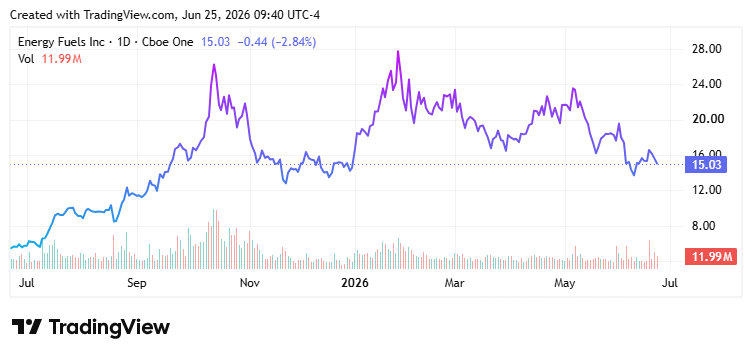
The market’s initial reaction treated the acquisition as a risky, premium-priced gamble, but a closer look at the price chart suggests a near-term floor is being established. While some observers claim the deal creates an outright Western monopoly, a realistic assessment points to a highly lucrative domestic duopoly.

Energy Fuels’ primary competitor is , which has a market capitalization of $10.2 billion and is constructing a 10,000-tonne-per-annum permanent magnet facility in Northlake, Texas, supported by a 10-year defense contract. This dual-player dynamic ensures healthy competition while establishing a highly secure, diversified supply base for Western automotive and defense clients.
Wall Street is increasingly recognizing this potential. On June 22, 2026, H.C. Wainwright reiterated its Buy rating and maintained its $29 price target, signaling robust analyst backing immediately prior to the transaction announcement. Recent headlines and the options market reinforce this bullish outlook, presenting a tight volume put/call ratio of 0.17. Meanwhile, short interest stands at 39.76 million shares, representing 16% of the free float. As Energy Fuels achieves its vertical integration milestones over the coming quarters, this heavy short position could provide a powerful short-squeeze catalyst.
Prepare for the Final Atomic Attraction
The strategic alignment of low-cost upstream mining and processing with downstream magnet fabrication creates a highly resilient business model. Cautious investors may prefer to monitor the progress of the upcoming regulatory approvals and the formal transaction close in early 2027 before initiating a core position to capitalize on the positive analyst forecasts.
5 Stocks Our Experts Predict Could Double In the Next Year
By submitting your email, you'll also get a free pivot & flow membership. A free daily market overview. You can unsubscribe at any time.