One company’s investment bill can become another company’s sales.
Listen to the audio version of this article (generated by AI).
Wall Street can handle bad news. What it really hates is uncertainty.
And yesterday, one of the market’s biggest uncertainties disappeared.
The Federal Reserve voted to raise its key interest rate by 25 basis points, bringing the target range to 3.75% to 4%. It was the Fed’s first rate hike since July 2023.
But what really caught my attention was the vote.
It was unanimous. All 12 voting members agreed.
Think about that for a moment. Back in July, Fed Chair Kevin Warsh joked that policymakers might have a good old-fashioned “family fight” over interest rates.
You can barely get 12 family members sitting around a Thanksgiving table to agree on what time to eat dinner. Somebody is going to argue.
Instead, there wasn’t a fight at all. That tells you something.
The Fed clearly believed it needed to act. And Wall Street took the news surprisingly well. Why? Because the rate hike itself was hardly a surprise.
As Fed Chair Kevin Warsh noted yesterday in his press conference following the hike decision: “The plain fact is that inflation is too high and has been for too long.”
There’s no denying the recent culprit has been energy.
And as I explained in a Special Market Podcast to my subscribers yesterday, I expected the Fed to raise rates. In my view, standing pat would have damaged the Fed’s credibility.
So, the question now isn’t whether the Fed has turned more hawkish. It has.
The more important question for investors is why, and what we should do about it.
So in today’s Market 360, I’m going to show you why there was a consensus, and what drove the Fed’s decision. Then we’ll look at a less obvious point Warsh raised about the spending behind the AI buildout and where you should be focused in this market.
What’s Driving the Energy Squeeze
We all know the conflict in the Middle East has been roiling global energy markets since late February.
As Warsh put it yesterday, “There’s no hiding from hot spots around the world.”
The Iran War has pushed oil prices above $100 per barrel in recent days. Prices for refined products like jet fuel have soared. Diesel prices recently reached record highs of $6.29 per gallon.
Iran-backed Houthi attacks have threatened Saudi Arabian infrastructure and Red Sea shipping routes.
A separate drone attack forced Saudi Arabia to shut down its East-West oil pipeline, a route that bypasses the Strait of Hormuz. The pipeline has a maximum capacity of 7 million barrels per day (bpd).
The big question for investors is how these disruptions will hit the cost of doing business. Because higher energy prices eventually work their way through the economy.
The latest inflation reports show the pressure.
The Producer Price Index (PPI), which looks at prices producers receive, rose 0.4% in August. Core PPI, which excludes food and energy, increased 0.2%. That was better-than-expected.
But look at what happened with energy.
Energy prices surged 4.2%, even before the latest jump in diesel prices. Food prices, by comparison, increased just 0.1%.
Here’s the real problem, folks. PPI is running at 5.4% over the past 12 months. And those diesel price increases could easily make their way into more inflation in the next report.
The Consumer Price Index (CPI) also sent a mixed message. Overall consumer prices rose 0.4% in August and 3.4% over the past 12 months. Core CPI increased 0.3% for the month, slightly above economists’ expectations, and 2.4% year-over-year.
Shelter costs climbed to 0.3% in August. So, the cost of housing remains part of the CPI problem, too. But if energy prices stay high for much longer, you can bet the cost of just about everything else will rise, too.
What’s interesting about all this is that the consumer remains surprisingly resilient through all of this mess.
Retail sales jumped 1.2% in August, rising across the board. Core retail sales climbed 1.4%, which was the biggest gain since September 2024.
And employers added 162,000 jobs in August, easily topping economists’ expectations.
What the Fed Sees Next
In his press conference, Warsh identified three reasons for the hike: a stronger economy, too little progress on inflation and a changed geopolitical outlook.
And if the rate hike itself was expected, what came next was more revealing.
The Fed’s latest “dot plot” showed that 16 of 18 officials expect at least one more rate hike before the end of the year.
In other words, policymakers aren’t treating Wednesday’s move as necessarily one-and-done.
Chair Warsh didn’t submit a dot, nor was he expected to. “I’m not in the forward guidance business,” he said in his press conference.
But Warsh also raised another issue that caught my attention.
Artificial intelligence.
“We care very much about what’s happening in artificial intelligence,” he said, pointing to AI’s effects on both demand and the economy’s productive capacity.
The Fed even has a task force studying AI’s economic impact, with findings expected by year-end.
And one particular point Warsh made gets directly to where I think investors should be looking now…
The Other Side of Higher Rates
Warsh was also asked about another issue that has been rattling investors lately: the rise in long-term Treasury yields.
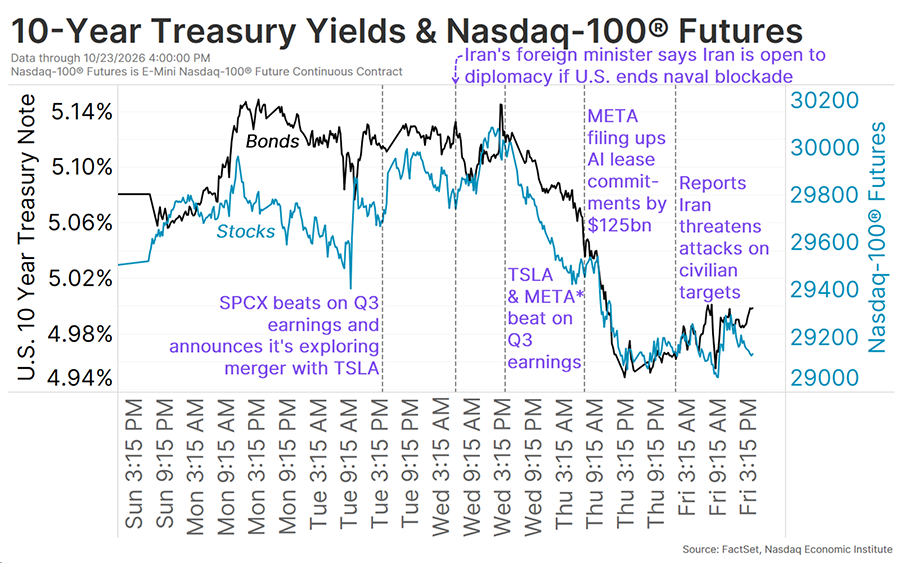
The 10-year Treasury yield recently climbed above 5% for the first time since 2007. That matters because the 10-year serves as an important benchmark for borrowing costs across the economy.
And Warsh pointed to AI spending as one reason yields have moved higher.
“The so-called hyperscalers are out in the market raising funding,” he said. “And so the competition for capital is real. And I think it partly explains the increase in yields.”
Folks, we’re talking about an extraordinary amount of money.
Bank of America says the five biggest hyperscalers sold $121 billion worth of U.S. corporate bonds last year. For some perspective, they had averaged just $28 billion from 2020 through 2024.
And the borrowing has only accelerated in 2026. Morgan Stanley estimates AI-related debt worldwide had already reached nearly $236 billion by the end of May. At that pace, the firm expects the total to approach $570 billion by year-end.
Why all the borrowing?
Because the AI buildout has become so large that even some of the richest companies on Earth can no longer fund it entirely out of their cash flow.
So, they are increasingly turning to the bond market to help finance new data centers, chips, power systems and other AI infrastructure.
That helps explain Warsh’s point about “competition for capital.”
These companies are competing with the U.S. government, other corporations and other borrowers for the same pool of money. When demand for capital rises, borrowing costs can rise with it.
But here’s the part I want you to focus on as an investor.
One company’s investment bill can become another company’s sales.
Every dollar being spent on data centers, computing systems, power infrastructure and other AI capacity has to go somewhere.
Of course, that does not make every supplier a winner.
But this is where I want to be looking for the next big winners, folks. Not just at who is spending the money, but at who can turn that spending into growing sales and earnings.
My team and I have been studying the next phase of AI computing taking shape at America’s national laboratories.
The goal goes beyond better chatbots. These systems are being designed for scientific work in fields like energy, medicine and advanced manufacturing.
I don’t need to predict which breakthrough arrives first to study the businesses helping build that computing capacity. But the numbers still have to hold up.
I want fundamentally superior stocks with outstanding sales and earnings growth, not just a good AI story.
And in my AI Reset presentation, I explain the opportunity and reveal the name and ticker of a company I believe is positioned to benefit, no matter what the Fed does next.
Click here to watch my AI Reset presentation now.
Sincerely,
Louis Navellier
Editor, Market 360
5 Stocks Our Experts Predict Could Double In the Next Year
By submitting your email, you'll also get a free pivot & flow membership. A free daily market overview. You can unsubscribe at any time.