Takeaways by Dark Side of the Boom
- The is not really a space story. It is a liquidity story. Investors are being asked how much of a future they are willing to buy today.
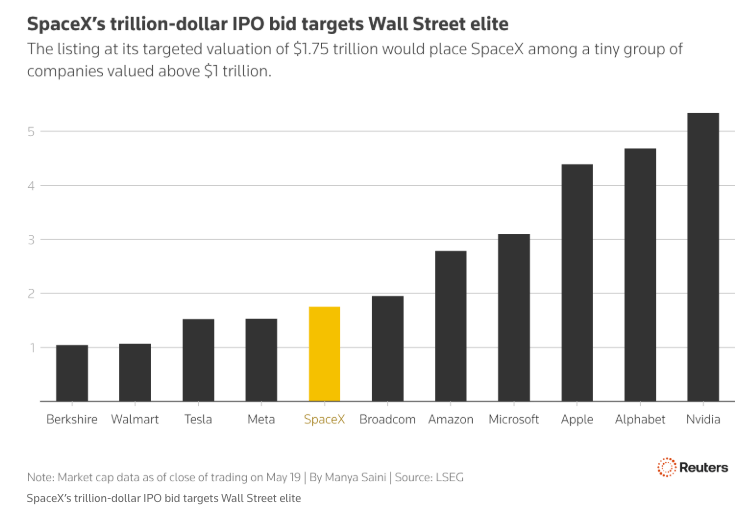
- A $1.75 trillion valuation turns SpaceX into a referendum on narrative scarcity. There are very few assets left that combine space, AI, communications, defence, and Elon Musk in a single ticker.
- The most important question is not whether the IPO is expensive. The real question is whether public markets have become so starved for growth that price has become secondary to access.
The Most Expensive Ticket to the Future
The market is about to discover whether valuation still matters when investors believe they are buying a front row seat to the future.
SpaceX is reportedly preparing to come public at $135 per share, a valuation that would place the company near $1.75 trillion and instantly elevate it into the same rarefied atmosphere occupied by the largest corporations on Earth. In practical terms, investors are being asked to pay roughly 94 times sales for a company that generated an estimated $18.67 billion in bookings while posting a loss approaching $5 billion. Under normal market conditions, those numbers would trigger intense scrutiny. Yet these are not normal market conditions. We are operating in an era where scarcity itself has become an asset class.

What makes this offering fascinating is that it arrives at a moment when investors are desperately searching for the next great growth vessel. The AI boom has already concentrated enormous amounts of capital into a relatively small collection of names. Every portfolio manager is effectively fishing in the same pond. SpaceX offers something different. It is not merely another software company promising future disruption. It owns physical infrastructure orbiting the planet, controls the largest rocket-launch and spaceship capacity that competitors struggle to replicate, and operates Starlink, which increasingly resembles the financial engine funding a much larger strategic vision.
That helps explain why some traditional valuation debates are struggling to gain traction. When Morningstar argues the company may be worth closer to $780 billion, the math itself is not necessarily controversial. The challenge is that investors are not pricing SpaceX as a conventional business. They are pricing an option on multiple futures at once. They are assigning value to satellite communications, military applications, launch dominance, artificial intelligence ambitions, and possibilities that have not yet been fully commercialized. In market language, this is less a stock and more a bundle of long-dated call options wrapped inside a corporate structure.
The comparison that comes to mind is not a typical IPO but a luxury auction. When a rare masterpiece appears after years of absence, bidders are often less concerned with the final price than with securing ownership before someone else does. SpaceX carries a similar scarcity premium. There are countless companies selling products. There are very few selling participation in what many investors perceive as the next chapter of technological civilization.
The structure of the offering only reinforces that dynamic. Because the deal is reportedly all primary issuance, the capital flows directly into the company rather than existing shareholders. In effect, investors are not simply purchasing stock. They are financing the expansion of the machine itself. The proceeds become additional fuel for launch programs, satellite deployment, communications infrastructure, and whatever ambitions emerge from Musk’s increasingly interconnected ecosystem.
At the same time, this valuation represents an extraordinary leap of faith. Every great market cycle eventually reaches a point where investors stop asking what something earns and begin asking what it might become. That transition often produces the most spectacular gains of the cycle, but it can also create the greatest disconnect between narrative and reality. The higher the launch trajectory, the more sensitive the vehicle becomes to even modest changes in expectations.
What happens next may matter far beyond a single listing. If investors enthusiastically absorb a $1.75 trillion.
5 Stocks Our Experts Predict Could Double In the Next Year
By submitting your email, you'll also get a free pivot & flow membership. A free daily market overview. You can unsubscribe at any time.