Overconfidence can cloud your judgment, but the right data can help keep your portfolio on track…
Listen to the audio version of this article (generated by AI).
If we don’t rein it in, our own psychology can be responsible for many of our worst investing blunders.
Over the years, I’ve discussed some of the psychological tendencies that can cause investors to stumble, including Recency Bias and Crowd-Seeking Bias.
The bottom line is that the more you know about the workings of your own mind, the “bugs” inside it and how they may work against our investment performance, the more you can develop strategies to mitigate their negative effects.
In today’s Market 360, we’ll talk about another major psychological challenge investors face: Overconfidence. I’ll detail overconfidence bias, how it works and how you can neutralize its negative effects.
Let’s get started.
Confidence vs. Overconfidence
First, let me clear the air a bit. I believe confidence is a good thing.
Without it, you wouldn’t do many of the things that make life great. Whether it’s applying for a job, asking someone for a promotion or even investing money in the market, confidence is part of what gets you to a great result.
However, overconfidence refers to the phenomenon that people’s confidence in their judgments and knowledge is higher than the accuracy of these judgments.
Put more simply, overconfidence blinds you to the reality of your ability and the circumstances around you.
It’s why 65% of Americans think they’re smarter than others; it’s why more than 50% of business owners view their businesses as more than 90% ethical than their competitors; it’s why 93% of American drivers think they’re above average.
Overconfidence is even partly to blame for the Titanic, which was considered to be an “unsinkable” ship.
It’s called the “mother of all cognitive biases” for a reason!
If overconfidence can sink a ship, it can certainly affect your investing life any number of ways. And sometimes it can take some time to experience the consequences.
For instance, the latest Retirement Confidence Survey by the Employee Benefit Research Institute found that 61% of workers are confident they’ll have enough money to live comfortably throughout retirement.
Of course, confidence alone doesn’t guarantee that you’re prepared. When it comes to something as important as retirement, you want the numbers to back it up.
That’s a lesson all of us should heed.
And it’s the same lesson I’ve applied to investing for decades.
People have used my quantitative system to invest in blue chip stocks, or to find small caps that can grow 10X. Now, I’ve taken that same data-driven approach and refined it to look for another important signal – where the biggest institutional investors may be moving before the rest of the market catches on.
That’s what I call Precursor Intelligence.
How Do You Combat Overconfidence?
I’m a numbers guy. Always have been. Since I was a kid, I’ve loved math and I knew that math was the right way to understand the world.
Said another way, I depend on evidence for my decisions.
And by sticking with the facts, I’ve found stocks that have made huge moves over short periods of time. We’re talking about moves of 100%, 200% and even 500% in months instead of years.
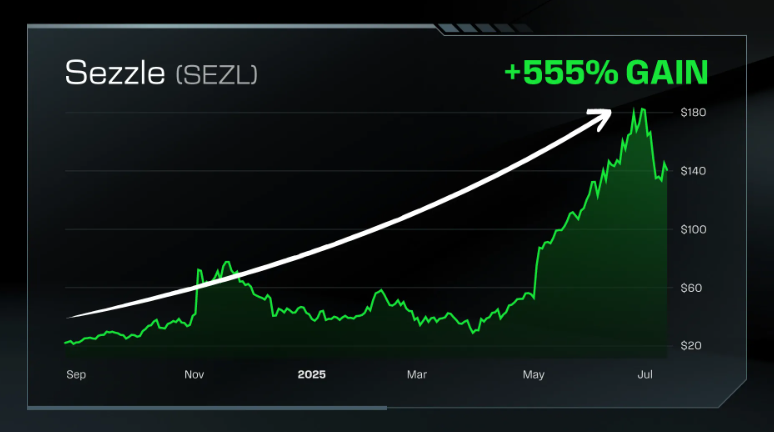
Take Sezzle Inc. (SEZL), for example.
Back in September 2024, my system identified a shift in Sezzle’s ownership structure. It showed me that the big institutional investors were moving in.
So, I did some final vetting and recommended the stock to my subscribers. In less than a year, they had the chance to capture a 555% gain.
That’s the power of following the numbers instead of relying on a hunch.
And the same principle works when it’s time to sell.
When you’re sitting on a great profit, it can be tough to let go. It’s all too easy to become emotionally invested – or too confident that a stock will keep climbing.
But numbers don’t lie… and you’re usually better off heeding them.
That’s especially important today, when so many investors are being pushed toward the same obvious stocks and the same popular ideas.
Precursor Intelligence is designed to help me look beneath the surface and identify shifts in fundamentals and institutional buying pressure before the broader crowd catches on. The system focuses in part on whether institutional investors are moving into or out of a stock.
The reality is that as wonderful as the human brain is, it is a terrible tool for investing. It’s like trying to eat soup with a fork.
That’s why I prefer to let the data guide me. And right now, Precursor Intelligence is helping me identify where the big money may be moving before those changes become obvious to everyone else.
I recently recorded a special presentation explaining how it works and the opportunities it’s uncovering today. Click here to learn all the details.
Sincerely,

Louis Navellier
Editor, Market 360
The Editor hereby discloses that as of the date of this email, the Editor, directly or indirectly, owns the following securities that are the subject of the commentary, analysis, opinions, advice, or recommendations in, or which are otherwise mentioned in, the essay set forth below:
Sezzle Inc. (SEZL)
5 Stocks Our Experts Predict Could Double In the Next Year
By submitting your email, you'll also get a free pivot & flow membership. A free daily market overview. You can unsubscribe at any time.