Cryptocurrency markets began soaring following the 2024 U.S. presidential election, reaching new all-time highs in August 2025 as the crypto-friendly Trump administration began implementing policies. But this summer has been anything but sunny for crypto markets. Bitcoin has erased all its post-election gains over the last few weeks, dipping below the critical $60,000 level for the first time since September 2024. Crypto is naturally a tornado of volatility, but this time the market action appears to be generating from major institutional players, not retail investors.
Why Crypto Markets Are Crashing in 2026
The total crypto assets market cap has fallen to under $2.5 trillion, down from nearly $4.4 trillion just eight months ago. After moving in tandem with the Nasdaq 100 for much of the AI rally, Bitcoin and its cohorts have become dislocated from the tech sector due to a host of industry and macroeconomic factors.
- Institutional Derisking: This should be the biggest concern amongst crypto investors. Bitcoin ETFs are seeing record outflows so far in 2026, including the newer spot ETFs that were viewed as less risky than the futures-based funds. Institutional funds have been a constant and reliable liquidity source, and if this capital exits the market, volatility will only get worse.
- Treasury Drag: Digital asset treasury companies have become a popular trade over the last few years. These companies would issue equity to buy digital assets, and investors would happily pay a premium for the stock to gain crypto exposure. However, as crypto prices plummet, these treasury companies could be forced sellers at prices below cost basis to cover other obligations. We’ll delve into an example in a minute.
- Geopolitical Shocks, Hawkish Policy, and Risk Rotation: While not crypto-specific, the specter of lingering inflation and high rates continues to weigh on volatile, risky assets. Market participants now consider rate hikes as likely as rate cuts this year, which is dampening crypto enthusiasm. Additionally, AI stocks have stolen the spotlight for retail risk seekers, and many former crypto traders now seek the volatility of memory or AI infrastructure stocks.
3 Stocks to Avoid as Cryptocurrencies Plummet
Crypto’s in trouble at the moment, and any urge to buy the dip is probably best left ignored. Bitcoin at $60,000 is still “only” 50% off its all-time high (a drawdown for ants, Bitcoin HODLers will tell you), and industry news continues to lean negative. Here are three stocks unlikely to get hot this summer:
1. Strategy: Bitcoin Sales Trigger Larger Worries
CEO Michael Saylor has been one of the world’s biggest Bitcoin bulls, but apparently even he sees trouble ahead. Last week, announced it had sold Bitcoin for the first time since 2022, dumping 32 tokens for approximately $2.5 million. Yes, 32 Bitcoins is a trivial amount for a company that holds more than 800,000 in total, but the reason for the sale spooked investors more than the amount. Strategy sold Bitcoin to cover dividend obligations from its preferred stock, , which dipped below par to $95 on June 3. STRC is issued to fund Strategy’s Bitcoin purchases and prevent dilution of common shareholders, but the dividend bump signals softening demand for the preferred.

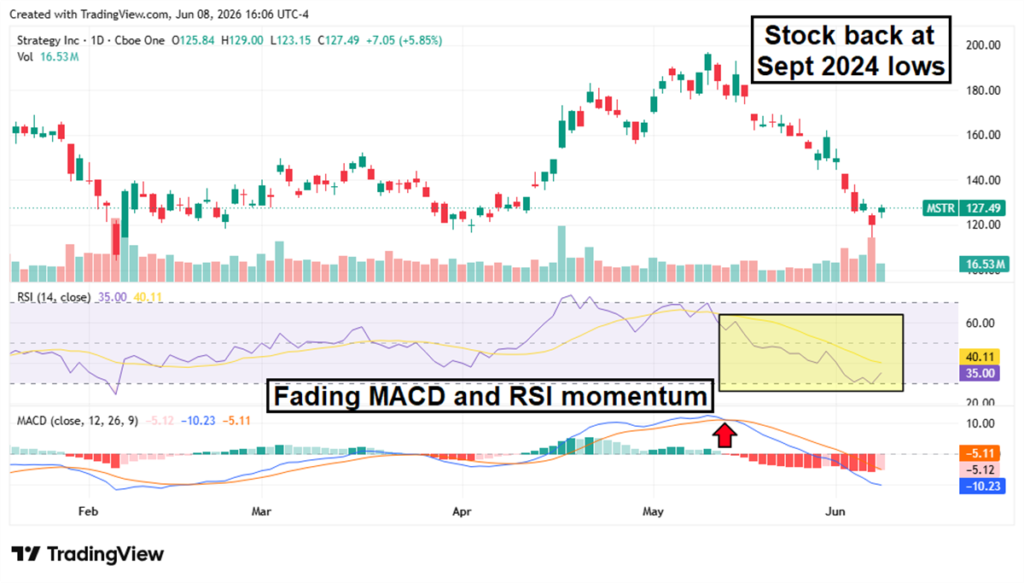
Strategy purchased more Bitcoin during the recent dip, but the “Never Sell” narrative has blown up, and weak demand for preferred shares puts the company’s whole treasury strategy at risk. MSTR shares have closely tracked Bitcoin spot prices, and like , the stock is back at September 2024 levels. No technical signals hinting at a reversal yet either; in fact, the Relative Strength Index (RSI) and Moving Average Convergence Divergence (MACD) indicators both continue to shed momentum.
2. Bullish: High Beta Exchange With Dwindling Volume
went public last summer, and its first year in public markets hasn’t exactly lived up to its namesake. Bullish is a cryptocurrency exchange similar to Coinbase Global Inc. NASDAQ: COIN.
Its shares now trade below their IPO price, thanks to declining trading volumes. The company missed earnings-per-share estimates in its Q1 2026 report on May 14, largely due to slowing growth in trading revenue. The $4.2 billion acquisition of Equiniti is also a huge risk, considering Bullish’s current market cap sits at $4.1 billion.

There appears to be no end in sight to the drawdown. The stock is revisiting the February all-time lows, and the RSI and MACD show sellers are in full control at the moment. Unless trading volumes return, it’s probably best to bet bearish on Bullish.
3. : Higher Costs and Risks Compared to Spot ETFs
The ProShares Bitcoin ETF was one of the first Bitcoin ETFs available on U.S. exchanges, but its strategy has quickly become outdated. BITO holds a combination of CME Bitcoin futures contracts and U.S. Treasuries, aiming to mimic Bitcoin’s price without actually holding it. But now that spot ETFs are on the market, holders are paying a 0.95% expense ratio for a fund facing decay risk. When Bitcoin prices decline, BITO is forced to roll its expiring futures into more expensive, later-dated contracts, which erodes the fund’s net asset value (NAV) and causes underperformance relative to Bitcoin’s spot price. A sustained drawdown is the worst type of bear market for futures-based funds like BITO.

BITO has lost more than 60% over the last 52 weeks, failing to capitalize on the crypto rally following Trump’s election win. The stock recently hit a new all-time low after another failed 50-day moving average breakout, and the MACD shows a complete collapse in buying. With assets under management (AUM) now below $1.50 billion, this is looking increasingly like an obsolete asset headed for dissolution.
5 Stocks Our Experts Predict Could Double In the Next Year
By submitting your email, you'll also get a free pivot & flow membership. A free daily market overview. You can unsubscribe at any time.