The market is changing. See Louis Navellier’s new solution on Nov. 12.
Listen to the audio version of this article (generated by AI).
The Most Dangerous Words in Business … and Investing
It’s often called “the most dangerous phrase in business.”
We’ve always done it this way.
It’s considered dangerous because too many organizations, even very successful ones, can grow complacent. Once a team achieves success, they can’t imagine doing anything differently.
It’s easy to understand why this happens. Changing means taking risks.
In 2007, Netflix (NFLX) had built a thriving operation around a simple idea: Instead of asking customers to drive to a brick-and-mortar store, they could deliver DVDs directly to mailboxes.
Americans loved it.
Netflix had more than 6 million subscribers. Its familiar red envelopes were arriving in mailboxes across the country. And the company was steadily taking customers away from traditional brick-and-mortar video rental stores.
But Netflix’s leadership could see that the world was changing.
In 2007, the company introduced a new service that allowed subscribers to watch movies and television shows over the internet.
Today, that’s commonplace. But remember what the world looked like in 2007.
Apple had only just introduced the first iPhone. The iPad was still three years away. There was no 5G. Broadband was becoming more common, but millions of Americans were still relying on internet connections that were so slow, you could achieve a half dozen household chores before a movie was ready to watch.
Moving toward streaming meant investing in a technology that wasn’t quite ready for prime time – and potentially undermining the business operations that had made Netflix successful.
It was an enormous gamble. But Netflix saw something its competitors didn’t appreciate.
The biggest threat to past success isn’t always the competition, but the temptation to keep doing what made you successful in the first place.
And that lesson is just as important for investors today.
The Same Old Portfolio?
How many of the stocks in your portfolio are there because they were great investments five or 10 years ago?
If you were building your portfolio from scratch today, would you buy those same stocks again?
Those are two very different questions.
Because just like the business world, the stock market never stands still.
Interest rates change. Consumer preferences change. New technologies emerge. And the market leaders one day can find themselves struggling to keep up the next day.
That doesn’t mean you should abandon a successful strategy.
It means you need to recognize when the investments themselves should change.
After all, there’s a big difference between buy and hold… and buy and forget.
That’s where Louis Navellier’s Stock Grader has served him so well.
Louis’ system is engineered to find fundamentally superior stocks with significant buying pressure. When those things start to improve, its grade improves.
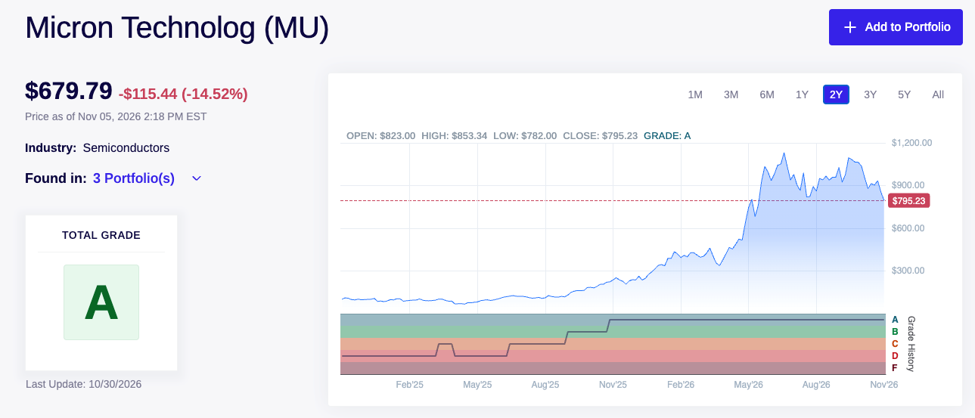
Below is a screenshot from Louis’ Stock Grader for Micron Technology (MU) over the last two years. It’s easy to see that the system gives it an overall A grade today.
Underneath the stock price chart, you can see the grade history, with an A at the top (in blue) and an F at the bottom (in dark red).
You can see Micron wasn’t always an A. In May 2025, the stock was a solid D.
You can also see that as the grade improved, the stock’s performance did too. By the summer of 2025, MU had a C-grade, and by November 2025, it moved from a B to an A. As the stock grade climbed, the stock’s price did too!
Louis recommended the stock to his Growth Investor subscribers on Jan. 30, 2026. The stock skyrocketed over the summer, up close to 180%. Since then, the stock has suffered the same sell-off as the rest of the AI trade. Even so, the stock is still up more than 70%.
Buying good stocks is easy but knowing when to change your strategy is more difficult. Louis uses his Stock Grader tool to help him determine when the timing is right.
A Dangerous Market for Complacent Investors
Right now, the danger of standing still may be greater than many investors realize.
You see, the stock market has suffered a brutal sell-off in recent weeks, with some of the biggest losses hitting the very AI stocks that had been leading the market higher.
And while the rebound that’s taking place as I write on Friday is welcome, it doesn’t erase the damage.
In fact, according to Louis’ research, more than half of S&P 500 stocks have declined by 20% or more from their highs.
Think about that.
While investors focus on new market highs, many individual stocks have already experienced their own bear markets.
And that’s not the only danger.
Interest rates remain a concern. The bond market is sending warning signals. And the companies that led the last great rally may not be the ones best positioned to lead in 2027.
That’s a dangerous situation for investors who assume their existing portfolios will continue delivering the same results.
But here’s the good news.
A changing market doesn’t just create new risks. It creates new opportunities.
And few people understand how to identify those opportunities better than Louis.
For decades, Louis has used his proprietary Stock Grader system to evaluate thousands of publicly traded companies, searching for those with the strongest combination of earnings growth, financial fundamentals, and buying pressure.
His goal isn’t to find stocks that were once great investments.
It’s to identify the companies with the strongest potential to outperform over the coming period, just like he did with Micron.
And now, Louis is preparing to take that approach in an entirely new direction.
A New Solution for a Changing Market
On Thursday, November 12, at 2 p.m. ET, Louis will unveil a brand-new investment strategy designed to address the challenges and opportunities he sees emerging in 2027.
It’s built around a simple but powerful idea:
What if your portfolio could evolve as the market changes?
Rather than relying on yesterday’s winners, Louis has developed a way to focus on the companies that earn the highest marks from his stock-selection system – and reassess those opportunities as conditions evolve.
And during this special presentation, he’ll explain why he believes the old rules of investing may leave some investors dangerously exposed.
He’ll also reveal:
- Why the next phase of the market could look very different from the last.
- The warning signs he’s watching as we head into 2027.
- How his new approach is designed to help investors adapt rather than fall behind.
- And one stock he believes investors should consider buying now – along with another he thinks they should avoid.
Click here to reserve your free spot for Louis Navellier’s November 12 presentation.
Everyone wants to avoid making the wrong decision.
But it’s just as dangerous to assume the right decision you made years ago is still the right one today.
Remember to sign up to attend the free presentation at 2 p.m. Eastern time on November 12 to get all the info.
In 2007, Netflix was willing to change to stay ahead of the competition. Make sure your portfolio shows the same flexibility to stay ahead of the market.
Enjoy your weekend,
Luis Hernandez
Editor in Chief, InvestorPlace
5 Stocks Our Experts Predict Could Double In the Next Year
By submitting your email, you'll also get a free pivot & flow membership. A free daily market overview. You can unsubscribe at any time.