Still, the decline below the IPO price does not settle the long-term debate around . Stocks can overshoot, especially after a squeeze. The more consequential move is taking place in the company’s debt.
Takeaways
- SpaceX below its IPO price is notable, but the 2056 bond near 7.5% is the stronger signal.
- •Record-wide hyperscaler spreads show investors are demanding more compensation for debt-funded growth.
- Higher financing costs could pressure AI capex returns, free cash flow and equity multiples.
- The key risk is not issuance alone, but whether credit inflows remain strong enough to absorb it.
SpaceX Falls Below Its IPO
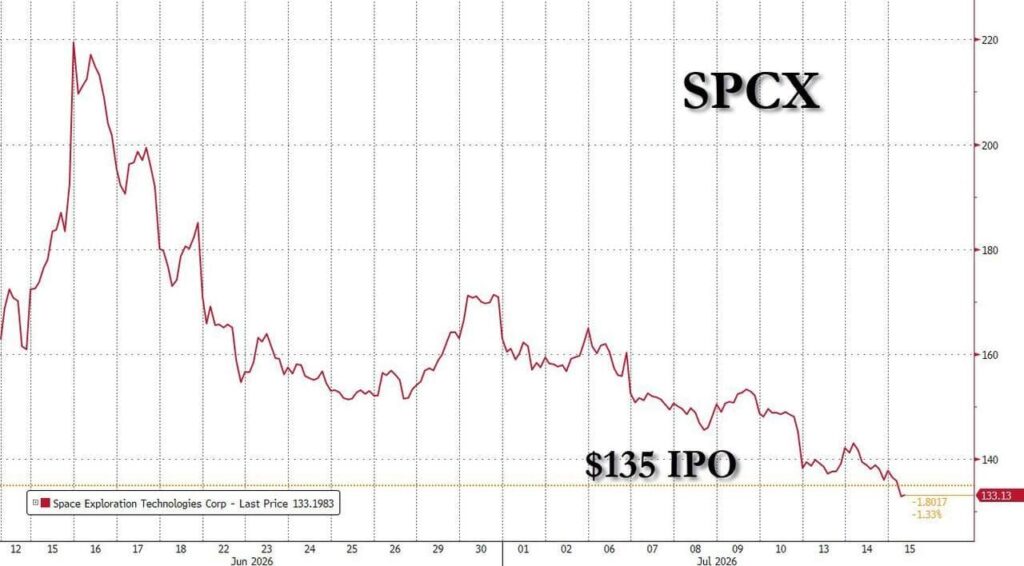
SpaceX has slipped below its $135 IPO price, nearly 40% beneath the June 15 peak above $220 reached during the gamma squeeze. That is a dramatic reversal, but not necessarily the most important one.

The equity story was always carrying more narrative fuel than conventional valuation support. Wall Street price targets ranged from roughly $60 to $800, a spread so wide that it revealed how little agreement there was over intrinsic value. At the bullish end, investors were not simply valuing launch revenues, Starlink subscriptions or defence contracts. They were buying a collection of future possibilities wrapped inside the Musk premium.

That can work while momentum is rising and investors are willing to pay almost any price for optionality. It becomes harder once the stock loses altitude and the market begins demanding evidence rather than imagination.
Still, the decline below the IPO price does not settle the long-term debate around SpaceX. Stocks can overshoot, especially after a squeeze. The more consequential move is taking place in the company’s debt.
SpaceX’s new $25 billion bond due in 2056 has fallen steadily since it began trading on June 24, pushing the yield toward 7.5%. That is a far less flattering verdict than the equity market’s usual volatility because bondholders are not being paid for dreams. They are being paid to absorb duration, leverage and execution risk over three decades.

The weakness has also pushed Goldman’s hyperscaler credit basket to its widest level since the basket was launched in February. That turns SpaceX from a company-specific story into a broader warning about the financing architecture beneath the AI and infrastructure boom.

The market has spent the past two years focused on the scale of future capital expenditure. Trillions of dollars are expected to flow into data centres, power generation, chips, cooling systems, fibre networks and satellite infrastructure. What received less attention was the source of that capital and the price investors would eventually demand to provide it.
For a while, the answer appeared simple. The investment-grade market was flooded with inflows, yields were attractive and investors were willing to absorb repeated waves of technology issuance. The debt arrived, the market digested it and spreads remained remarkably calm.
That calm is beginning to crack.
The problem is not that the credit market has already closed. It has not. The largest technology companies still have strong cash generation, vast balance sheets and reliable market access. The problem is that issuance is accelerating just as investors are becoming more selective.
Credit capacity is not unlimited. Every large hyperscaler deal consumes duration appetite, dealer balance sheet and portfolio risk. As supply increases, investors eventually demand wider spreads, better covenants or higher yields. The next borrower must then pay more than the last one, even when the underlying business remains strong.
That is where the SpaceX bond matters.
A 7.5% yield on a newly issued, high-profile security suggests the market is no longer treating every piece of AI-adjacent debt as a scarce asset. Investors are beginning to distinguish between growth potential and financing risk. The story may still be compelling, but the cheque now comes with a higher interest rate.
For equity investors, this is not merely a bond-market footnote. The entire AI valuation framework rests on an enormous capital-spending cycle producing future revenue, productivity and cash flow. If financing costs continue to rise, that cycle becomes less efficient.
Projects with marginal returns may be delayed. Free cash flow forecasts may need to be cut. Interest expense will absorb a larger share of earnings. Companies may be forced to choose more carefully between capex, acquisitions and buybacks.
None of that kills the AI boom. It does, however, remove the assumption that funding will remain frictionless.
The most important risk is a mismatch between issuance and inflows. If demand for investment-grade credit continues at the strong pace of the past two years, the market may absorb the coming supply, although spreads would likely remain under pressure. If inflows slow while hyperscaler borrowing continues to expand, the bond market becomes the bottleneck.
That is the signal equity investors should be watching.
SpaceX falling below $135 makes the cleaner headline. The 2056 bond yielding around 7.5% carries the larger macro message. The stock market is questioning how much of the future was already priced in. The credit market is questioning who will finance that future, and on what terms.
The rocket has not fallen out of the sky. But the bond market has started sending the bill.
5 Stocks Our Experts Predict Could Double In the Next Year
By submitting your email, you'll also get a free pivot & flow membership. A free daily market overview. You can unsubscribe at any time.