Get the latest insights on Bitcoin, Ether and altcoins, along with a round-up of key cryptocurrencymarket news
Here’s a quick recap of the crypto landscape for Monday (July 13) as of 10:00 p.m. UTC.
Bitcoin price update
Bitcoin (BTC) was priced at US$62,212.28 , down by 3.3 percent over the past 24 hours.
Bitcoin price chart
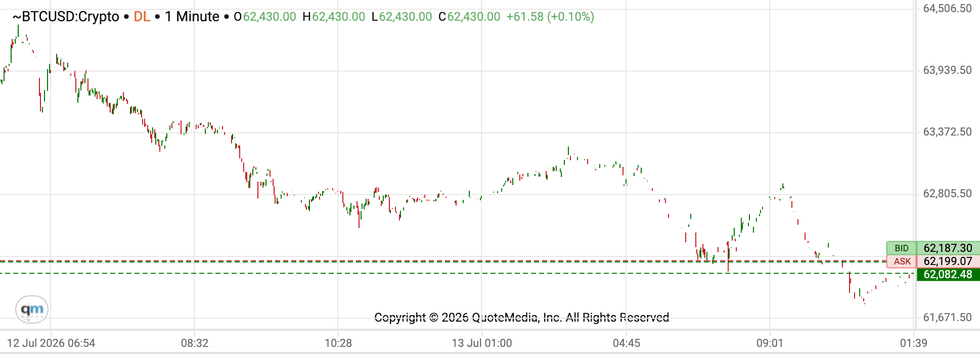
Chart via Investing News Network.
Bitcoin price performance, July 13, 2026.
Ether and altcoin price update
- Ether (ETH) was priced at US$1,772.50, trading 3.2 percent lower over the last 24 hours.
- XRP (XRP) was priced at US$1.07, trading 3.6 percent lower over the past 24 hours.
- Solana (SOL) was trading at US$75.10, trading 3.5 percent lower over the past 24 hours.
Today’s crypto news to know
Read on for a round-up of the biggest cryptomarket news
- Empery Digital liquidates nearly half of Bitcoin treasury
- Metaplanet launches regulated securities subsidiary
- Webull EU secures MiCA authorization
- Japan advances stablecoin buildout
- Bolivia could recognize USDT as currency
Empery Digital liquidates nearly half of Bitcoin treasury
Digital asset firm Empery Digital has offloaded nearly half of its core Bitcoin treasury since early May to address mounting conventional financial obligations. Following the massive asset sale, the company’s remaining treasury holds 1,514 BTC alongside US$73.9 million in cash, while its outstanding debt facility sits at US$45 million.
According to a recent filing with the US Securities and Exchange Commission, the company sold 1,400 BTC at an average price of approximately US$62,200 per coin, generating US$87.1 million in gross proceeds.
Empery Digital used US$10 million of the cash injection to retire outstanding debt on July 7, earmarking the remaining capital to cover general operating costs and rising legal bills tied to a pending shareholder lawsuit.
Additionally, a substantial portion of the proceeds is reserved to finance a previously announced US$65 million property transaction to secure a 25 percent ownership stake in a private entity. This private venture is acquiring a strategically located Midwest facility slated for conversion into a state-of-the-art artificial intelligence data center.
Metaplanet launches regulated securities subsidiary
Investment firm Metaplanet (TSE:3350,OTCQX:MTPLF) has finalized its 2.1 billion yen buyout of Siiibo Securities to launch Metaplanet Securities, a regulated digital asset investment banking subsidiary.
The newly minted business is operating under a Type I Financial Instruments Business Operator license from Japan’s Financial Services Agency and possesses the legal framework required to structure and distribute securities products linked to digital assets. Metaplanet said it plans to leverage this acquisition to drive advanced financial engineering tailored specifically for Japanese capital markets.
The subsidiary’s flagship initiative, dubbed Project Nova, will focus on developing a regulated digital credit ecosystem by using the parent company’s extensive Bitcoin treasury as credit-enhancement collateral.
Webull EU secures MiCA authorization
Webull Europe has secured regulatory approval under the EU’s landmark Markets in Crypto-Assets (MiCA) framework, enabling the firm to launch continental crypto trading and custody services in late 2026. The authorization marks one of the first high-profile approvals since the formal conclusion of the MiCA transition period on July 1.
Webull Group, which already commands substantial retail market share through its zero-commission models in the US and the UK, established its core European foothold via the Netherlands in 2025.
The broker reported a 36 percent year-on-year revenue surge to US$159.9 million in the first quarter of 2026, despite recording a net loss driven by aggressive expansionary spending.
Webull’s compliance path contrasts sharply with other industry giants.
The sweeping MiCA implementation has heavily consolidated the European market down to roughly 200 licensed firms while leaving non-compliant exchanges facing operational bans.
Japan advances stablecoin buildout
In a series of recent moves, Japan is continuing to build out its full stablecoin ecosystem.
SBI Group, a Japanese financial conglomerate, is reportedly planning a lending service for its yen-backed JPYSC stablecoin, which is part of Japan’s regulated stablecoin framework.
Meanwhile, Japanese convenience store Lawson will test yen-denominated stablecoin payments at its Takanawa Gateway City store in Tokyo in August, in a pilot with KDDI and HashPort. The trial will use HashPort’s non-custodial wallet and integrate stablecoin payments directly into Lawson’s point-of-sale system.
“Retail pilots like this are an important milestone because they move stablecoins beyond financial markets and into everyday consumer spending,” said Marcos Viriato, CEO and co-founder of Rayls developer Parfin.
“The real test is what happens after the payment. How funds settle, how merchants reconcile transactions, and how seamlessly those payments connect with existing financial infrastructure,” he told the Investing News Network.
“Most retail consumers don’t think about the technology behind the payment. They simply expect it to work. If stablecoins can make payments faster, cheaper and more reliable behind the scenes while fitting naturally into existing merchant workflows, they’ll become embedded in everyday commerce rather than remaining a niche digital asset.”
At the same time, Netstars has launched Stablecoin Pay, a merchant-facing service that will initially support USDC, USDT and JPYC on Solana and Polygon, with MetaMask as the supported wallet.
Bolivia could recognize USDT as currency
Bolivia is reportedly considering USDT for payments amid a dollar shortage, though the move has not been officially confirmed as a policy change. Economy and Public Finance Minister Jose Gabriel Espinoza said at a press conference on Monday that the government is assessing a regulatory framework that would allow USDT to circulate “as just another currency,” alongside the boliviano and the US dollar.
He added that any such actions would require a strong and thorough regulatory framework, as well as anti-money laundering safeguards due to Bolivia’s position on the Financial Action Task Force gray list.
Don’t forget to follow us @INN_Technology for real-time news updates!
Securities Disclosure: I, Meagen Seatter, hold no direct investment interest in any company mentioned in this article.
Securities Disclosure: I, Giann Liguid, hold no direct investment interest in any company mentioned in this article.
Editorial Disclosure: The Investing News Network does not guarantee the accuracy or thoroughness of the information reported in the interviews it conducts. The opinions expressed in these interviews do not reflect the opinions of the Investing News Network and do not constitute investment advice. All readers are encouraged to perform their own due diligence.
5 Stocks Our Experts Predict Could Double In the Next Year
By submitting your email, you'll also get a free pivot & flow membership. A free daily market overview. You can unsubscribe at any time.