The healthcare sector is one of the best-performing sectors in the S&P 500 over the past month, with a gain of around 6%. But while that rebound has been led by a handful of mega-cap Big Pharma companies, it has also been reflected in the performances of smaller firms.
One of those is mid-cap Hims & Hers Health, the telehealth platform that provides direct-to-consumer (D2C) personal care products and virtual medical services.
Over the past 30 days, is up more than 45%, which has brought the stock’s year-to-date (YTD) gain to nearly 20%. After a run like that, the stock may be due for a short-term breather. But according to healthcare industry experts, a looming catalyst could have an outsized benefit on Hims & Hers in 2027 and beyond, which is setting the stock up for a buying opportunity on its next pullback.
The GLP-1 Craze Is Pushing Up Employers’ Healthcare Plan Costs
As the cost of weight-loss drugs continues to climb, Reuters recently reported that some employers are planning to drop coverage for GLP-1 treatments, including Wegovy, Ozempic, Zepbound, Mounjaro, and Foundayo—products manufactured by Novo Nordisk and Eli Lilly.
Last year, over 40% of employers covered weight loss drugs, and estimates for this year are roughly the same. But two industry groups’ analyses cited by Reuters show that is very likely to change in 2027.
According to policy research group Business Group on Health, about 10% of employers that currently offer coverage for GLP-1 drugs for weight loss said they planned to drop them in 2027. A second survey conducted by Mercer, a benefits consultancy, finds that 5% of large employers plan to drop coverage in 2027 or are actively considering doing so.
While that is unfortunate news for those undergoing treatment, it is welcome news for HIMS shareholders. Patients losing healthcare coverage for GLP-1 drugs should be a boon for Hims & Hers Health, which presently generates around one-third of its revenue from its weight-loss business.
Analysts forecast the company’s revenue to grow from an estimated $2.89 billion in 2026 to $3.45 billion in 2027, and increased subscription demand for weight loss drugs amid eroding insurance options should play a significant role in that top-line growth.
Lost coverage for GLP-1 treatments should spur a migration to D2C telehealth providers, with Hims & Hers serving as a natural destination due to its platform bundling medical provider access, unlimited clinical consultations, and pharmacy fulfillment services into one streamlined subscription.
Technical Analysis and Wall Street Suggest a Correction Is Ahead
With its recurring revenue model, Hims & Hers should be a long-term beneficiary of dropped coverage. The platform charges a $39 fee for the first month of its weight loss membership. After that, the charge goes up to $149 for clinical subscriptions, not including the cost of the medication itself. Medication is billed separately, and Hims says the membership does not include or guarantee a prescription. Compounded oral options, for instance, can run $145 to more than $199 per month, while branded GLP-1 pens—like Wegovy—can run even higher.
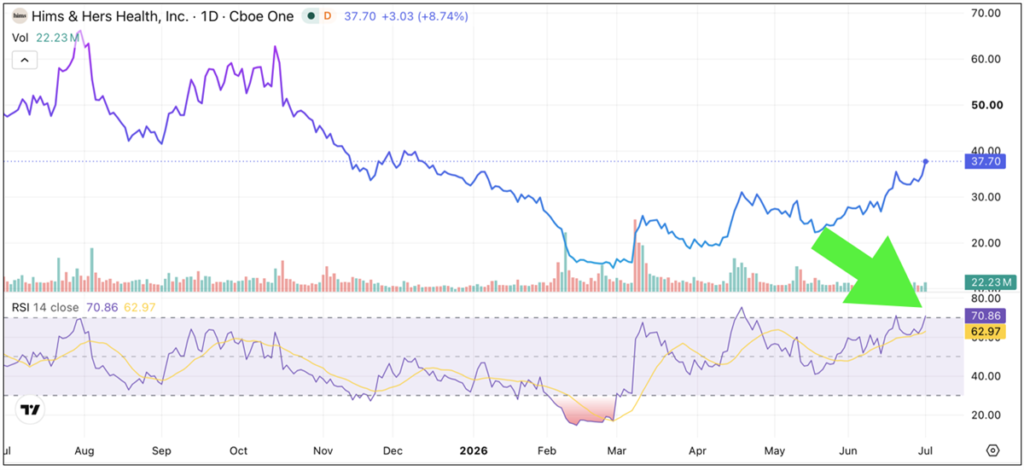
However, following its approximately 160% gain from its YTD low on Feb. 27, HIMS appears overdue for a price correction. According to the Relative Strength Index (RSI)—a technical momentum indicator that shows if a stock is overbought (above 70), oversold (below 30), or fairly valued (somewhere in between)—HIMS has pushed into overbought territory.
As shown by the green arrow below, the RSI on HIMS one-year chart currently reads 70.86, suggesting that the stock is overbought and due for a price reversal:
 Technical analysis is hardly a perfect science. But the last two times the stock’s RSI breached 70—first in mid-April then again in mid-June—HIMS pulled back more than 28% and nearly 8%, respectively, before continuing its rally.
Meanwhile, Wall Street remains bearish on the stock after its outperformance this year. Of the 16 analysts currently covering HIMS, only four assign it a Buy rating.
Overall, the stock receives a consensus Hold rating alongside a 12-month price target that implies over 19% potential downside from current prices.
Concerningly, with a high-volatity beta of 2.35, current short interest for HIMS now stands at more than 32% of the float, or about 65.4 million shares valued at $1.97 billion.
That is the most the stock has been shorted since March and marks a nearly 5% month-over-month increase.
At the same time, insider activity has seen an uptick in selling this year. In Q1 2026, $3.46 million worth of HIMS shares were sold with no buys. In Q2, that figure rose $4.86 million against $1.17 million bought.
5 Stocks Our Experts Predict Could Double In the Next Year
By submitting your email, you'll also get a free pivot & flow membership. A free daily market overview. You can unsubscribe at any time.