U.S. stocks are inching higher following a brutal two-day sell-off as chip stocks rebound ahead of Micron Technology’s (NASDAQ:) earnings after the close and as continue to decline.
US Futures
-0.05%, 0.27%, and 0.4%
In Europe
-0.4% and -1%
- U.S stocks are set to rise after recent losses
- Tech stocks rebound after losses, MU reports later
- Fed rate hike expectations could limit gains
- Oil falls to a 4-month low
U.S. Stocks Edge Higher as Investors Await Micron Earnings
U.S. stocks are inching higher following a brutal two-day sell-off as chip stocks rebound ahead of Micron Technology’s earnings after the close and as oil prices continue to decline.
The fell 1.5% yesterday as investors questioned the AI trade that has driven markets higher for much of the past year. The plunged 8% as investors reassessed whether massive spending on AI infrastructure will ultimately translate into profits.
While the sell-off has steadied, with South Korea’s rebounding 4% after a 10% slump earlier this week, attention now turns to Micron Technology’s earnings. As a key supplier to the AI industry, its results could help determine whether the recent sell-off is simply a valuation reset or the start of a broader reassessment of the AI investment cycle.
Gains could also be limited by increasingly hawkish Fed expectations. Markets are now pricing around a 70% probability of a September , up from 36% last week, as investors focus on sticky and a resilient labour market despite falling oil prices.
Attention now turns to U.S. data tomorrow, which could provide further clues over the outlook for interest rates.
Corporate Movers
Micron Technology is under the spotlight ahead of earnings after the close. Despite recent weakness, including a 13% drop on Monday, the stock still trades up around 370% year to date. Expectations are for revenue of $33.5 billion and a gross margin of around 81%.
Memory stocks are rebounding after the recent sell-off, with Western Digital (NASDAQ:), SanDisk (NASDAQ:) and Seagate Technology (NASDAQ:) all trading more than 1% higher pre-market.
FedEx (NYSE:) is falling 6.5% despite posting better-than-expected fiscal Q4 result
Wendy’s is surging after becoming one of the most discussed stocks on WallStreetBets amid short-squeeze speculation.
S&P 500 Forecast – Technical Analysis

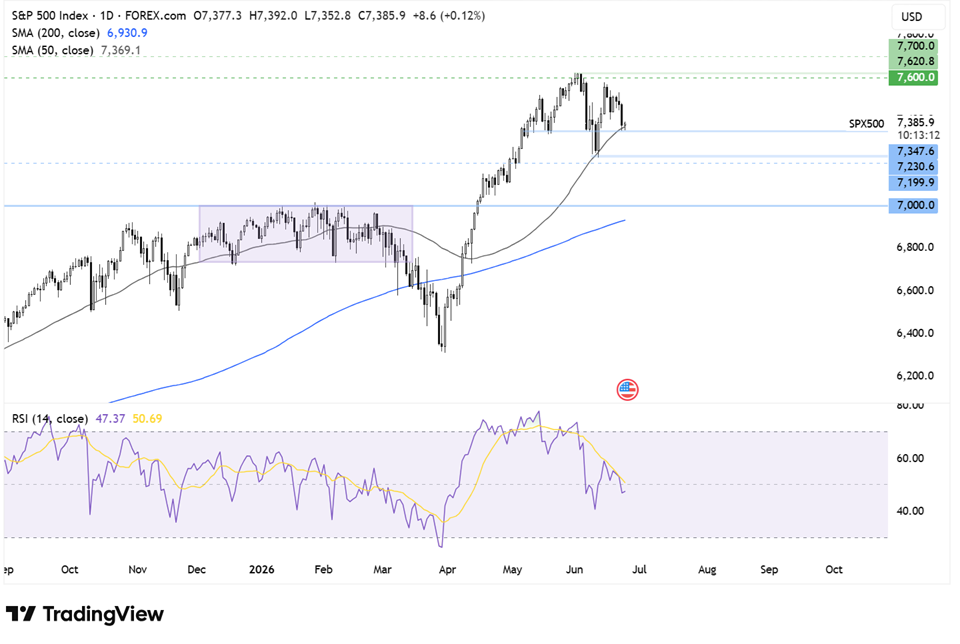
Having recovered from the 50 SMA in early June, the price ran into resistance at 7,575, forming a lower high, and has since fallen sharply back towards the 50 SMA at 7,350.
Sellers will look to break below this level to expose 7,250, the June low. A break below here creates a lower low and opens the door towards 7,200 and then the psychological 7,000 level.
Should the 50 SMA hold, buyers will need to rise above 7,480, the 20 SMA, to look towards 7,575. A rise above here brings the record high at 7,620 into focus.
FX Markets – USD Rises, EUR/USD Falls
The has risen to a 13-month high amid expectations for a more hawkish Fed and continued safe-haven demand following the recent sell-off in technology stocks.
has fallen to a yearly low below 1.1350 despite expectations that the ECB could hike rates again. However, recent comments from ECB President Christine Lagarde suggest the oil shock only requires a measured policy response, limiting support for the euro.
has fallen to 1.3250, its lowest level since November’s budget, amid U.S. dollar strength and domestic political uncertainty. Reports that Britain’s next expected Prime Minister, Andy Burnham, may seek greater flexibility within the government’s fiscal rules are keeping investors cautious given the UK’s fragile public finances.
Oil Falls to a 4-Month Low
Oil prices have extended declines, dropping 2% to a four-month low as shipping activity through the Strait of Hormuz gradually resumes, easing supply concerns.
The number of vessels crossing through the Strait has increased in recent days, although volumes remain below pre-conflict levels. Estimates suggest around 6 to 7 million barrels per day are currently moving through the waterway, compared with around 20 million before the conflict.
However, alternative pipeline routes mean flows may only need to recover to around 14 million barrels per day for Gulf exports to return to pre-conflict levels.
The market is increasingly focused on the speed of supply normalisation rather than the risk of disruption. The faster exports recover, the greater the risk that oil markets move back towards oversupply later this year, which could keep prices under pressure.
5 Stocks Our Experts Predict Could Double In the Next Year
By submitting your email, you'll also get a free pivot & flow membership. A free daily market overview. You can unsubscribe at any time.