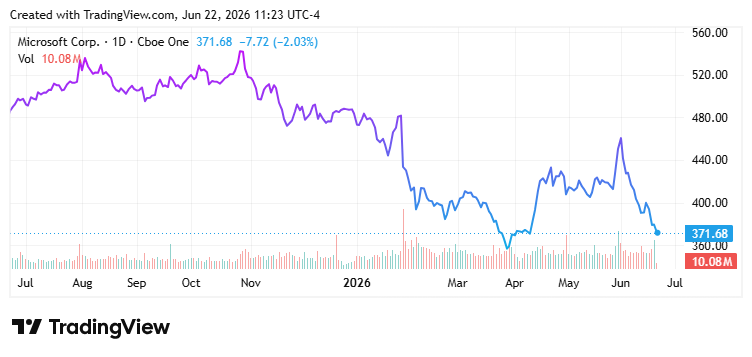
is down approximately 20% in the last 12 months. Most of the news around the company has been negative.
There have been layoffs, significant ongoing capital expenditures to support its artificial intelligence ambitions, cost pressures in its gaming division, and the ongoing transformation of Microsoft’s relationship with OpenAI.
That’s created significant noise around the company and takes away from the fact that the company’s business is doing just fine.
Significantly, investors are only paying about 22x earnings to own MSFT. That has some investors crying foul due to the company’s self-reported $80.1 billion in capital expenditures in the nine months ending March 31, 2026.
But there’s more nuance to that story than may appear. And that’s where the boring but beautiful story begins.
Microsoft’s AI Spending Is Backed by Strong Cash Flow
It’s fair to point out that Microsoft’s free cash flow (FCF) is down. Operating cash flow over that nine-month stretch mentioned above was $127.5 billion, which means CapEx alone consumed roughly 63 cents of every dollar of operating cash generated. That’s compared to about 51 cents in the prior-year period.
But there’s an equally compelling counterargument that needs to be considered in an honest discussion. That is, Microsoft is funding the buildout primarily through the cash machine it already runs, not by mortgaging the balance sheet.
In fact, long-term debt is actually shrinking. The $80 billion CapEx isn’t leverage-fueled speculation; it’s a company deploying its own cash to build infrastructure it expects to monetize. That should take investors to the company’s nine-month net income, which hit $98 billion.
The takeaway is that Microsoft’s cash generation engine isn’t under stress. Perhaps more importantly, the company’s AI business surpassed an annual revenue run rate of $37 billion in the last quarter. That was up 123% year over year (YOY).
Azure grew 40%, and contracted future revenue was up 99% YOY to $627 billion. That backlog is the story behind infrastructure spending. Management is guiding for roughly $190 billion in capital expenditures for calendar year 2026 and simultaneously reporting demand that continues to outpace capacity.
Microsoft’s Dividend Growth Story Is Easy to Overlook
But something else was going on behind the scenes in the last 20 years. In fact, it’s been the last 23 years. That’s the number of consecutive years that Microsoft has increased its dividend payment.
Many investors will yawn at a yield of just 0.95%. However, the more salient number is the average annual growth rate of over 10% in the last three years. That’s resulted in an annual payout per share of $3.64. Both numbers are well supported by a payout ratio of around 18% based on next year’s earnings estimates.
It may not mean much to say that Microsoft will be a Dividend Aristocrat in two years. But the company’s path to that title hasn’t come at the expense of growth. In the last 10 years, MSFT has delivered a total return of over 780%, and obviously, with a dividend yield under 1%, virtually all of those gains have come from stock price appreciation.
What makes the dividend story particularly compelling right now is the timing. Microsoft’s next annual dividend increase is likely to be announced alongside its fiscal Q4 earnings report, due in late July. Investors who buy before that announcement lock in a lower cost basis on a growing income stream. That’s a straightforward value proposition that tends to get overlooked with investors who are fixated on CapEx.
MSFT’s Valuation Looks Increasingly Attractive
MSFT’s 20% decline in 2026 has quietly created one of the more attractive entry points Microsoft has offered in years. At roughly 22x forward earnings, MSFT is trading approximately 24% below its 10-year average price-to-earnings (P/E) ratio of around 31x.

Investors can choose to look at MSFT as a stock in distress. However, a more accurate framing may be to view it as a company being repriced because the market is impatient with infrastructure spending that hasn’t yet fully shown up in free cash flow.
Microsoft’s business, however, hasn’t missed a beat. Over each of the three most recent quarters, Microsoft posted 18% revenue growth. Operating margins expanded year-over-year in each of those same periods. Net income for the trailing 12 months recently crossed $125 billion.
Are those the numbers of a company in trouble? It doesn’t seem so. They look more like the numbers of a company transitioning from a software giant into a cloud and AI infrastructure platform. That transition is measurably ahead of schedule.
For investors who want exposure to AI without paying the speculative premiums attached to pure-play names, Microsoft is an unusual combination. It’s a business growing at 18% annually, returning capital through buybacks and a growing dividend, with a balance sheet that carries more cash than long-term debt and a contracted backlog approaching two-thirds of a trillion dollars.
The noise around the stock may be real—but it’s also masking the opportunity.
5 Stocks Our Experts Predict Could Double In the Next Year
By submitting your email, you'll also get a free pivot & flow membership. A free daily market overview. You can unsubscribe at any time.