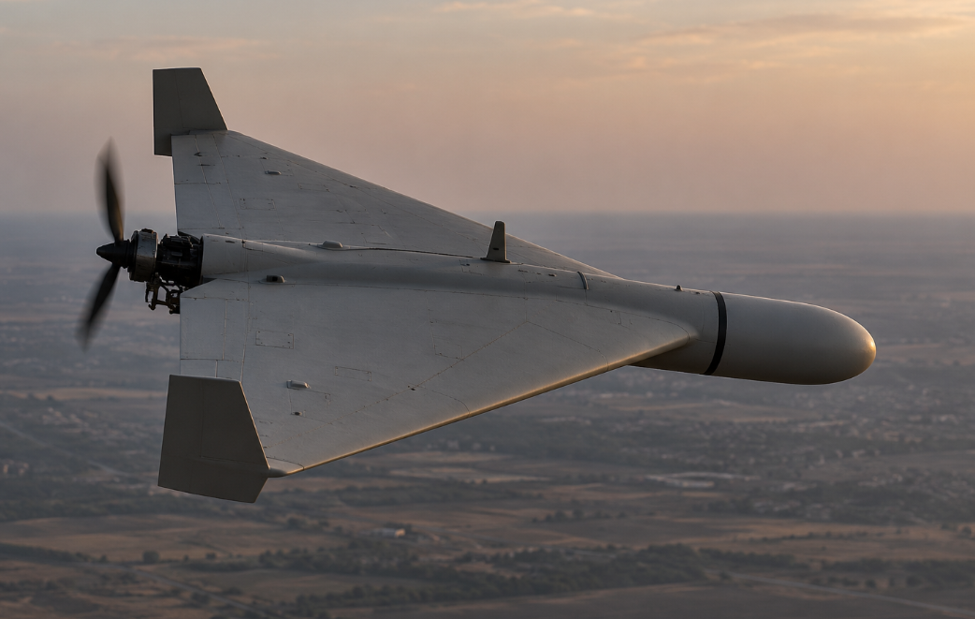
An Army drone demonstration reveals an investment opportunity hiding in plain sight.
Listen to the audio version of this article (generated by AI).
Editor’s Note: Cheap drones can create an expensive problem for the military – and a lucrative new business for the companies that help defend against them.
My colleague Luke Lango believes that’s one opportunity investors may be overlooking amid the recent selloff in defense stocks. Below, he explains why America’s push to replenish its arsenal and upgrade its defenses has him watching one established contractor in particular.
This isn’t just a one-off opportunity. In fact, Luke believes we’re about to see the biggest defense-spending supercycle in U.S. history.
And in his latest presentation, Rearming America, Luke explains that while the same legacy names will benefit, a small group of innovative defense stocks is set to go up by as much as 10X or more over the months ahead.
Take it away, Luke…
************************************
“Arming.”
Army Chief Warrant Officer 2 Nate Shea had maneuvered his drone behind a fixed-wing target aircraft. Seconds later, he detonated the Claymore mine his drone was carrying.
Watching on a screen, First Lieutenant Francesco La Torre looked up in time to see the target plummet.
The Army’s first drone-on-drone strike had just taken place during a live-fire demonstration at Fort Rucker, Alabama.
This August 2025 training had taken weeks to prepare.
Paratroopers practiced for hours each day. Pilots trained in changing weather to intercept an aircraft that could appear anywhere.
La Torre described the potential plainly: “With the right kit,” paratroopers could use “a low-cost system with preexisting munitions” to protect their units.
Those four words, with the right kit, begin to reveal the investment opportunity here.
Equipping more units requires hardware, reliable components, and manufacturers capable of delivering at scale. Adding AI and automation creates further opportunities for the companies developing the next generation of military systems.
That’s why I’m watching defense stocks closely. And right now, I think Wall Street is overlooking something important.
Defense stocks have been hit hard in recent months. Peace-talk headlines, uncertainty over Washington’s budget, and higher interest rates have weighed on the sector. Yet the military’s underlying needs haven’t gone away.
Missiles that have been fired still need replacing. And nobody is going back to fighting wars without drones.
Today, I’ll explain why America’s military buildup could create opportunities for years to come, why the recent selloff may be giving investors a second chance, and share one established defense stock I believe is worth a closer look.
From One Successful Strike to an Entire Military
Right now, America faces three overlapping defense demands: replenish weapons already deployed, prepare for warfare increasingly shaped by drones and AI, and expand the industrial capacity needed to do both.
Consider the first problem. The war with Iran has consumed substantial quantities of missiles and interceptors. Advanced military equipment requires specialized components, manufacturing capacity, and trained workers. Some systems take years to produce.
Meanwhile, the White House has proposed a $1.5 trillion defense budget for 2027. That’s not money Congress has approved yet, but it shows how seriously Washington is taking the need to rebuild and modernize America’s military.
One defense contractor deserves a closer look here…
Defending the Skies
The basic appeal of a missile manufacturer is pretty straightforward: Militaries use weapons, and then order replacements. Defending against an aerial attack, however, involves much more than firing an interceptor.
First, a system has to detect the incoming object. Then it must track it, identify the threat, and fire a weapon capable of stopping it.
This is where RTX Corp. (RTX), whose Raytheon division has been building military equipment for more than a century, comes in.
RTX’s products include Patriot air and missile defense equipment, GEM-T interceptors, and the Lower Tier Air and Missile Defense Sensor, or LTAMDS. That last one is a radar designed to strengthen the military’s ability to detect and track threats.
For RTX, the potential extends across replenishment, upgrades, and additional systems.
And the orders are already coming in.
In the second quarter of 2026 alone, Raytheon booked a $3.7 billion contract for Patriot interceptors for Ukraine, another $988 million for Poland, and $827 million for new Army missile-defense radars.
By September 30, Raytheon’s defense order backlog had reached $130 billion, up from $75 billion at the end of 2025. That’s equipment customers have ordered but the company hasn’t yet delivered — a substantial pipeline of future work.
And that brings us back to the changing economics of warfare.
Why Cheaper Drones Can Create Demand for Better Defenses
Imagine an attacker launching dozens of inexpensive drones at a military base. Defenders can’t simply ignore them. Even a cheap drone can cause enormous damage if it reaches an aircraft, ammunition depot, or other valuable target.
But using a costly interceptor against every incoming drone quickly becomes an expensive proposition. And an adversary that can manufacture drones faster than you can replace your interceptors has another advantage.
That is one reason I’m interested in layered defenses: systems that combine detection and tracking with multiple ways to defeat an incoming target.
RTX’s counter-drone products, including its Coyote interceptors and Ku-band Radio Frequency System radar, give it exposure to this requirement as well.
In other words, the drone revolution isn’t just good news for drone makers. It’s creating new business for the companies that defend against them.
Of course, there’s more to RTX than missile defense. The company’s Collins Aerospace and Pratt & Whitney divisions give it substantial exposure to commercial aviation as well as military customers.
That’s worth remembering. RTX isn’t a pure defense stock. Commercial aviation, engine costs, and manufacturing problems can affect its results, too. And a $130 billion backlog doesn’t guarantee every contract will be profitable.
But the opportunity I’m seeing goes well beyond RTX.
The Other Side of the Defense Trade
Established contractors such as RTX have something newer defense companies often lack: decades of experience delivering complex military systems, existing customer relationships, and large multiyear contracts.
That can provide a measure of stability. But it doesn’t necessarily offer the fastest growth.
Consider what happens when the Pentagon moves from experimenting with drones to purchasing them by the thousands. The companies developing drones that can operate on their own, software that helps commanders make faster decisions, and other emerging technologies could see demand grow much faster than the overall defense budget.
That’s why I favor owning both types of companies: established contractors that can profit from rebuilding America’s arsenal, and smaller technology firms that could grow much faster as the military adopts new weapons.
But those newer stocks also carry greater risks. They’re especially vulnerable when interest rates rise or investors become less willing to pay high prices for future growth. That’s part of what we’ve seen in the recent selloff.
A falling share price doesn’t automatically mean the business is deteriorating. But neither does it guarantee a bargain.
That’s why I’ve been looking beyond the familiar defense contractors to find companies that could benefit from the next wave of military spending. Some make weapons, others develop new technology, and still others supply the materials that make those weapons possible.
That’s the larger opportunity I’ve been researching in my Rearming America presentation.
I explain why I believe the United States is entering a historic military buildup, how government spending and private investment could accelerate it, and which five companies I’ve identified across three major areas: replenishing the arsenal, developing the next generation of weapons, and rebuilding America’s industrial capacity.
I also discuss two additional opportunities involving the future of naval shipbuilding and military AI.
You can see my complete strategy here, including more info about the companies I believe are best positioned for the years ahead.
The soldiers at Fort Rucker needed the right kit to bring down a drone. Equipping an entire military for the next generation of warfare will take a great deal more. And that’s where I believe the real investment story begins.
Sincerely,

Luke Lango
Senior Investment Analyst, InvestorPlace
P.S. Luke believes one of the market’s next big investment opportunities could come from America’s effort to rebuild and modernize its military. Missiles need replacing. Drones and AI are changing warfare. And billions of dollars in new business could flow to the companies supplying the equipment. Luke has identified five stocks he believes could be major winners, along with two additional opportunities. See his free Rearming America presentation here to learn which companies he’s watching and why he believes the opportunity is just beginning.
5 Stocks Our Experts Predict Could Double In the Next Year
By submitting your email, you'll also get a free pivot & flow membership. A free daily market overview. You can unsubscribe at any time.