stock surged after the company posted a massive first-quarter earnings beat, but the rally quickly faded as investors realized much of the upside was tied to a litigation settlement. Shares ultimately ended the session only slightly higher, as investors appeared more cautious after digging into the report.
Some enthusiasm may also have been tempered by the company’s incredible multi-year run. Shares, which had climbed more than 270% over the past five years, began to pull back from their all-time highs as investors reassessed the stock following the massive rally.
Q1 Earnings Get a Big Boost From Legal Settlement
It’s easy to see why Dillard’s stock rallied immediately following the report. The department store chain reported Q1 earnings on May 14 of $16.04 per share, significantly higher than year-ago earnings of $10.39 and $5.91 above Wall Street’s expectations of $10.13 per share.
Earnings received a major boost from a litigation settlement, which added $5.10 per share after taxes. The company said the settlement followed a long-standing lawsuit regarding payment card interchange fees.
Revenue for the quarter came in at $1.59 billion, up 2.7% from the prior year and topping estimates by nearly $34 million. Meanwhile, same-store sales rose 3%, while margins improved.
Operating expenses increased during the quarter, however, largely due to higher payroll and payroll-related expenses. Inventory rose 3%.
Merchandise Sales Increased Across Categories
Dillard’s said year-over-year sales increases were reported across all merchandise categories, with significant gains in home and furniture, ladies’ accessories, lingerie, and shoes. The company saw more moderate increases in men’s apparel and accessories, juniors’ and children’s apparel, and ladies’ apparel. Cosmetics sales increased slightly.
Dillard’s Chief Executive William T. Dillard II commented on the results in the company’s press release, saying, “We are pleased to report a good start to 2026 with a profitable 3% sales growth supported by an increased 45.8% retail gross margin. We continue to focus on motivating our customer with newness in our merchandise assortment.”
Dillard’s offered limited forward guidance for 2026, including projected capital expenditures of roughly $130 million, up from $93 million last year, and depreciation and amortization expense of about $175 million, down slightly from $179 million the previous year.
Stock’s Rally Quickly Lost Steam
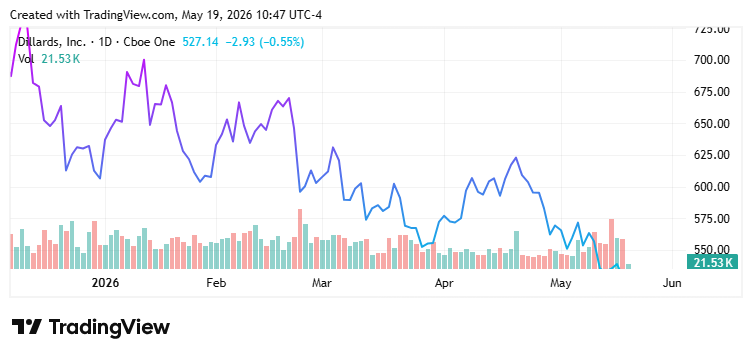
At first glance, investors seemed thrilled by the earnings report, with shares surging in premarket trading and climbing further at the open. The stock, which had closed the previous session below $532, jumped to nearly $593 before quickly giving up those gains. At one point, shares briefly dipped into negative territory, though they ultimately ended the session up around 0.4%.
The stock has been on a tear for more than five years, climbing roughly 270% during that time. The second half of 2025 was especially strong, helped by multiple quarters of earnings and revenue beats that continued pushing shares higher. Shares climbed from below $400 in early June to an all-time intraday high above $742 in December.

Since hitting the peak, momentum has cooled. Shares are down more than 20% over the last three months, with sentiment taking another hit after the company’s fourth-quarter earnings report on Feb. 24. During that quarter, both earnings and revenue declined year over year, while revenue missed Wall Street expectations.
Wall Street Remains Cautious on the Stock
Although Q1 results were solid, analysts remain cautious on the stock. Based on five Wall Street analysts covering the company, Dillard’s currently carries two Sell ratings and three Hold ratings. The average 12-month price target is around $521, slightly below the current stock price of around $527. The lowest target stands at $449, while the highest is $650.
After such a strong run in the stock price, some investors may also be questioning the stock’s valuation. Dillard’s trades at around 12X earnings, which is above the broader retail industry average of roughly 10.8X. It also trades at a premium to traditional department store peers. Macy’s Inc. currently trades at a P/E of roughly 8X, while value-oriented chain Kohl’s Corp. trades at just under 5X earnings.
However, it’s worth noting that despite generating less revenue than Macy’s and Kohl’s, Dillard’s remains more profitable. The company has a net margin of around 10.1%, far above Macy’s roughly 2.4% and Kohl’s less than 1.8%. Its return on equity of nearly 32% also tops Macy’s roughly 14% and Kohl’s less than 5%.
While Dillard’s continues to post strong profitability metrics, investors appear increasingly cautious after the stock’s massive multi-year rally. For now, Wall Street seems to be waiting for stronger underlying growth and a clearer outlook before turning more bullish on the shares.
5 Stocks Our Experts Predict Could Double In the Next Year
By submitting your email, you'll also get a free pivot & flow membership. A free daily market overview. You can unsubscribe at any time.