The AI Boom’s biggest profits keep moving down the supply chain and now we know where to look next
Listen to the audio version of this article (generated by AI).
On a plateau south of Bandung, in what is now Indonesia, Dutch planters spent decades cultivating a scrubby South American tree.
It was called cinchona.
And for a long time, it was one of the most strategically important plants on Earth.
Its bark contained quinine, which was then the world’s best defense against malaria. If European powers wanted to build railroads, man military outposts, or expand deeper into the tropics, they needed quinine.
And the Dutch controlled almost all of it.
By the 1920s, plantations in the Dutch East Indies supplied more than 90% of the world’s cinchona. Prices were effectively controlled by a cartel formed by growers and manufacturers that set production quotas and prices, referred to as Amsterdam’s Kina Bureau.
Source: Envato
And for years, everyone paid the toll.
Then the supply disappeared.
Germany occupied the Netherlands in 1940 while Japan captured Java in 1942, and, almost overnight, the Allies lost access to both the cinchona plantations and its processing infrastructure.
The consequences were brutal.
During the Pacific campaign, malaria hospitalized more soldiers than enemy fire. By December 1942, more than 8,500 American troops were hospitalized with the disease. In some wards, in eight out of every 10 beds laid a soldier suffering from fever rather than wounds from combat.
A massive military machine had been built on top of one tiny bottleneck. And almost nobody appreciated how important it was until that bottleneck broke.
I’ve been thinking about that story this week because Nvidia Corp. (NVDA) recently reported earnings, which spoke to where the next big profits in the AI Boom could show up.
It wasn’t Nvidia’s revenue or its earnings. Rather, the big story is in Nvidia’s margins.
Let me explain.
The Number That Still Matters
Weeks after Nvidia’s earnings report, one number still deserves investors’ attention: 70%.
That’s the revenue growth Nvidia expects in fiscal 2028, which roughly corresponds to calendar 2027. Before the report, analysts were expecting growth closer to 45%. That gap helped reset expectations for how much runway the AI boom has left.
Using the revenue baseline behind those earlier estimates, that’s the difference between roughly $580 billion and $680 billion in annual sales.
About $100 billion in additional revenue.
That comparison captures the size of the surprise Nvidia delivered weeks ago. The question now is what it would take to deliver on it.
You can understand why analysts had expected a sharper slowdown. Nvidia has become enormous. Every percentage point of growth requires more sales, more manufacturing capacity, and more infrastructure to support the chips it ships.
Yet management’s outlook suggests growth could remain exceptionally strong even as the business gets larger.
To be clear, 70% is an outlook for one fiscal year, not a permanent cruising speed. But achieving it would still require an extraordinary expansion at Nvidia’s scale.
And that brings us to the part of the story we think deserves more attention today.
Revenue expectations can rise with a few changes to a spreadsheet. The supply chain has to expand in the physical world — where factories take time to build, specialized components remain difficult to produce, and suppliers can’t always increase output on command.
For investors, that creates a second question alongside “How fast can Nvidia grow?”
Who supplies the things Nvidia needs to reach those numbers, and how much pricing power do they have?
That’s where the conversation gets especially interesting…
Source: Envato
The Number That Matters More
Nvidia’s growth outlook is still drawing attention weeks after earnings. But its margin outlook may tell investors more about where the next AI opportunities are taking shape.
The company expects rising memory costs to pressure gross margins through the second half of the year. In other words, Nvidia anticipates keeping less gross profit from each dollar of sales.
Normally, that would give investors pause.
Here, though, the reason matters: The components needed to support AI’s expansion are becoming more expensive.
That shifts the question from how much Nvidia can sell to how much it must pay the companies that make those sales possible.
And it gives investors a reason to look one layer down the supply chain.
Nvidia’s higher costs can become a supplier’s higher revenue. When that supplier can raise prices faster than its own costs rise, more of the spending can reach its bottom line.
That isn’t an automatic, dollar-for-dollar transfer of profit. But it is the kind of shift in bargaining power we want to watch.
Micron Technology Inc. (MU) belongs in that conversation because of its role in memory. SanDisk Corp. (SNDK) offers exposure to storage, another piece of the AI infrastructure buildout. Optical networking suppliers warrant attention for the connections that allow these systems to move data.
The opportunity in each depends on what it supplies, how scarce that product becomes, and how much pricing power it can sustain.
Which companies control the components that could hold up the next stage of AI growth?
That’s the bottleneck trade. And Nvidia’s margin outlook gives investors a concrete reason to keep following it.
Follow the Bottleneck
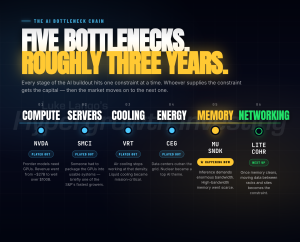
The AI Boom has never really been one trade but a rolling series of bottlenecks.
And each bottleneck has created a new group of winners.
Source: Claude Design
First came compute.
AI companies couldn’t train frontier models without GPUs, so Nvidia became the critical supplier. Revenue exploded from about $27 billion to well over $100 billion, and the stock followed.
Then came servers.
Someone had to package all those GPUs into usable systems. For a stretch, Super Micro Computer Inc. (SMCI) became one of the fastest-growing companies in the S&P 500.
Then came cooling.
Stuff that much computing power into one building and traditional air cooling stops working. Suddenly, liquid cooling became mission-critical, and Vertiv Holdings Co. (VRT) transformed from a relatively obscure infrastructure company into a major AI trade.
Then came energy.
Data centers started consuming more electricity than utilities could easily deliver. Nuclear power went from yesterday’s technology to one of Wall Street’s hottest AI infrastructure themes, helping stocks like Constellation Energy Corp. (CEG) soar.
Then came memory.
AI inference requires enormous memory bandwidth. High-bandwidth memory became scarce, creating another wave of winners.
That’s five bottlenecks in roughly three years, each following an identifiable pattern.
First, hardly anyone cares.
Then supply tightens.
Then pricing power improves.
Then earnings explode.
Then Wall Street notices.
And eventually, everyone piles into the trade.
That is why the most useful question in AI investing is to ask where the next bottleneck is forming.
Because wherever the hyperscalers are about to spend their next $100 billion, there is probably a shortage forming somewhere nearby.
Right now, two of the biggest constraints appear to be memory and networking. And I think networking is especially interesting.
Most investors still think the main constraint inside an AI data center is the chip. But once you pack hundreds of thousands of processors into one facility, those processors need to operate together like one giant computer.
If they cannot communicate fast enough, say goodbye to performance.
Suddenly, the cable that connects racks can become almost as strategically important as the chips powering them.
Source: Envato
That’s why Nvidia’s moves in optical networking are critical.
Earlier this year, the company committed billions of dollars to secure supply from Lumentum Holdings Inc. (LITE) and Coherent Corp. (COHR). Companies only make commitments like that when they are worried about supply.
In other words, Nvidia is showing us where one of its own chokepoints lies. And historically, that is exactly where investors should be looking.
Which Brings Me to Elon
Every company in the AI Boom pays a bottleneck tax.
The hyperscalers pay it to Nvidia.
Nvidia pays it to memory and optical suppliers.
And everyone pays it to utilities and power infrastructure providers.
But one person has spent years trying to eliminate as many of those tollbooths as possible.
Elon Musk.
Ignore whatever you think about Musk personally and just look at how his companies are structured.
He owns a massive source of real-time training data.
He builds enormous AI compute clusters.
He owns rockets.
He owns a satellite communications network.
And he builds physical machines that could eventually use the intelligence produced by those systems.
Look at those businesses individually, and they can seem chaotic. Look at them together, and a pattern emerges.
Musk is systematically trying to control more of the infrastructure required to produce and distribute intelligence. That means owning bottlenecks instead of paying someone else to control them.
It’s an old industrial playbook.
John D. Rockefeller built his own barrels because suppliers charged too much.
Henry Ford bought mines, railroads, forests, and shipping assets because he wanted more control over his supply chain.
Musk has repeatedly done the same thing.
If a component is too expensive, too slow, or too difficult to procure, his instinct is often to bring it in-house. But that creates an interesting investing filter because Musk still buys plenty of things from outside suppliers.
And after two decades of aggressive vertical integration, the companies that remain inside his supply chain are probably there for a reason.
Whatever they make, Musk has likely asked some version of the same question:
Can we build this ourselves?
And if the answer was no, that tells you something no Wall Street analysis could. It suggests that supplier may possess technology, manufacturing expertise, scale, or intellectual property that is unusually difficult to replicate.
In other words, a moat.
And I think Wall Street dramatically underestimates how valuable that information can be.
The Bottom Line
Nvidia’s latest quarter told investors two important things: The AI boom remains powerful, and the bottleneck is moving.
Even at its enormous scale, Nvidia sees a path to growth near 70%. Yet suppliers are gaining leverage, putting pressure on its margins — and pointing investors toward the next pockets of pricing power.
We’ve watched this happen repeatedly over the past three years: compute, servers, cooling, energy, memory, and now networking.
The names change. The pattern stays the same.
When something becomes scarce in a massive investment boom, pricing power flows toward whoever controls it. That was true when global empires depended on cinchona bark growing on a Javanese plateau. And it is true today when AI giants depend on specialized components buried deep inside their data centers.
So don’t just watch what the giants are building. Watch what they cannot build themselves.
That question has guided my research into Elon Musk’s empire — and it’s at the heart of The Vertical AI Event.
On the surface, his businesses can look like separate bets: social media, artificial intelligence, rockets, and robots. But I believe the connections between them reveal something much bigger: a push to bring AI out of the chatbot window and into the physical world.
Those ambitions also create a revealing tension. Musk wants to control more of the technology behind his businesses. Yet even his empire depends on outside suppliers to deliver critical pieces.
Which suppliers control something he can’t easily replace?
In the workshop, I connect those pieces, examine four bottlenecks standing between Musk and his ambitions, and share the names and tickers of companies positioned to help solve them.
If Nvidia’s results have you wondering where the AI opportunity moves next, this is the next step in that conversation.
Watch The Vertical AI Event before the replay comes down at midnight Tuesday, Sept. 15.
Follow the bottleneck. The company trying to change the world may depend on a much-smaller company that makes the change possible
5 Stocks Our Experts Predict Could Double In the Next Year
By submitting your email, you'll also get a free pivot & flow membership. A free daily market overview. You can unsubscribe at any time.