Today we’re taking a deeper dive into ’s fundamentals. Visa shares have struggled since the stock hit a record high in June, down about 7.5%. Despite that, Visa is up about 26% over the past year and sports an impressive long-term track record, up 368% over the last decade. For context, the S&P 500 is up “just” 233% in that span.
The Business
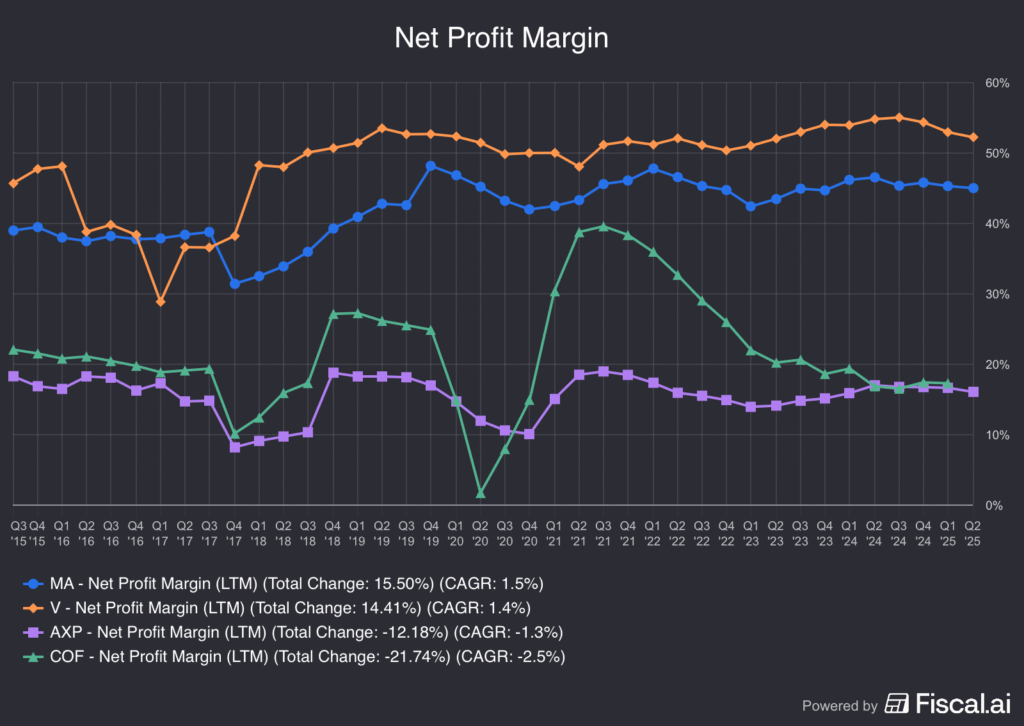
Investors know Visa as a credit and debit card company — that much is obvious. But it’s often referred to as the “toll booth” of digital transactions. enjoys a similar distinction. And while there are other credit card companies — like , , and — they also function as banks. While there are pros and cons to each business model, Visa and MasterCard command much higher profit margins with their business.  Visa has grown its revenue and earnings at a compound annual growth rate (CAGR) of 11.1% and 15.7%, respectively. Looking forward, analysts expect impressive results as well, including:
- Revenue growth estimates*: 11.4% in 2025, 10.6% in 2026, and 10% in 2027.
- Earnings growth estimates*: 15.3% in 2025, 12.3% in 2026, and 12.7% in 2027.
*Estimates according to Fiscal.ai Trading at roughly 28x forward earnings expectations, Visa stock is about in-line with its long-term average. The stock has been considered relatively cheap when shares trade at about 23x to 24x forward earnings and expensive in the low- to mid-30x. Historically, many investors have justified Visa’s premium valuation due to its elevated growth rates and high margins.
Risks & Bottom Line
The main risks to Visa are pretty obvious: Market volatility and economic activity.
If market volatility picks up, Visa isn’t immune. For instance, the stock suffered a peak-to-trough decline of ~18.5% earlier this year amid the tariff tantrum. While this was actually better than the S&P 500’s swing of 21.3%, it’s still a big swing.
The other risk would be an economic slowdown or a recession. Because Visa is a global company, a global or US slowdown would be a negative for many businesses — credit card companies included — especially when it comes to consumption.
The Bottom Line: Investors who believe Visa will continue to generate strong top- and bottom-line growth may justify the stock’s valuation, which is at a slight premium to the S&P 500 but roughly in-line with its long-term average. Those who view the stock as unattractive at current levels may wait for Visa’s valuation to potentially dip to a more attractive level or they may not like Visa’s business and decide to disregard it altogether.
***
Disclaimer: Please note that due to market volatility, some of the prices may have already been reached and scenarios played out. Content, research, tools, and stock symbols displayed are for educational purposes only and do not imply a recommendation or solicitation to engage in any specific investment strategy. All investments involve risk, losses may exceed the amount of principal invested, and past performance does not guarantee future results.
5 Stocks Our Experts Predict Could Double In the Next Year
By submitting your email, you'll also get a free pivot & flow membership. A free daily market overview. You can unsubscribe at any time.