Takeaways
- The market is no longer trading peace headlines directly. It is trading the absence of systemic escalation and the belief that global energy flows will remain functional.
- Artificial intelligence has evolved from a technology story into a full-scale capital spending supercycle driving earnings optimism, liquidity flows, and equity leadership globally.
- Treasury yields remain the critical pressure valve underneath the entire rally because disorderly bond market conditions would eventually choke the financing mechanics supporting the AI boom.
Latest Headlines
- A Diplomatic Source In Islamabad Told IRNA That Field Marshal Syed Asim Munir, The Commander Of The Pakistani Army, Left For The Islamic Republic Of Iran. @IRNA_1313 Agency Telegram
- Arabic Sources: The Pakistani Army Chief Is On His Way To Tehran @AlArabiya_Brk
 |
Pushes Toward Historic Winning Streak
The market is ending the week like a trader who has heard the fire alarm so many times that he no longer bothers to leave the building. Every geopolitical headline still flashes across screens with maximum theatrical urgency, yet risk assets increasingly treat the noise as background static rather than existential danger. The S&P 500 is now marching toward its longest weekly winning streak since 2023, and the remarkable part is not simply the magnitude of the rally but the market’s growing emotional numbness to the geopolitical risk itsel
 |
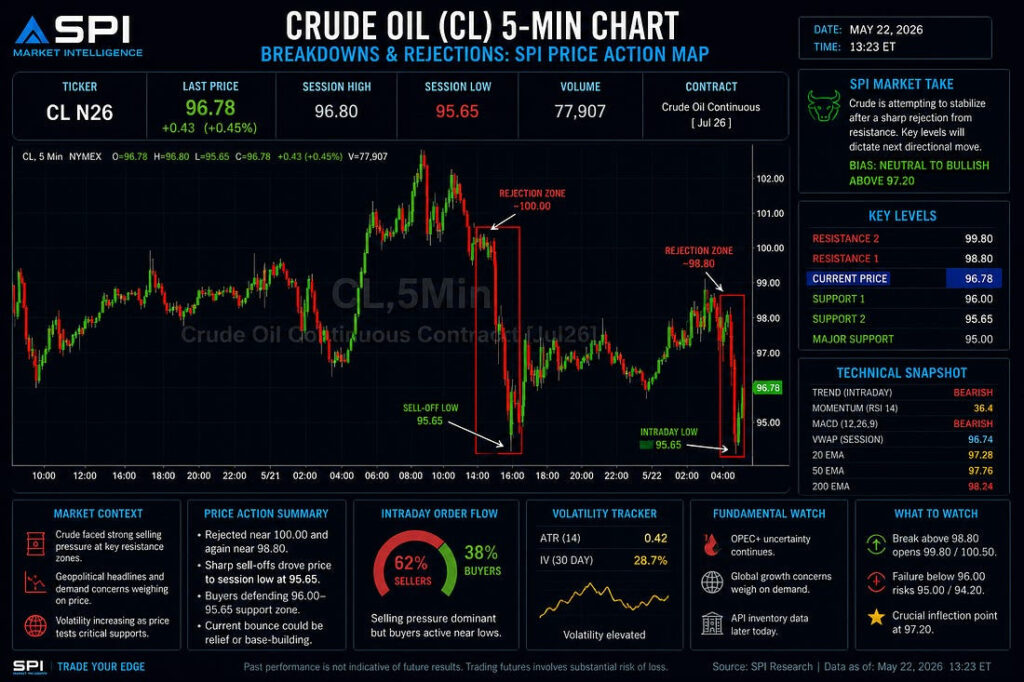
Futures edged higher again as investors leaned back into the same dominant narrative that has controlled price action for months: artificial intelligence remains the largest capital migration story on the planet, while the Middle East, despite remaining combustible, has not yet detonated the global inflation shock traders feared several weeks ago. trades well within recent ranges, but now moves with the exhausted rhythm of a market struggling to sustain panic. The geopolitical premium still exists, but it no longer expands with the same violence, as traders increasingly believe that all sides understand the economic consequences of accidentally blowing up the global energy plumbing system.
What the market is really trading now is not peace itself, but the absence of escalation. That distinction matters enormously. Investors have slowly recalibrated their psychology regarding the situation in Iran. The fact that negotiations continue at all has been enough to stabilize sentiment, as markets interpret ongoing dialogue as proof that nobody wants to push the Strait of Hormuz from a geopolitical leverage point into outright economic catastrophe. Every additional day without a major shipping disruption lowers the probability that a true inflation shock will collide with an already fragile global rate structure. In effect, traders have stopped demanding certainty and started pricing survivability instead. That shift explains why volatility has remained surprisingly subdued despite the constant swirl of conflicting reports surrounding negotiations. The stock market no longer reacts to every headline as if it were the opening scene of a global recession movie. Instead, traders increasingly see the Middle East as a contained burn rather than an uncontrolled wildfire.
At the same time, the AI liquidity machine continues operating like a massive industrial flywheel that cannot easily be slowed once momentum reaches escape velocity. What began as a narrow semiconductor boom has now metastasized into a full-scale capital spending supercycle touching nearly every corner of the corporate ecosystem. The hyperscaler spending surge is no longer isolated to chipmakers. The money is spreading outward through power infrastructure, cooling systems, networking, data centers, cloud architecture, financing vehicles, industrial suppliers, software ecosystems, and labor demand itself. Wall Street has effectively convinced itself that it is witnessing the early stages of a new digital industrial revolution, and that belief has become powerful enough to overpower macro anxiety almost everywhere else. The market is now trading AI not as a theme, but as the central operating system of future corporate profitability.
That dynamic has created one of the most reflexive market structures since the post-financial crisis liquidity era. Rising equity prices reinforce confidence. Confidence unlocks additional capital spending. Capital spending expands earnings expectations. Those expectations then justify higher valuations, which attract more passive inflows and momentum-chasing capital. It becomes a self-feeding machine in which liquidity itself acts like oxygen pumped directly into the market’s lungs. The result is a tape that continues to levitate even as Treasury yields remain historically elevated and geopolitical tensions simmer beneath the surface. In many ways, this rally increasingly resembles a giant suspension bridge swaying above a canyon. The structure still holds because the tension cables remain intact, but everyone can feel the vibrations underneath their feet.
Importantly, however, this remains a highly concentrated advance. Beneath the surface glamour of index highs, leadership is still dominated by the largest technology names and the broader AI ecosystem. The equal-weighted S&P continues trailing the cap-weighted benchmark, reinforcing the idea that this is not yet a universally healthy expansion but rather a liquidity monarchy ruled by a handful of mega-cap generals dragging the broader army uphill behind them. Europe joined the chase again overnight as semiconductor-linked names pushed regional equities higher, while Japan continued benefiting from global AI-related capital flows. Meanwhile, Chinese equities remain trapped inside a completely different emotional framework. Regulatory pressure on cross-border brokerages reminded traders once again that China is still grappling with capital flight concerns, while the United States continues to ride a speculative growth wave powered by technological optimism and massive corporate investment cycles.
The bond market remains the true heartbeat underneath all of this. Equities may dominate headlines, but Treasuries continue acting as the market’s central nervous system. Yields pulled lower for a third consecutive session after recently testing multiyear highs, and that reversal mattered far more than most investors probably realize. Washington understands what sustained oil-driven inflationary pressure would do to long-end borrowing costs. The White House knows the AI boom cannot continue functioning smoothly if Treasury yields spiral higher and financing conditions tighten aggressively. The administration appears deeply aware that steepening curves eventually suffocate liquidity-driven equity expansions because the cost of funding the boom itself starts becoming restrictive. In that sense, every diplomatic effort in the Middle East now carries a second layer of importance. It is not simply about preventing war. It is about preventing another inflation pulse from colliding directly into a bond market already struggling under the weight of enormous issuance requirements and higher term premiums.
That is why markets have become strangely comfortable with uncertainty itself. Traders no longer require a clean geopolitical resolution to maintain bullish positioning. They simply need conditions stable enough to keep the AI engine running and bond yields from quickly spiralling into disorderly territory. As long as oil avoids entering a true supply-shock regime and Treasury markets remain relatively contained, equities continue to behave like a momentum machine with very few natural sellers. The irony is that the longer this calm persists, the more confidence builds underneath the rally itself. Fear slowly decays while positioning expands. The market becomes conditioned to buy every wobble because every previous wobble has been rewarded. That is often how late-stage liquidity regimes operate. Risk does not disappear. It merely becomes anesthetized until something large enough finally breaks the spell.
BULL vs BEAR? ( Via Beta Test Agentic AI Model)
 |
Can Asia’s Stock Rally Continue?
- North Asia is separating from the rest of Asia because it sits directly inside the global AI infrastructure and semiconductor supply chain.
- South Korea’s memory chip boom increasingly resembles a structural scarcity cycle rather than a traditional semiconductor rebound, with earnings leverage vastly exceeding current market pricing assumptions.
- Southeast Asian and energy-importing economies continue facing margin pressure from higher oil prices and weaker currencies, while AI-linked markets absorb the majority of global equity inflows.
North Asia Breaks Away as the AI Capital Supercycle Rewrites Asia’s Market Map
Asian equities are no longer trading as one unified region. The old rising-tide narrative that once lifted everything from Seoul to Jakarta has fractured into two distinct market realities, and the fault line runs directly through artificial intelligence, semiconductors, and energy vulnerability. North Asia is increasingly behaving like the control room of the global AI industrial complex, while large parts of Southeast Asia are being forced to absorb the economic aftershocks of higher oil prices, weaker currencies, and slower earnings momentum. In effect, Asia has become a tale of two supply chains. One side is manufacturing the digital future. The other is paying the energy bill for it
 |
South Korea, Taiwan, and Japan continue to pull capital toward them like giant electromagnetic fields because they sit directly within the AI hardware bloodstream. These markets are no longer merely participating in the AI story. They are becoming the physical infrastructure through which the entire global compute revolution flows. Investors increasingly understand that every hyperscaler expansion plan, every sovereign AI initiative, every enterprise automation buildout, and every wave of agentic AI adoption eventually circles back toward chips, memory, networking, and power-intensive semiconductor ecosystems concentrated heavily across North Asia. That realization is beginning to reshape the entire regional investment map.
South Korea increasingly sits at the epicentre of that shift. What the market originally treated as another cyclical semiconductor rebound is now morphing into something far larger and structurally more durable. The memory chip cycle is behaving less like a traditional inventory recovery and more like a multi-year scarcity regime in which supply simply cannot scale fast enough to meet exploding compute demand. The important distinction here is that the market still appears psychologically anchored to the old semiconductor boom-and-bust framework, while the AI buildout increasingly resembles a prolonged infrastructure expansion cycle, closer to the early internet backbone era. Token demand for agentic AI systems is projected to explode over the next decade, and memory remains one of the critical bottlenecks within that architecture. That keeps pricing power elevated while operating leverage turns revenue growth into an earnings detonation.
Korean equities are now riding what increasingly looks like a once-in-a-generation earnings wave. Forecasts implying earnings growth near 300% sound almost absurd at first glance, yet that is precisely what happens when high-fixed-cost memory producers suddenly experience a sharp pricing acceleration in a constrained supply environment. The market is effectively watching an industrial furnace shift from idle to full combustion. Every increase in memory pricing flows disproportionately to the bottom line because the infrastructure is already in place. The profitability machine simply runs hotter. What makes this even more remarkable is that Korean semiconductor names still trade at valuation levels more consistent with late-cycle skepticism than structural scarcity. Single-digit forward earnings multiples continue to imply that the market does not yet fully believe in the cycle’s durability. That disconnect is becoming one of the most important themes across Asian equities.
Importantly, this is no longer just a speculative momentum trade fueled by retail enthusiasm. The structure underneath the Korean market has become increasingly institutionalized. Longer-term semiconductor supply agreements extending three to five years are beginning to replace the shorter cyclical contracting behaviour that historically defined memory markets. That matters enormously because it transforms earnings visibility from unstable spot pricing into something far more durable and investable. Meanwhile, Korea’s corporate governance reforms continue to slowly compress the country’s longstanding valuation discount, while foreign positioning remains surprisingly balanced. In other words, the market has rallied hard, but the positioning still does not resemble the euphoric overcrowding typically associated with late-stage blowoff tops.
Taiwan is another direct beneficiary of this AI hardware arms race because its equity market has effectively become a listed proxy for global compute demand. Technology now accounts for more than 80% of the benchmark index’s weighting, making Taiwan one of the purest expressions of the AI capex boom anywhere in the world. Earnings expectations continue ratcheting higher because the market increasingly realizes this is not simply about consumer electronics demand returning. It is about a global scramble for computing infrastructure that now resembles a modern industrial resource war. In many ways, chips have become the new oil fields of the digital economy, and Taiwan sits directly atop some of the richest reserves.
Japan’s story is slightly different but equally important. Unlike Korea and Taiwan, Japan benefits not only from the AI supply chain but also from the return of political stability, improving corporate governance, foreign capital inflows, and the long-delayed normalization of domestic interest rates. The country increasingly feels like a giant industrial ship slowly returning to the global trade currents after drifting for decades in deflationary isolation. A more stable political backdrop, combined with favourable currency dynamics and stronger earnings growth, has reawakened global investor interest in Japanese equities to a degree not seen in years. Foreign inflows continue to pour into the market as investors increasingly view Japan as both an AI beneficiary and a relative macro safe harbour within Asia.
China presents perhaps the most fascinating divergence of all because the gap between onshore and offshore equity performance reveals two entirely different economic stories unfolding simultaneously. Mainland A shares have quietly outperformed thanks to stronger-than-expected earnings delivery, domestic policy support, and early signs that the long deflationary industrial drag may finally be stabilizing. Offshore Chinese equities, however, remain weighed down by weaker internet-sector earnings and lingering skepticism about the broader growth outlook. The contrast increasingly highlights how local Chinese industrial and manufacturing sectors are stabilizing faster than internationally owned platform technology names. In effect, domestic China is slowly reflating while offshore China continues fighting an emotional hangover from years of regulatory and growth disappointments.
Meanwhile, large parts of Southeast Asia remain trapped on the wrong side of the regional divide because they are far more exposed to imported energy inflation and currency pressure without possessing the same direct leverage to the AI hardware supercycle. Markets such as Indonesia and the Philippines continue lagging badly behind North Asia because higher oil prices function more like a tax than a growth catalyst for those economies. The recent Middle East energy shock exposed that vulnerability very clearly. While Korean and Taiwanese equities quickly reclaimed and exceeded their pre-conflict highs, much of Southeast Asia still struggles beneath the weight of higher import costs and margin pressure. India faces a similar issue to some degree. Strong long-term structural growth remains intact, but higher energy prices and currency weakness increasingly threaten corporate profitability assumptions that still appear overly optimistic relative to reality.
Ultimately, Asia is beginning to trade less like a geographic region and more like a giant balance-sheet sorting machine, separating future AI infrastructure winners from economies still primarily tethered to commodity sensitivity and imported inflation risk. Capital is no longer flowing evenly across the continent. It is concentrating aggressively on the markets closest to the compute bottlenecks, semiconductor scarcity, and the industrial plumbing required to power the next phase of the digital economy. The result is an Asian market structure increasingly defined not by traditional emerging-market cycles but by proximity to the AI supply chain itself.
5 Stocks Our Experts Predict Could Double In the Next Year
By submitting your email, you'll also get a free pivot & flow membership. A free daily market overview. You can unsubscribe at any time.