The company’s first public report may matter more for Rocket Lab, Redwire, Planet Labs, and BlackSky
Listen to the audio version of this article (generated by AI).
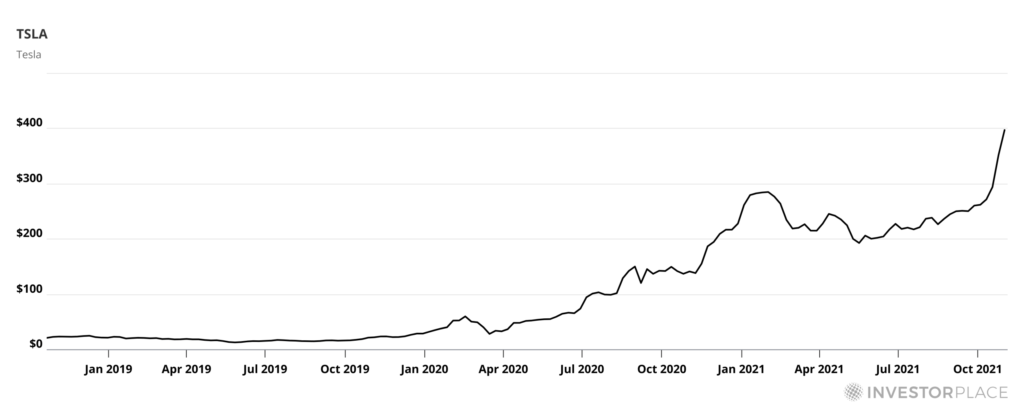
In May of 2019, Tesla (TSLA) was a $12 stock (split-adjusted).
The company had just bled roughly $1 billion of cash in a single quarter – the latest installment in a free-cash-flow bonfire that had consumed some $24 billion since 2011. And after a furious Model 3 production ramp in late 2018, Wall Street took the early ‘19 delivery slump as a harbinger of doom.
Yet, beneath all the noise, the machine kept whirring. Deliveries were scaling. Gigafactory Shanghai came online, with the first production vehicles rolling out less than a year after breaking ground. Tesla’s stock was falling, but its technology lead kept growing.
Here’s what I wrote in June 2019:
“All in all, not only is the Tesla growth narrative far from dead, but it’s about to get a lot better. As it does, I wouldn’t be surprised to see TSLA stock rally back towards $300.”
You know what happened next.
Within two years, TSLA stock rallied more than 20-fold, and the people who got paid weren’t the ones who were right about the quarter. They were the ones who were right about the decade.
I bring this up because we just watched Elon Musk report earnings twice in two weeks – once at Tesla, and once at the newly public SpaceX (SPCX).
Both reports carried the exact same growth profile: explosive top-line growth, ugly bottom-line optics, gargantuan capex, and a market of investors who can’t decide whether they’re looking at a money pit or the ground floor of an empire.
Let’s break down both – and, more importantly, let’s talk about where I think the real torque is hiding.
Tesla Earnings Show the Musk Reinvestment Blueprint
Tesla’s second-quarter report on July 22 was like a study in contradiction.
The top line was a monster. Revenue hit a record $28.2 billion, up 26% year-over-year – the company’s first real growth inflection in over a year – on a Q2-record 480,126 vehicle deliveries that blew past estimates. Energy storage deployments jumped more than 40% to 13.5 gigawatt-hours. Services revenue surged 50% to record profitability. And Tesla crossed $100 billion in trailing-twelve-month revenue for the first time in its history.
Meanwhile, the bottom line? A mess. Operating income cratered 57% to just $398 million, compressing operating margins to a razor-thin 1.4%. Adjusted EPS of $0.33 badly missed the ~$0.51 consensus. Regulatory credits – once a reliable profit cushion – collapsed to $146 million from $439 million a year ago. Capex exploded 142% to $5.8 billion, and free cash flow swung negative by about $1.1 billion.
So, which is it: a broken profit engine, or a company reinvesting everything into what comes next?
Look at where the money went: Cybercab production starting at Giga Texas. Robotaxi operations now live in seven metro areas. First-generation Optimus production lines being installed. AI infrastructure spend ramping across the board. Tesla isn’t losing its profitability. It’s spending its profitability – aggressively and all at once – to fund the Physical AI era.
Sound familiar? It should. Because Musk’s other trillion-dollar company just did the exact same thing.
SpaceX Earnings: 92% Growth and an $18.4 Billion Spending Bill
SpaceX’s first earnings report as a public company was, directionally speaking, everything the bulls could have asked for.
Revenue surged 92% year-over-year to $7.8 billion. Adjusted EBITDA nearly tripled to $3.5 billion. Starlink subscribers doubled to 12 million. Enterprise and government connectivity revenue jumped 108%, and Starshield locked in more than $6 billion of new contracts.
But the showstopper was AI. SpaceX’s AI revenue soared 247% to $2.6 billion, and the segment swung to $1.1 billion of positive adjusted EBITDA. Management has already signed another $6.7 billion of cloud business in Q3, with new compute investments paying back in under a year. The company expects compute capacity to exceed 2 gigawatts this year and approach 10 gigawatts by the end of 2027.
The integrated space-connectivity-AI flywheel isn’t a slide-deck fantasy anymore. This quarter put real numbers behind it.
Now, was it a clean “all clear” for the stock? No. SpaceX spent a staggering $18.4 billion in the quarter – $15.8 billion of it on AI – and expects similarly elevated capex for at least two more quarters. The company is still GAAP-loss-making. Some of those shiny cloud contracts contain easy exit clauses. And a looming insider-share unlock hangs over a stock that has been in free fall since its IPO.
In other words, SPCX has the same fingerprint as TSLA – enormous growth, enormous spend, and near-term optics ugly enough to keep the tourists away.
SPCX Stock Is a Time-Horizon Trade
On a six-to-12-month horizon, these are frustrating stocks. Cash-flow optics are ugly. Execution risk is extreme. Every headline is a landmine. There are probably better places for short-term investors to park their money.
Now, on a five-to-10-year horizon, this is exactly what empire-building looks like. Tesla in 2019 looked like a cash bonfire right up until it looked like the best trade of the decade. Musk’s companies have always traded today’s income statement for tomorrow’s market position – and history has, so far, rewarded the patient side of that trade.
Your outlook on TSLA and SPCX will depend almost entirely on which of those two investors you are.
But here’s the thing. I’m actually less interested in what SpaceX’s report said about SpaceX and far more interested in what it said about everyone else.
What SpaceX Earnings Mean for Rocket Lab, Redwire, and Other Space Stocks
SpaceX is already a trillion-dollar-plus company. Even in a raging bull market for space, its upside is governed by the law of large numbers.
The smaller space stocks – Rocket Lab (RKLB), Redwire (RDW), Planet Labs (PL), BlackSky (BKSY), AST SpaceMobile (ASTS) – are not. In a bullish regime, those names carry dramatically more upside torque over the next 12 months. And this earnings report may have just flipped the regime back to bullish, because it put real, strong numbers behind the space economy bull thesis.
Commercial space is graduating from being a speculative science project, to a scaled, economically viable infrastructure market with multi-billion-dollar profit potential. And with SpaceX progressing toward rapid Starship reusability, launch costs could collapse, unlocking an explosion in satellite deployments, constellation refreshes, orbital computing, and space-based services.
Rocket Lab and Redwire: The Strongest Earnings Readthrough
Rocket Lab and Redwire get the cleanest readthrough. For RKLB, SpaceX just validated the vertically integrated launch-and-space-systems model, accelerating constellation demand, and an enormous national-security opportunity – with Neutron positioned as a strategically important alternative to SpaceX itself. RDW may be an even purer picks-and-shovels play: more satellites, orbital data centers, and lunar infrastructure all mean more demand for Redwire’s power systems, components, and in-space infrastructure. Both stocks have been hammered 50%-plus over the past one to two months – and both charts are starting to act like they want to stage a serious comeback. They’re my favorites in the group right now.
Planet Labs and BlackSky: Government Demand Is Expanding
Planet Labs and BlackSky get a strong readthrough, too. Starshield’s $6 billion-plus in new awards confirms governments are racing to embrace commercial space architectures for communications, sensing, and intelligence. That supports PL’s daily Earth-data, sovereign-satellite, and defense businesses, and strengthens demand for BKSY’s high-frequency Gen-3 imagery and AI-powered intelligence platform. Yes, SpaceX’s expanding sensing ambitions create competitive risk, particularly for BKSY. But the bigger takeaway is that the addressable market for real-time space intelligence is growing fast enough to support multiple differentiated winners. Both stocks have also been decimated 50%-plus, and both charts are perking up. Also favorites.
AST SpaceMobile: Validation With a Competitive Warning
AST SpaceMobile is the one exception where the readthrough is mixed. SpaceX emphatically validated the enormous direct-to-device opportunity – but it also unveiled a much more aggressive Starlink Mobile roadmap built on next-gen satellites, owned spectrum, and terrestrial infrastructure. That intensifies the competitive threat to ASTS, even as AST retains real differentiation through its carrier partnerships, broadband-first architecture, and global spectrum position. It remains one of my favorite long-term plays in the group. However, between the competition risk and a rather mixed chart, the next few months could be choppy.
The Bottom Line: Own the SpaceX Earnings Readthrough, Not Just the Rocket
SpaceX is both the rising tide lifting the entire space economy and the shark swimming within it. That’s strongly bullish for infrastructure suppliers and differentiated platforms – and I like the dip-buy setups forming right now in RKLB, RDW, BKSY, and PL.
But if I’m being honest with you, the most important takeaway from these two earnings reports isn’t any single stock. It’s the pattern that connects them.
Tesla and SpaceX just showed us the same movie twice over: sacrifice the quarter, build the empire. Two trillion-dollar companies, run by the same man, pouring every available dollar into the same handful of converging technologies – AI, compute, energy, autonomy, orbit.
That’s the blueprint.
And it’s the reason I’ve spent the past several months digging into what I believe is the single biggest opportunity hiding inside the Musk universe…
What happened when SpaceX finally hit the public market? Remember, it priced its IPO at $135 on June 12, raising roughly $75 billion at a $1.77 trillion opening valuation. Then SPCX stock ripped toward $226… before it gave back as much as 32% from the highs.
On the one hand, tourists saw a broken IPO. On the other hand, I see a coiled spring.
SpaceX president and chief operating officer Gwynne Shotwell has spoken openly about a convergence between SpaceX and Tesla – two Musk empires increasingly building toward the same future. Wall Street is already choosing sides on how far that convergence goes, with Wedbush pounding the table, and Oppenheimer pushing back.
I believe that convergence points directly at what I call “XPANSE” – a project so big that Elon himself believes it could make early investors 1,000 times their money.
It’s the same project that could help America eliminate a looming threat one high-ranking government official has dubbed “an economic apocalypse.”
In my new briefing, I lay out the three steps you must take to get on the right side of this shift and give away the name and ticker symbol of an investment perfectly positioned to capitalize on it.
Click here to check out the full briefing.
5 Stocks Our Experts Predict Could Double In the Next Year
By submitting your email, you'll also get a free pivot & flow membership. A free daily market overview. You can unsubscribe at any time.