Space Exploration Technologies SPCX, better known as SpaceX, will report second-quarter earnings tomorrow after the market closes. While Wall Street expects another quarter of strong revenue growth, investors will be looking beyond the headline numbers. The bigger question is whether Starlink’s growing cash flows can continue funding the company’s ambitious investments in AI infrastructure and Starship.
This will be SpaceX’s first quarterly report as a public company since its blockbuster IPO in June, when shares were priced at $135 and quickly ran up to $225.64. The stock has since cooled off considerably, trading around $108, roughly 52% below that peak.
Earnings Whispers
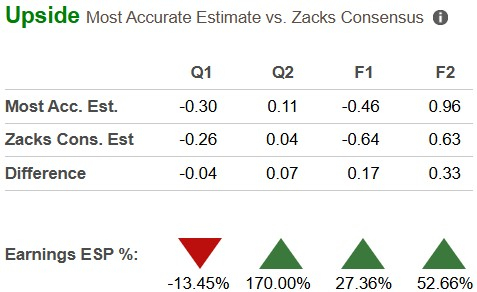
The Zacks Consensus Estimate for SpaceX’s second-quarter revenues is pegged at $6.72 billion, implying a sharp jump from $4.69 billion in the first quarter of 2026. However, profitability remains elusive, with the consensus estimate calling for a loss of 26 cents per share.
Our proven model does not predict an earnings beat for SpaceX for the second quarter. The combination of a positive Earnings ESP and a Zacks Rank #1 (Strong Buy), 2 (Buy) or 3 (Hold) increases the chances of an earnings beat. This is not the case here. You can uncover the best stocks to buy or sell before they’re reported with our Earnings ESP Filter.
SpaceX currently has an Earnings ESP of -13.45% and a Zacks Rank #3. You can see the complete list of today’s Zacks #1 Rank stocks here.
 Image Source: Zacks Investment Research
SpaceX now reports results across three distinct businesses— Space, Connectivity, and AI — and each tells a very different story. Connectivity, led by Starlink, is the company’s only consistently profitable segment. AI is growing rapidly but consuming enormous amounts of capital, while the Space business continues to require heavy investment as Starship development advances.
AI: The Expensive Bet
The AI segment, built around the company’s February merger with xAI, is both the fastest-growing part of the business and its biggest drag on profitability. In the first quarter of 2026, it generated $818 million in revenues but incurred a $2.46 billion operating loss and negative adjusted EBITDA of $609 million. Capital spending told an even more dramatic story– $7.7 billion poured into the AI segment alone in a single quarter, dwarfing the $1.05 billion spent on Space and $1.33 billion on Connectivity.
That spending is chasing large contracts. SpaceX has agreements to rent AI data center capacity to both Anthropic (worth $1.25 billion a month through May 2029, which began ramping in May and June) and Alphabet‘s GOOGL Google ($920 million a month, not yet started).
Investors will be looking for updates on additional customer wins, progress in AI infrastructure deployment and management’s long-term vision for launching AI compute satellites aboard Starship. Elon Musk has said Tesla‘s TSLA AI chip effort will eventually be aimed at “space-based AI compute,” a sign that orbital data centers are becoming a running theme across his companies.
Commentary on “Nameplate Compute Draw,” which tracks installed GPU capacity, will also be closely watched as an indicator of how quickly AI capacity is expanding.
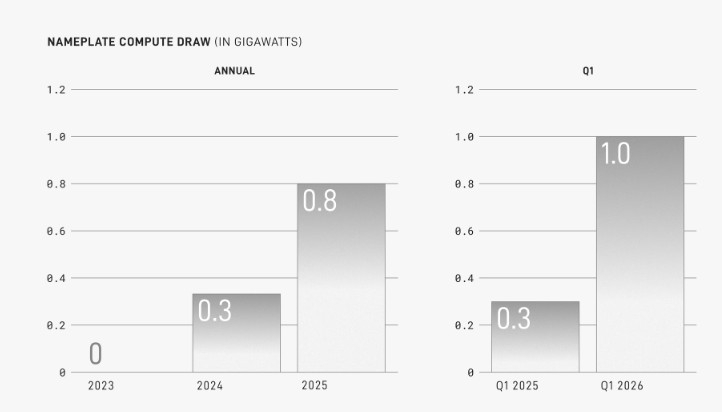 Image Source: SpaceX
Connectivity: The Profit Engine
If AI is the expensive experiment, Connectivity— anchored by Starlink— is what actually pays the bills. The segment generated $3.26 billion in the first quarter of 2026 in revenues, $1.19 billion in operating income, and $2.09 billion in segment adjusted EBITDA, making it the only one of the three segments solidly in the black.
Subscriber growth will be one of the key metrics to watch. Starlink had roughly 10.3 million subscribers at the end of the first quarter of 2026, more than double the 5 million reported a year earlier.
But the number that deserves more scrutiny is average revenue per user, which fell from $86 a month to $66 a month year over year. The decline isn’t a one-off. Management has said it expects ARPU to keep sliding as Starlink expands into international and lower-priced markets. The real question for the to-be-reported quarter isn’t whether subscribers keep growing (they almost certainly will), but whether margin expansion elsewhere can offset the steady erosion in what each customer pays.
Space: The Original Business, Still Unprofitable
The Space segment— Falcon and Starship launches— remains the smallest and least profitable of the three, with $619 million in first-quarter revenues and a $662 million operating loss. SpaceX launched 40 Falcon rockets in the first quarter, and Starship completed its 13th flight test in July.
Investors will be watching for an update on flight 14, along with any fresh disclosure on Starship’s ballooning costs— development spending has reportedly topped $15 billion to date. This segment is less about near-term profit and more about proving the long-term platform (including that AI-satellite ambition) actually works.
Guidance Could Matter More Than the Quarter
Perhaps the biggest catalyst won’t be the quarterly numbers themselves.
SpaceX has never issued formal financial guidance. If management provides expectations for the remainder of 2026— and maybe a glimpse into 2027—it would help investors to better evaluate the company’s aggressive investment strategy.
Final Thoughts
For now, the story is simple. Starlink funds the ambition, Starship tests the platform, and AI is the expensive bet that could define the next several years.
The central question is whether Starlink’s strong profitability can continue funding the company’s capital-intensive AI and Space businesses without placing excessive strain on its financials.
If the Connectivity unit continues generating robust cash flows while AI contracts ramp and Starship development progresses, investors may remain patient with near-term losses. Otherwise, rising capital expenditures and an uncertain path to profitability could continue weighing on sentiment.
Beyond Nvidia: AI’s Second Wave Is Here
The AI revolution has already minted millionaires. But the stocks everyone knows about aren’t likely to keep delivering the biggest profits. AI’s second wave is moving from infrastructure to implementation and these companies are at the forefront of this transition, positioned to become what Amazon and Google were to the internet era.
Space Exploration Technologies Corp. (SPCX) : Free Stock Analysis Report
Tesla, Inc. (TSLA) : Free Stock Analysis Report
Alphabet Inc. (GOOGL) : Free Stock Analysis Report
This article originally published on Zacks Investment Research (zacks.com).
5 Stocks Our Experts Predict Could Double In the Next Year
By submitting your email, you'll also get a free pivot & flow membership. A free daily market overview. You can unsubscribe at any time.