A weaker yen and improving corporate sentiment are supporting Japan’s equity market, but the chart suggests bulls still have one important hurdle to clear.
- Bulls stumble at trendline resistance
- Business confidence climbs to multi-year highs
- Weaker yen reinforces constructive backdrop
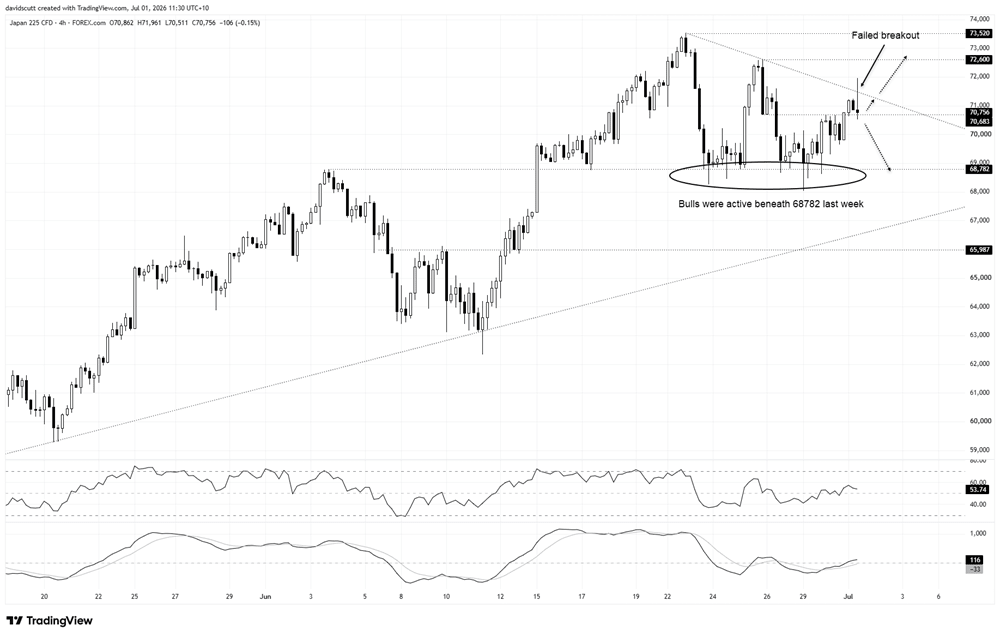
A battle between bulls and bears is underway after a failed breakout attempt at trendline resistance, leaving 70,683 as the key near-term battleground.
While the failed breakout may disappoint the bulls, the broader technical picture remains constructive. The repeated defence of 68,782, the early June swing high, remains the standout feature on the H4 timeframe, with buyers repeatedly stepping in at or beneath the level over the past week. That suggests demand remains healthy despite the latest rejection.
Having previously acted as both support and resistance, 70,683 is now emerging as the key near-term battleground. How the price behaves around the level may prove informative on near-term directional risks.
Source: TradingView
A convincing bounce from 70,683 would shift the focus back to trendline resistance, with a sustained break of that level potentially opening the door for a retest of the June 25 swing high at 72,600 and, beyond that, the record high at 73,520. Conversely, a break beneath 70,683 would open the door for a potential retracement towards support at 68,782.
The message from the oscillators is mixed. RSI (14) has recovered towards the neutral 50 level, while MACD has crossed above its signal line from below and flipped back into positive territory. Together, they suggest upside momentum is marginally in the ascendancy rather than decisively bullish, leaving price action the more important guide for the near-term outlook.
Much like the longer-term price action, the broader fundamental backdrop remains constructive for the bulls. The has slid to fresh 40-year lows against the , and historic lows against a basket of currencies as seen below, with little sign that Japanese authorities are willing to fight the prevailing trend via outright intervention, as was seen earlier this year.
Source: TradingView
Although Japanese officials have remained publicly critical of yen weakness, the currency’s depreciation appears to be providing a strong tailwind for Japan’s export-oriented equity market.
The latest quarterly Bank of Japan Tankan survey showed sentiment among large manufacturers climbed to its highest level since 2018, while confidence among non-manufacturers reached its strongest level since 1991. Importantly, the survey was largely completed before the U.S.-Iran memorandum of understanding was signed, triggering the 60-day ceasefire and subsequent decline in energy prices. If lower energy costs persist alongside a weaker yen, the backdrop for Japan’s export sector may become even more supportive.
The relationship between the yen and Japanese equities has also strengthened recently. The rolling 20-day correlation coefficient between the index and USD/JPY sits at 0.71, the strongest reading since late January, suggesting the weaker yen may once again be providing a tailwind for Japanese equities, particularly those with large offshore earnings.
5 Stocks Our Experts Predict Could Double In the Next Year
By submitting your email, you'll also get a free pivot & flow membership. A free daily market overview. You can unsubscribe at any time.