When Warner Music Group WMG reported its fiscal third-quarter earnings, the music entertainment company had analysts on the edge of their seats. Expectations were high, with forecasts predicting earnings per share of 27 cents and sales of $1.56 billion. The reality fell just shy of these figures, as EPS landed at 27 cents on revenue of $1.55 billion.
Comparing to the year-ago quarter, Warner Music’s numbers looked slightly better. The company posted 27 cents with a total revenue of $1.56 billion, outperforming the expected 20 cents on $1.47 billion in revenue.
Despite a 2.4% drop in revenue for Warner’s recorded music segment to $1.25 billion in Q3, there was a notable 7.8% increase in music publishing sales to $305 million. Not to be outdone, digital revenue also saw a 5% boost year-over-year, reaching $1.08 billion, driven by increased streaming activity.
Moreover, adjusted OIBDA surged by 6.4% to $316 million, with a 130 basis points improvement in the margin to 20.3%. Warner Music CEO Robert Kyncl attributed this success to the company’s content advantage and favorable industry trends that boosted subscription streaming growth.
Looking forward, anticipation looms as analysts project a rise in EPS to $1.33 by the end of the year, marking a nearly 27% increase from the previous year. Sales are expected to hit $6.44 billion, up by 6.7% from the previous year’s $6.04 billion. The fiscal year 2025 is predicted to bring further expansion, with EPS soaring to $1.49 on sales of $6.75 billion.
Peering beyond the financials, a potentially lucrative shift awaits the music entertainment industry on a global scale. MIDiA Research forecasts that music industry revenue could surpass $100 billion by 2031, spurred by expanding music platform subscribers that may exceed one billion in 2027.
Driving this growth is the industry’s expansion into the Global South, with MIDiA projecting China to become the second-largest recorded music market by 2031.
The MUSQ ETF offers investors a convenient avenue to tap into the evolving global music industry. By investing in the MUSQ Global Music Industry ETF MUSQ, they gain exposure not only to Warner Music Group but also to other major players like Universal Music Group UMGNF and Tencent Music Entertainment Group TME. The ETF’s holdings even extend to small-cap entities such as Reservoir Media RSVR.
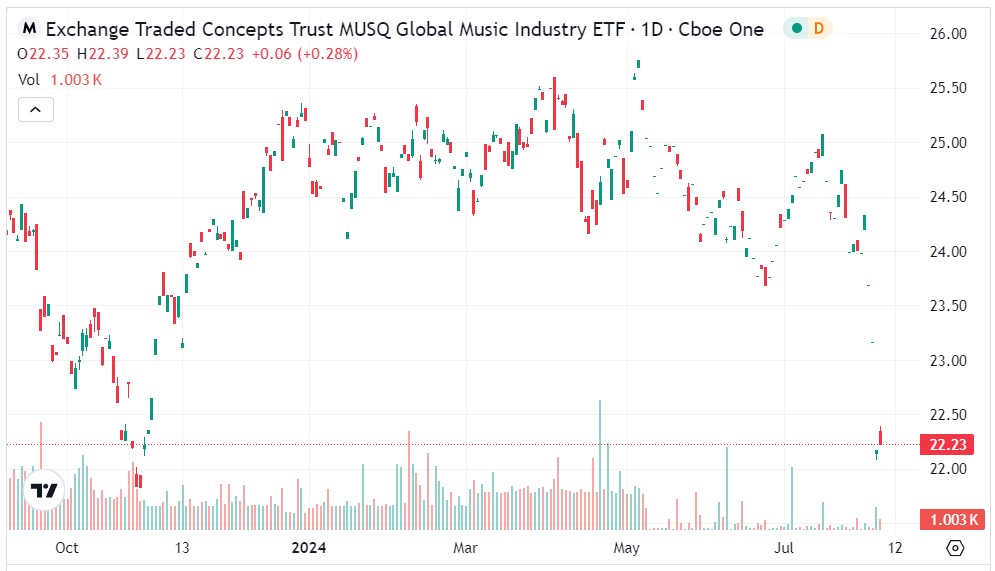
The MUSQ Chart tells a tale of resilience amidst market volatility. Despite setbacks during recession fears, MUSQ is now positioned attractively in response to global economic shifts.
- Currently, MUSQ has shown a 1.4% gain in Wednesday’s trading session, aiming to surpass the psychological barrier at $23, which currently acts as resistance.
- For bullish investors, breaking through the upper support at $24.20 is the next target, followed by a plausible rally towards the $25 mark.
- Notably, as music-related enterprises climb during the midweek, MUSQ is poised to capitalize on the upward trend.

Featured image by Bob McEvoy from Pixabay
5 Stocks Our Experts Predict Could Double In the Next Year
By submitting your email, you'll also get a free pivot & flow membership. A free daily market overview. You can unsubscribe at any time.