Understanding Brokerage Recommendations
When it comes to making investment decisions, Wall Street analysts wield significant influence. Investors often rely on the advice of these analysts before deciding whether to buy, sell, or hold a stock. The question, though, is whether these recommendations truly matter.
Bearing in mind your hard-earned cash, let’s delve into the insights of Wall Street heavyweights and their wager on UnitedHealth Group (UNH), alongside discussions on brokerage recommendations’ reliability and how to exploit them to your advantage.
UnitedHealth Group’s Brokerage Recommendations
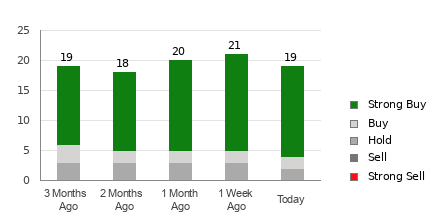
UnitedHealth presently holds an average brokerage recommendation (ABR) of 1.33 on the scale of 1 to 5. Unpacked, that falls between Strong Buy and Buy. The ABR is derived from the cumulative recommendations of 20 brokerage firms, with 16 Strong Buy and 2 Buy, forming 80% and 10% of all suggestions, respectively.
Onto the more perennial trends, the ABR trend for UNH is a spectacle in itself. However, before partaking in impulsive investment decisions, studying its efficacy would be sagacious. Research shows that there is little, if any, proven track record of brokerage recommendations being a reliable ecosystem guiding investors to stocks poised for substantial price appreciation.
So, what’s the catch? It emerges that brokerage firms, due to their intrinsic interest in the stocks they cover, tend to bandage them with an overtly positive bias. For each “Strong Sell” recommendation, they bestow five “Strong Buy” recommendations. In essence, their interests are not always attuned with common investors, infrequently depicting where a stock’s price could actually head. Consequently, these insights are best used to corroborate one’s personal research or as an indicator with a track record of predicting stock price movements.
The Efficacy of Zacks Rank
In vouchsafing a credible track record, Zacks Rank offers a reliable gauge of a stock’s near-term price performance. An unconditional assurance, the Zacks Rank classifies stocks into five quintiles, ranging from Zacks Rank #1 (Strong Buy) to Zacks Rank #5 (Strong Sell). Thus, aligning the Zacks Rank with ABR could be pivotal in charting an astute investment trajectory.
Comparing ABR and Zacks Rank
Even though ABR and Zacks Rank share a numerical scale from 1 to 5, they represent divergent measures. ABR is simply a function of brokerage recommendations, quantified in decimals, whereas Zacks Rank, a quantitative model reliant on earnings estimate revisions, displays a whole number from 1 to 5.
Broker recommendations are steeped in optimism, while Zacks Rank is underpinned by earnings estimate revisions. It’s been established that near-term stock price movements align closely with trends in earnings estimate revisions. Recalling the roots of empirical research, this correlation stands steadfast.
Moreover, Zacks Rank evenly applies its various grades to all stocks, thus preserving a balanced hierarchy. Another distintion is that while ABR might not always be up-to-date, Zacks Rank swiftly reflects the revisions made by brokerage analysts to capture a company’s evolving business dynamics, ensuring timely insights into future price movements.
Should You Invest in UnitedHealth?
As per the earnings estimate revisions for UnitedHealth, the Zacks Consensus Estimate for the current year has experienced a stagnant 0% change over the past month, settling at $27.81. With analysts displaying an increasingly glum outlook on the company’s earnings prospects, homogeneity in downgrading EPS estimates presages an imminent stock slump.
Alluded to the recent shifts in the consensus estimate, alongside other pivotal factors related to earnings estimates, UnitedHealth shoulders a Zacks Rank #4 (Sell). In view of this, prudence in reconsidering the Buy-equivalent ABR for UnitedHealth would be the quintessence of wisdom.
Zack’s Investment Research claims no proprietary interest in UnitedHealth (UNH). Commensurately, the hasty frenzy to accede to brokerage recommendations must be tempered with discernment built on a foundation of holistic research and a multi-faceted investment strategy.
5 Stocks Our Experts Predict Could Double In the Next Year
By submitting your email, you'll also get a free pivot & flow membership. A free daily market overview. You can unsubscribe at any time.