When it comes to making investment decisions, many investors turn to analyst recommendations for guidance. The buzz surrounding rating changes by these sell-side analysts can sway a stock’s valuation, but how much weight should you give these opinions?
Let’s delve into what industry experts are saying about Leidos (LDOS) as we unpack the significance of brokerage recommendations and how you can leverage them to your advantage.
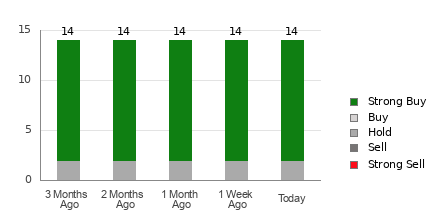
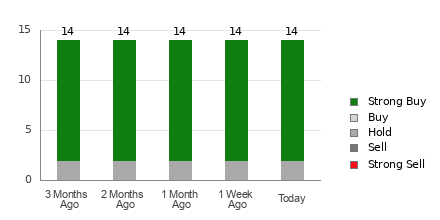
Currently, Leidos boasts an average brokerage recommendation (ABR) of 1.29, falling between a Strong Buy and a Buy on a scale of 1 to 5. This number is an amalgamation of ratings given by 14 brokerage firms, of which 12 suggest a Strong Buy – a solid 85.7% of all recommendations.
The Trend of Brokerage Recommendations for LDOS
The ABR points toward an endorsement of Leidos, but relying solely on this metric may not be prudent. Studies reveal that brokerage recommendations often fall short in identifying stocks poised for substantial price appreciation.
Why is this the case? Analysts working for brokerage firms have a vested stake in the stocks they cover, commonly resulting in an overly optimistic bias. In fact, research indicates that for every “Strong Sell” rating, there are five “Strong Buy” ratings – a glaring discrepancy in the objectivity of analyst recommendations.
Thus, instead of viewing these recommendations as gospel truth, they may be best used to corroborate your independent research or as a secondary viewpoint to supplement a more reliable indicator of a stock’s future trajectory.
Our proprietary tool, Zacks Rank, stands out as a robust stock evaluation mechanism with a track record scrutinized by external auditors. This model classifies stocks into five categories, from Zacks Rank #1 (Strong Buy) to Zacks Rank #5 (Strong Sell), offering a dependable gauge of a stock’s near-term performance. Hence, cross-referencing the ABR with the Zacks Rank can aid in making well-informed investment decisions.
Distinguishing ABR from Zacks Rank
Although both ABR and Zacks Rank employ a 1 to 5 scale, they diverge significantly in essence.
ABR hinges solely on brokerage recommendations, typically depicted in decimal form like 1.28. Conversely, Zacks Rank relies on a quantitative model that leverages earnings estimate revisions and is represented in whole numbers from 1 to 5.
Broker analysts’ penchant for positivity often skews their ratings, contradicting the substance of their appraisals. On the flip side, the Zacks Rank pivots on earnings estimate revisions, which, as empirical studies indicate, closely correlate with short-term stock price movements.
Another salient disparity pertains to timeliness. While ABR may lag in real-time updates, the Zacks Rank swiftly reacts to changing business dynamics, ensuring its continual relevance in predicting future price actions.
Is Leidos (LDOS) a Viable Investment?
Recent data reveals a 2.5% surge in the Zacks Consensus Estimate for Leidos this year, landing at $8.97.
The communal optimism among analysts, evident through their unanimity in raising EPS projections, could fuel Leidos’ ascent in the immediate future.
This pronounced shift in consensus estimates, coupled with other favorable indicators, has earned Leidos a Zacks Rank #1 (Strong Buy), signifying a ripe opportunity for investors. For a comprehensive list of Zacks Rank #1 stocks, click here.
Hence, the ABR, aligned with a Buy-equivalent stance, could serve as a strategic compass for potential investors.
Free: See Our Top Stock And 4 Runners Up
Leidos Holdings, Inc. (LDOS) : Free Stock Analysis Report
5 Stocks Our Experts Predict Could Double In the Next Year
By submitting your email, you'll also get a free pivot & flow membership. A free daily market overview. You can unsubscribe at any time.