Intel Corporation INTC and Qualcomm Incorporated QCOM are two premier U.S.-based semiconductor firms focusing on AI (artificial intelligence), advanced chip technologies and the data center semiconductor ecosystem. Both are competing hard in the AI-powered PC processor market, with Intel pushing Xeon-based AI infrastructure and Qualcomm expanding its AI accelerator and data-center CPU roadmap, expanding its Snapdragon X lineup into Windows laptops and desktops.
Intel is currently focusing on AI chips for data centers and PCs, which marks one of the largest architectural shifts for the company in 40 years. The decision is primarily aimed at gaining a firmer footing in the expansive AI sector, spanning cloud and enterprise servers to networks, volume clients and ubiquitous edge environments, in tune with the evolving market dynamics. The foundry operating model is a key component of the company’s strategy and is designed to reshape operational dynamics and drive greater transparency, accountability and focus on costs and efficiency.
Qualcomm offers high-performance, low-power chip designs for mobile devices, PCs, XR (Extended Reality), automotive, wearable, robotics, connectivity and AI use cases. The company boasts a comprehensive intellectual property portfolio comprising 4G, 5G and other technologies. Qualcomm’s brands include Snapdragon systems-on-chip, FastConnect Wi-Fi and Bluetooth systems, and Qualcomm-branded 4G, 5G and IOT equipment. The company is currently integrating on-device generative AI into all of its product lines.
Let us try to analyze some of the competitive strengths and weaknesses of the companies to understand who is in a better position to maximize gains from the emerging market trends.
The Case for INTC
Intel is witnessing healthy traction in AI PCs that have taken the market by storm. Its innovative AI solutions are set to benefit the broader semiconductor ecosystem by driving down costs, improving performance and fostering an open, scalable AI environment. The proliferation of generative AI applications is driving significant investments in data center infrastructure. Although GPUs remain at the center of AI computing, CPUs continue to play an important role in supporting AI workloads. This is creating incremental opportunities for Intel’s Xeon portfolio. The momentum is encouraging as AI-related infrastructure spending is likely to remain healthy, providing Intel with an opportunity to capitalize on rising compute requirements.
Intel is ramping Panther Lake and Wildcat Lake products based on its advanced 18A process technology. Increasing adoption of these products, coupled with an eventual enterprise PC refresh cycle, should support the client business over the long run. The company is also expanding its presence in edge computing and physical AI applications, including robotics. These emerging markets could broaden Intel’s addressable opportunity beyond traditional PCs.
However, Intel derives a significant part of its revenues from China. As Washington tightens restrictions on high-tech exports to China, Beijing has intensified its push for self-sufficiency in critical industries. This shift poses a dual challenge for Intel, as it faces potential market restrictions and increased competition from domestic chipmakers. The company is also lagging in the GPU and AI front compared to peers, such as NVIDIA Corporation NVDA and Advanced Micro Devices, Inc. AMD. Leading technology companies are reportedly piling up NVIDIA’s GPUs to build computing clusters for their AI work, driving exponential revenue growth.
The Case for QCOM
Qualcomm is well-positioned to meet its long-term revenue targets, driven by solid 5G traction, greater visibility and a diversified revenue stream. The company is increasingly focusing on the seamless transition from a wireless communications firm for the mobile industry to a connected processor company for the intelligent edge. Qualcomm is witnessing healthy traction in edge networking, which helps transform connectivity in cars, business enterprises, homes, smart factories, next-generation PCs, wearables and tablets. The automotive telematics and connectivity platforms, digital cockpit and C-V2X solutions are also fueling emerging automotive industry trends such as the growth of connected vehicles, the transformation of the in-car experience and vehicle electrification.
The company is aiming to extend its Oryon CPU and AI acceleration beyond smartphones into PCs and servers. Management observed that its 2026 Snapdragon X2 PC platforms are in production and positioned to enable always-on agentic experiences, supported by a Hexagon NPU delivering up to 85 TOPS. Qualcomm is entering the custom silicon space with a leading hyperscaler and expects initial shipments in the December quarter, adding a revenue stream that is not tied to handset unit cycles. The Alphawave buyout has added high-speed wired connectivity IP and custom silicon capabilities to help accelerate the company’s expansion into data centers.
Despite efforts to ramp up its AI initiatives, Qualcomm has been facing tough competition from Intel in the AI PC market. A shift in the share among OEMs at the premium tier has reduced Qualcomm’s near-term opportunity to sell integrated chipsets from the Snapdragon platform. Memory supply constraints and related pricing are adversely impacting its handset revenues as OEMs (particularly in China) continue to draw down channel inventory.
How Do Zacks Estimates Compare for INTC & QCOM?
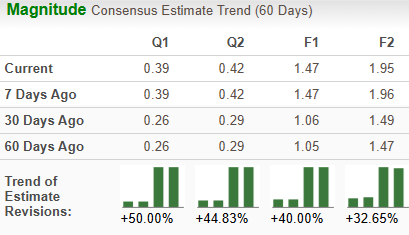
The Zacks Consensus Estimate for Intel’s 2026 sales implies year-over-year growth of 17.5%, while that for EPS indicates a surge of 250%. The EPS estimates have trended up 40% over the past 60 days.

Image Source: Zacks Investment Research
The Zacks Consensus Estimate for Qualcomm’s fiscal 2026 sales indicates a year-over-year decline of 2.8%, while that for EPS suggests a fall of 12.1%. The EPS estimates have trended down 1.6% over the past 60 days.

Image Source: Zacks Investment Research
Price Performance & Valuation of INTC & QCOM
Over the past year, Intel has surged a stellar 339.7% compared with the industry’s growth of 26.3%. Qualcomm has gained 3.9% over the same period.

Image Source: Zacks Investment Research
Qualcomm looks more attractive than Intel from a valuation standpoint. Going by the price/sales ratio, Intel’s shares currently trade at 7.33 forward sales, higher than 3.88 for Qualcomm.
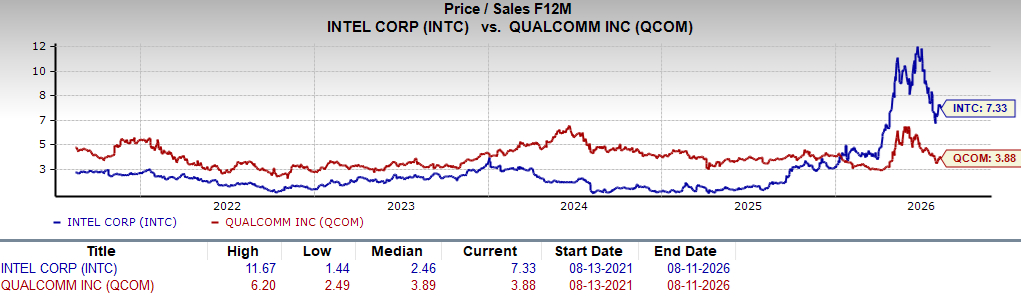
Image Source: Zacks Investment Research
INTC or QCOM: Which is a Better Pick?
Intel currently carries a Zacks Rank #3 (Hold). You can see the complete list of today’s Zacks #1 Rank (Strong Buy) stocks here.
Qualcomm currently carries a Zacks Rank #4 (Sell).
Intel expects revenues and earnings to improve in 2026, unlike Qualcomm. In terms of price performance, Intel has outperformed Qualcomm, although it is trading a bit expensively. With a better Zacks rank, solid fundamentals and healthy growth potential, INTC appears to be relatively better placed than QCOM. Consequently, Intel is a better investment option at the moment.
Beyond Nvidia: AI’s Second Wave Is Here
The AI revolution has already minted millionaires. But the stocks everyone knows about aren’t likely to keep delivering the biggest profits. AI’s second wave is moving from infrastructure to implementation and these companies are at the forefront of this transition, positioned to become what Amazon and Google were to the internet era.
Intel Corporation (INTC) : Free Stock Analysis Report
QUALCOMM Incorporated (QCOM) : Free Stock Analysis Report
Advanced Micro Devices, Inc. (AMD) : Free Stock Analysis Report
NVIDIA Corporation (NVDA) : Free Stock Analysis Report
This article originally published on Zacks Investment Research (zacks.com).
5 Stocks Our Experts Predict Could Double In the Next Year
By submitting your email, you'll also get a free pivot & flow membership. A free daily market overview. You can unsubscribe at any time.