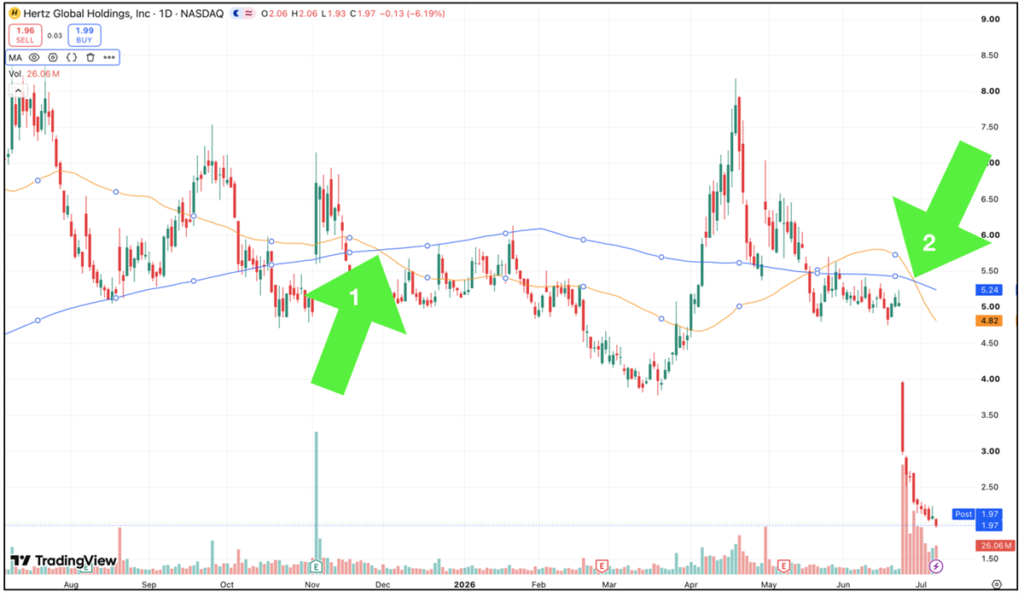
Of all the bearish indicators in technical analysis, there is perhaps none more ominous than the death cross.
For beaten-down stocks, the trend confirmation pattern pops up when the short-term 50-day moving average crosses beneath the long-term 200-day moving average, suggesting more downside price action may be ahead.
And while sharp pullbacks and corrections can often indicate a looming price bottom, potential reversal, and trigger a buying opportunity, the death cross—in many instances—can signal that bearish momentum is strengthening.
That is likely the case for Hertz Global Holdings and Kinross , as sentiment, ratings, and fundamentals support what the death cross has already suggested. For investors on the hunt for value buys, consider leaving these two stocks off your watchlist.
Hertz: Dilution, Depreciation, and a Slashed Profit Outlook
Hertz has been here before, and not long ago.
The previous instance of a death cross pattern on Hertz’s one-year chart was on Nov. 28.
That was followed by a 26% loss before the stock bottomed and rallied through its year-to-date high on April 20.
But a multitude of factors—many of which have remained in place since the prior death cross—came to a head in Q2. Hertz lowered its guidance to a range of $50 million to $80 million as weaker used-car values increased depreciation pressure across its rental fleet. At the same time, investor sentiment has deteriorated further as the company raised capital through a $350 million debt package and a related $100 million borrowed-share offering, which involved more than 37 million borrowed shares and raised concerns about leverage and dilution.
Those factors culminated in a 41% single-day loss on June 24. Then, in early July, a second death cross displayed on Hertz’s one-year chart.
 The stock recently hit a fresh 52-week low after losing nearly 60% in the past month alone, and around 70% over the past year. Since its five-year high in November 2021, has plummeted more than 94%.
Hertz has missed on earnings 10 out of the last 13 quarters. In Q1, the company reported a 92% year-over-year reduction in operating cash flow growth, while earnings per share (EPS) growth slipped more than 130% from the prior quarter.
On June 30, Morgan Stanley lowered its price target on Hertz from $5 to $3.50. The stock carries a consensus Reduce rating, short interest now exceeds 17% of the float, and HTZ now sports a beta of 2.2, suggesting its recent bout of volatility is not yet in the rearview mirror.
As Gold Tumbles, So Too Does Kinross
Since the start of 2024, Kinross Gold has mirrored the record-setting gains in the precious metals market.
That years-long rally was good to gold stocks in general, but it was particularly beneficial to Kinross, which operates six active gold mines located in Brazil, Mauritania, and the United States.
The stock has gained more than 550% from January 2024 to Jan. 28, 2026, when it hit its all-time high (ATH).
But Q2 told a different tale. After gold prices experienced their worst quarterly performance in 13 years, Kinross lost favor among commodities traders.
 Since its ATH, the stock is down more than 39%, and on the last day of June, a death cross emerged on ’s one-year chart:
Since Kinross’s performance is closely tied to the , the stock sold off alongside the precious metal as investors locked in profits following a multi-year run-up. Gold is now mired in a bear market as a rebound in the U.S. dollar, and rising inflation has led to speculation about interest rate hikes that, if they materialize, will continue to incentivize investors to rotate out of the metal and into yield-generating securities.
Kinross beat earnings in 13 of the last 14 quarters, and in 2025, the Toronto-based mining company reported record revenue, net income, and free cash flow. But the company’s forward production guidance is mostly flat at around 2 million ounces per year through 2027.
At the same time, CapEx has grown more than 56% from $764 million in 2022 to nearly $1.2 billion last year. Despite a Moderate Buy rating, short interest is currently 26% higher than it was the month prior, while institutional selling has increased for four out of the past five quarters.
5 Stocks Our Experts Predict Could Double In the Next Year
By submitting your email, you'll also get a free pivot & flow membership. A free daily market overview. You can unsubscribe at any time.