The just reminded everyone how fast things break when fear takes the wheel.
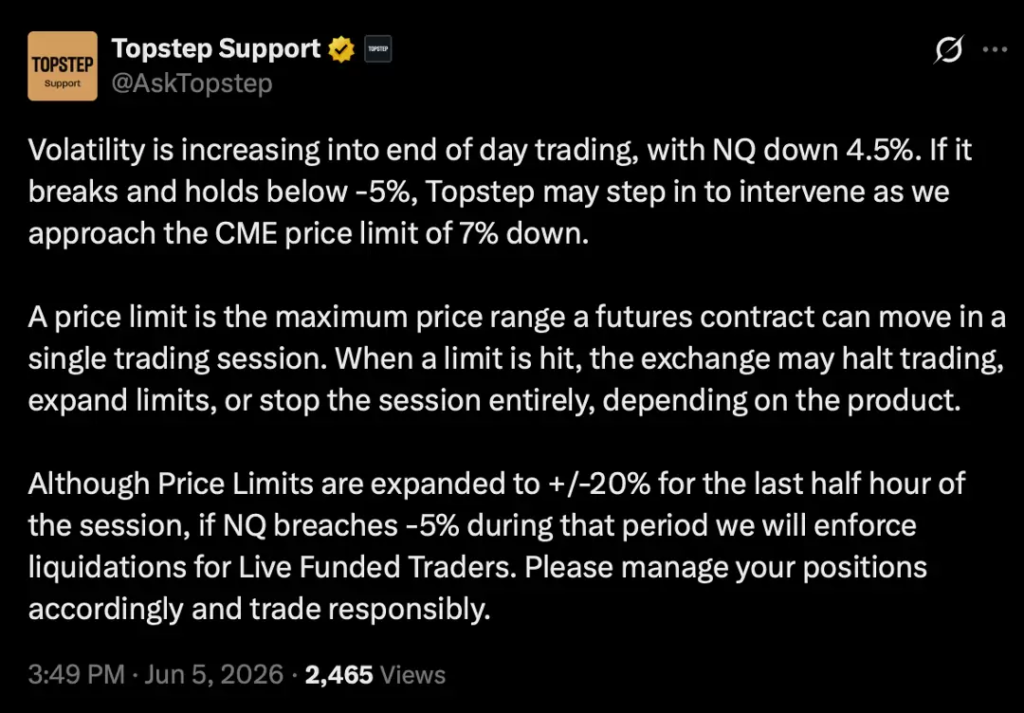
Down nearly 2% on Wednesday. Down more than 4% on Friday, June 5, volatility has returned to the market in a big way. Sharp intraday swings, widening ranges, and rapidly changing sentiment have become the norm rather than the exception
Most traders are asking the obvious question: Does the selloff continue, or do buyers finally step in?
But veteran futures traders know something the crowd doesn’t. In extreme volatility, the biggest risk isn’t always on the chart.
Sometimes it’s buried in the rulebook.
and traders learned this the hard way. When the CME hiked margin requirements during the metals collapse, prop traders were shut out of trading metals. The lesson was brutal and simple: market structure can hurt you just as badly as market direction.
Now it’s Nasdaq traders’ turn to pay attention, because there’s another exchange rule that almost never matters… until the one day it absolutely does.
CME price limits.
Why Price Limits Matter
The CME uses price limits and circuit breakers as a pressure release valve. When markets fall too far, too fast, these safeguards kick in to slow panic selling and give traders time to digest whatever just hit the tape.
On a normal day, you’ll never think about them.
But when volatility spikes, price limits go from footnote to front page. As contracts grind toward those levels, liquidity dries up, spreads blow out, and managing risk gets exponentially harder.
That’s exactly why futures prop firms watch these thresholds like hawks, especially when live funded traders are involved.
It’s Not Just a CME Rule
Here’s the misconception that costs traders money: thinking exchange rules only matter if the limit actually gets hit.
Wrong.
Many prop firms run their own internal risk controls that trigger long before the CME limit comes into play.
In the recent selloff, some firms like Topstep warned traders directly: if kept sliding, losing more than 5% in one day, they may intervene before the CME’s price limit of 7% down.
And this isn’t one firm being trigger-happy. Similar policies exist across the entire futures prop industry. The fine print varies from firm to firm, which is exactly why you should read your firm’s risk disclosures before the volatility hits, not after.
What Makes Live Accounts Different
If you’re grinding through a simulated evaluation, CME price limits probably feel like someone else’s problem.
If you’re trading a live funded account, they’re very much your problem.
When firms carry real market exposure, everything changes. A market in freefall toward exchange limits it threatens the prop firms directly and they get conservative fast, often without changing a single word of their published trading rules.
The Lesson From Gold
The gold selloff proved that markets answer to more than support and resistance.
Exchange rules. Margin requirements. Firm risk controls. Most days, these forces sit quietly in the background. During a major volatility event, they take over the show.
Nasdaq traders, take note.
NQ doesn’t need to actually touch a CME price limit to wreck your trading day. As volatility climbs, firms start managing risk long before the exchange safeguards ever trigger.
Gold showed us why that gap is dangerous. If volatility comes roaring back to Nasdaq futures, CME price limits and your prop firm’s risk policies could matter just as much as your strategy.
CFD Prop Traders: A Different System
If you trade Nasdaq (NQ) with a CFD prop firm like Hola Prime, FundedNext and IC Funded, CME margins do not apply. CFDs are not traded on exchanges. They are issued by brokers or by a prop firm’s CFD liquidity and price providers.
This means:
No CME margin
No settlement rules
No exchange liquidations.
Your risk comes from your broker and your prop firm’s pricing and execution, not from the CME. You still face volatility, spread widening, and slippage in metals, but for different reasons.
Spend a few minutes now learning how your firm handles price-limit events. It’s the cheapest insurance you’ll ever buy, and you’ll be glad you have it when the market is moving at its fastest.
5 Stocks Our Experts Predict Could Double In the Next Year
By submitting your email, you'll also get a free pivot & flow membership. A free daily market overview. You can unsubscribe at any time.