The semiconductor sector, fueled by the rapid adoption of artificial intelligence (AI) technology across various industries, has witnessed significant growth. The PHLX Semiconductor Sector index has soared by a commendable 20% in 2024, propelled by technologies used in data centers, smartphones, and personal computers.
Nvidia, listed as NASDAQ: NVDA, has emerged as a dominant force in the AI chip industry, registering an impressive 135% increase in its stock value this year. The company reigns supreme in the AI graphics processing unit (GPUs) market, boasting a colossal market share of 94% as of 2023.
On the contrary, Advanced Micro Devices (AMD), with the NASDAQ ticker AMD, has faced modest growth of 6% amid tepid revenue and earnings expansion in comparison to Nvidia. Will Nvidia continue to outshine AMD as the preferred AI stock, or can AMD’s growing AI capabilities ignite a resurgence in its stock performance?
Evaluating Nvidia’s Dominance
Nvidia’s unrivaled position in AI GPUs underscores its superiority over AMD. The company’s data center revenue soared to a record $26.3 billion in the last quarter, marking a remarkable 154% surge from the previous year.
Contrastingly, AMD reported data center revenue of $2.8 billion, representing a 115% year-over-year increase. In the AI chip market landscape, Intel generated $3 billion in data center and AI revenue, experiencing a slight 3% decline. However, Nvidia commands over 80% of the market share in this segment, eclipsing its competitors.
Nvidia’s robust data center revenue growth outpaced its rivals, reflecting sustained demand for its chips. Customers are eagerly anticipating the release of Nvidia’s Blackwell chips, succeeding the Hopper AI GPUs, with predicted soaring demand heading into 2025.
Projections by KeyBanc analyst John Vinh estimate Nvidia’s data center business to rake in a monumental $200 billion in revenue by 2025, surpassing the $140 billion consensus forecast. Amidst the current fiscal year’s $49 billion in data center sales, Nvidia is on track to achieve nearly $100 billion in revenue by fiscal 2025.
With the impending introduction of Blackwell processors, Nvidia anticipates a substantial revenue boost, commencing production in the fourth quarter of the present fiscal year. Analysts foresee significant revenue growth in the following year, with UBS’s Timothy Arcuri predicting a revenue target of $204 billion for Nvidia in calendar 2025.
This anticipated growth trajectory solidifies Nvidia’s status as a premier AI stock, poised to deliver remarkable revenue and earnings expansion.
Deciphering the Potential of AMD
A stark contrast emerges in AMD’s performance within the AI data center GPU market, trailing far behind Nvidia. While Nvidia eyes data center revenue eclipsing $100 billion this year, AMD’s management sets sights on reaching $4.5 billion in data center GPU revenue for 2024, emphasizing a sizable gap in scale.
Nonetheless, AMD holds promise in tapping into AI’s growth potential across diverse sectors beyond data center GPUs. The company witnessed a notable 49% surge in client segment revenue, reaching $1.5 billion in Q2, driven by the strong demand for its Zen 5 Ryzen processors tailored for AI applications in personal computers (PCs).
AMD’s innovative processors integrate dedicated AI chips to facilitate local AI workloads on PCs and notebooks. Projections suggest that three-quarters of laptops shipped in 2027 will feature AI capability, with the AI PC market forecasted to achieve a robust 44% annual growth through 2028 by Canalys.
With a burgeoning presence in the client CPU market and controlling over a third of the space, AMD is well-positioned to leverage this burgeoning opportunity. Additionally, AMD’s data center business stands to benefit from the escalating demand for general-purpose server CPUs crucial for developing small AI models and inference needs.
Intel’s estimate of $24 billion in annual revenue by 2027 from general compute chips like server CPUs highlights AMD’s growth potential in the data center arena through AI applications. Despite current disparities, AMD holds significant room for expansion, leveraging AI technologies to drive future growth.
The Ever-Evolving Tussle in the Tech Jungle
Shifting Sands in the Chip Market
In the arena of high-tech giants, AMD continues to seize a bigger slice of the server CPU kingdom from Intel. Simultaneously, trends suggest that AMD’s footprint in the data center GPU market is poised for an expansion, even if it remains a subordinate force compared to Nvidia’s stronghold.
The Forecast and The Fiddle
For investors backing AMD, the outlook appears rosy as the company’s growth trajectory is set to gain momentum in the foreseeable future. However, the horizon favors Nvidia as the forecast predicts a pace of earnings development soaring at a compound annual growth rate of 52% over the next five years—far outstripping AMD’s projected 33% growth pace over the same span. Remarkably, Nvidia’s allure is amplified by its comparative cost-efficiency against AMD.

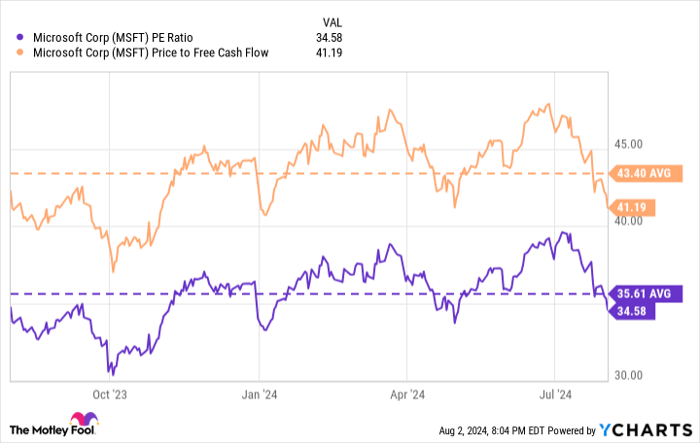
NVDA PE Ratio data by YCharts
Hence, those eyeing investments in the AI playground to leverage the surging AI chip arc may find Nvidia an enticing avenue—even post its significant gains in 2024. Given Nvidia’s dominant stance in this landscape, the prospect of substantial growth looms large.
The Million-Dollar Dilemma
Contemplating an investment of $1,000 in Nvidia? Ponder on this:
The Motley Fool Stock Advisor crew recently unearthed what they consider the 10 best stocks to bet on right now—and Nvidia didn’t make the cut. The elite 10 are anticipated to yield staggering returns in the years ahead.
Picture this: When Nvidia adjoined that list on April 15, 2005… Had you invested $1,000 based on our counsel, you’d be eyeing a jaw-dropping $760,130!
The Stock Advisor scheme equips investors with a user-friendly blueprint for triumph—featuring strategic insights on portfolio construction, routine updates from analysts, and a bi-monthly bestowal of two fresh stock picks. In terms of cumulative returns since 2002*, the Stock Advisor facility has surged beyond quadruple the S&P 500’s performance.
*Stock Advisor returns as of September 23, 2024
5 Stocks Our Experts Predict Could Double In the Next Year
By submitting your email, you'll also get a free pivot & flow membership. A free daily market overview. You can unsubscribe at any time.