Russ Cohen

Apple’s Legal and Regulatory Risks Spark Concerns

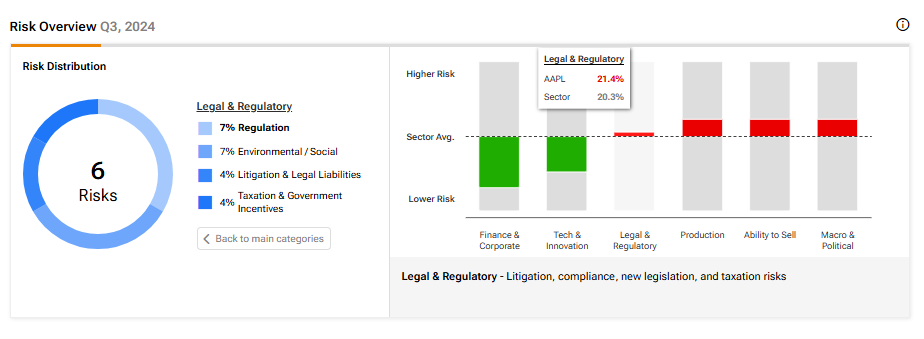
Like other big tech giants, Apple (AAPL) faces various legal challenges, including antitrust lawsuits and patent disputes. According to the TipRanks Risk Factors tool, one of AAPL’s main risk categories is Legal and Regulatory, which accounts for 21% of the total 28 risks identified. Moreover, the legal risk exposure is higher than the industry average of 20.3%.

Within the legal and regulatory category, Apple is subject to evolving laws and regulations globally, which can lead to potential liabilities and higher costs, thereby impacting its business operations. Also, Apple’s failure to meet its environmental, social, and governance (ESG) targets could result in liabilities and added costs.

Moreover, Apple is exposed to tax risks due to its global operations, including the possibility of changes in international and domestic tax rules. These legal challenges could impact its financial performance.

Looking at Apple’s Other Risk Categories

Similar to the Legal and Regulatory risk category, Ability to Sell also accounts for 21% of the total risks. Interestingly, the company’s exposure to this risk is higher than the industry average of 17.4%, which is a cause for concern.

Moving on, Production risks are next most significant for AAPL, accounting for 18% of total risks. Moreover, Technology and Innovation, as well as Finance and Corporate, each contribute 14% to the company’s overall risk profile. Lastly, Macro and Political factors make up 11% of Apple’s total risks.

Despite operating in a complex environment with numerous potential risks, Apple has shown resilience in effectively managing these challenges. The company’s successful risk management practices position it well for continued long-term performance.

See also  Unveiling the Intricacies of Wealth Growth Through Strategic PlanningThe Voyage of Wealth Creation: Embarking on the Financial Odyssey

The journey to financial stability and prosperity is not for the faint of heart. It requires commitment, a touch of daring, and most importantly, a well-thought-out plan. As seasoned investors will attest, the path to accumulating a substantial nest egg for retirement is rife with challenges and pitfalls. Yet, the key to success lies in unwavering perseverance and a dash of optimism.

Image source: Getty Images.

The Seed of Prosperity: Early Years of Wealth Cultivation

When venturing into the realm of long-term stock investment, the initial stages may seem lackluster. It's during these times that many falter, particularly when faced with market fluctuations or downturns. Stock market corrections are as much a part of the investment landscape as the sun rising each day. Yet, history has shown that perseverance pays off, with markets consistently recovering and reaching new heights.

Let's delve into the numbers and explore the potential growth of your investments. Assuming an annual contribution of $12,000 with an average growth rate of 8%, let's unravel the journey:

Growing at 8% For:

$12,000 Invested Annually Grows To:

Total You Invested:

1 year

$12,960

$12,000

2 years

$29,957

$24,000

3 years

$42,073

$36,000

4 years

$58,399

$48,000

5 years

$76,031

$60,000

Data source: calculations by author.

While the progression may seem gradual, the momentum is building. By the fifth year, you've invested $60,000 and accrued earnings of $16,000, bringing the total to around $76,000. A promising start indeed.

It's essential to note that actual growth may not mirror the table due to the market's volatility. Fluctuations are the heartbeat of the stock market, with returns oscillating between single and double digits. On average, the market has historically yielded close to 10% annually, although a conservative estimate of 8% is prudent. Inflation, however, can nibble away at purchasing power over time, underscoring the need for strategic planning.

For a real-world perspective on growth, the table below showcases the year-by-year returns of the S&P 500 index, offering a glimpse into the ebb and flow of wealth creation.

Year

S&P 500 Return

2007

5.49%

2008

(37%)

2009

26.5%

2010

15.1%

2011

2.1%

2012

16%

2013

32.4%

2014

13.7%

2015

1.4%

2016

12%

2017

21.8%

2018

(4.4%)

2019

31.5%

2020

18.4%

2021

28.7%

2022

(18.11%)

2023

26.29%

2024

7.86%*

Data source: Slickcharts.com. Returns reflect reinvested dividends.*Year to date as of mid-April, 2024.

The Pinnacle of Prosperity: In the Midst of the Wealth Growth Symphony

As we continue our saga of wealth growth, with annual investments of $12,000, we transition into the pivotal mid-years of the investment voyage. The results begin to take shape, painting a picture of potential prosperity:

Growing at 8% For:

$12,000 Invested Annually Grows To:

Total You Invested:

10 years

$187,746

$120,000

15 years

$351,892

$180,000

20 years

$593,076

$240,000

Data source: Calculations by author.

The Power of Compound Interest: A Path to Wealth Unlocking the Potential: The Magic of Compound Interest

Is Apple Stock a Buy?

Turning to Wall Street, AAPL has a Moderate Buy consensus rating based on 24 Buys, eight Holds, and two Sells assigned in the last three months. At $245.68, the average Apple price target implies a 9.57% upside potential.

See more AAPL analyst ratings

Disclosure