Six U.S. companies have ascended to the elite club of trillion-dollar valuation, hailing from the technology sector:
- Apple (NASDAQ: AAPL): $3.44 trillion
- Microsoft (NASDAQ: MSFT): $3.16 trillion
- Nvidia (NASDAQ: NVDA): $3.14 trillion
- Alphabet (NASDAQ: GOOGL)(NASDAQ: GOOG): $2.07 trillion
- Amazon (NASDAQ: AMZN): $1.87 trillion
- Meta Platforms (NASDAQ: META): $1.33 trillion
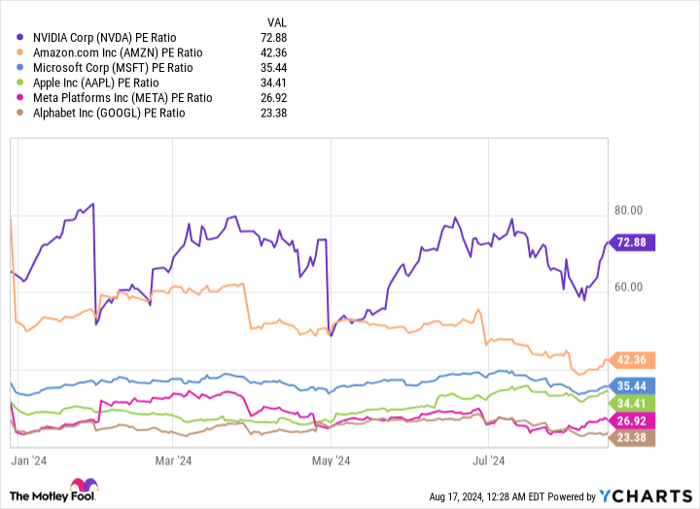
All these tech titans are financially robust, allowing investors to gauge their value using the prevalent price-to-earnings (P/E) ratio – computed by dividing a company’s share price by its earnings per share. The Nasdaq-100 index, a key benchmark, presently boasts a P/E ratio of 30.9, serving as a useful point of reference.
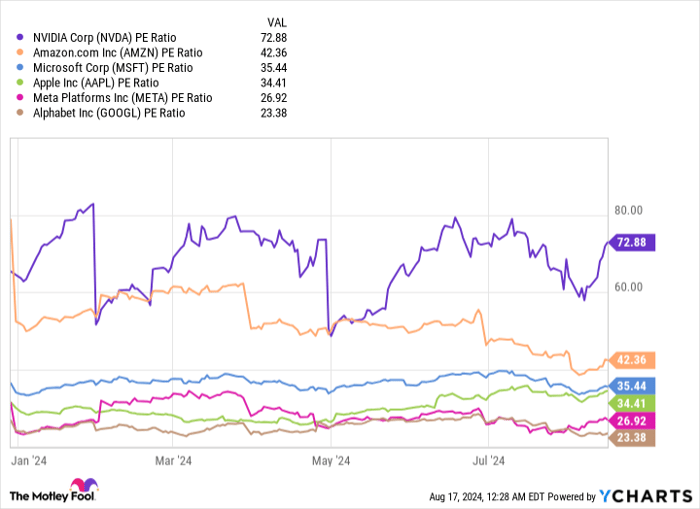
Data by YCharts.
Nvidia emerges as the priciest trillion-dollar stock today in terms of P/E ratio. Nonetheless, with its meteoric growth trajectory, the company’s forward P/E ratio stands at 33.1 based on next year’s earnings projection. Essentially, Nvidia’s valuation becomes markedly more palatable if investors adopt a longer-term outlook.
The most economically viable option among this prestigious cohort is Alphabet. A recent legal ruling categorized Google Search as a monopoly, prompting scrutiny from the U.S. Department of Justice and the specter of a potential breakup. This regulatory backdrop, coupled with the emergence of AI chatbots that pose a challenge to Google’s dominance, cultivates a climate of cautious optimism surrounding Alphabet’s valuation.
Enter Amazon, a standout performer set to amass $635 billion in revenue this year, trumping its peers. Noteworthy is the fact that Amazon boasts the most attractive price-to-sales ratio, calculated by dividing market capitalization by revenue. Furthermore, with a projected 63% earnings growth this year and 23% in 2025, its seemingly elevated P/E ratio appears justified.
In conclusion, evaluating a stock based solely on its P/E ratio may not always paint the complete picture. It’s plausible for investors to advocate that despite Nvidia’s triple P/E ratio, the stock presents a more compelling investment proposition compared to Alphabet, given its robust growth trajectory juxtaposed with Alphabet’s regulatory uncertainties.
Is Now the Time to Invest in Nvidia?
Prior to plunging into Nvidia stock, deliberate on this:
The Motley Fool Stock Advisor analyst ensemble recently unveiled what they perceive as the 10 best stocks for investors to consider… with Nvidia conspicuous by its absence. The highlighted 10 stocks hold the potential to yield substantial returns in the foreseeable future.
Reflect on Nvidia’s inclusion in this list back on April 15, 2005… a $1,000 investment at the time of the recommendation would have blossomed to a staggering $787,394.
Stock Advisor furnishes investors with a user-friendly roadmap to success, offering guidance on portfolio construction, regular analyst updates, and two fresh stock recommendations every month. The Stock Advisor service has outperformed the S&P 500 by more than fourfold since 2002*.
* Stock Advisor returns as of August 22, 2024
5 Stocks Our Experts Predict Could Double In the Next Year
By submitting your email, you'll also get a free pivot & flow membership. A free daily market overview. You can unsubscribe at any time.