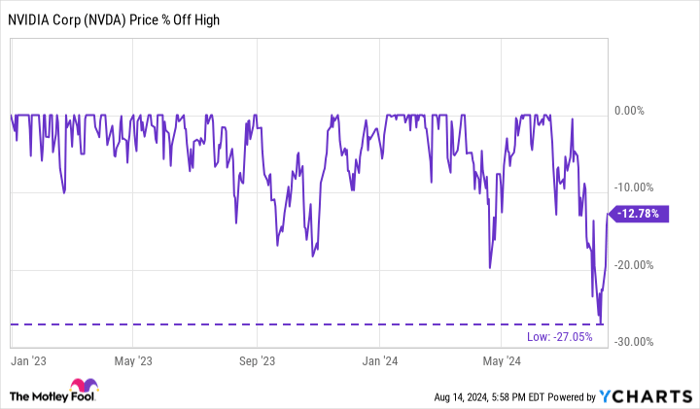
Having long held a bullish stance on Nvidia (NASDAQ: NVDA), the recent downturn in Nvidia stock has even me, a steadfast supporter, feeling a tad uneasy.
It’s worth noting that Nvidia is confronting its first 20% drawdown since the inception of 2023.
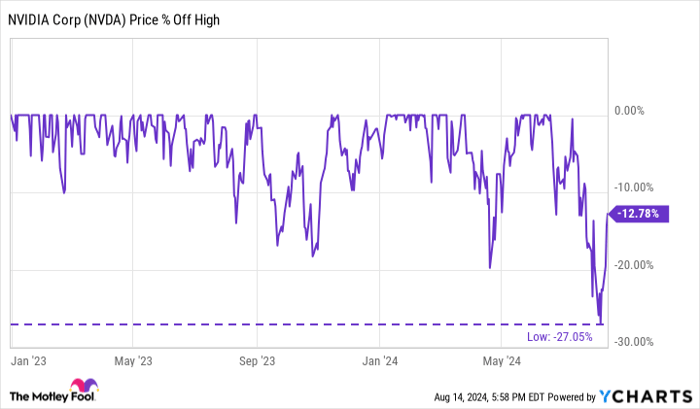
In essence, a chink has appeared in Nvidia’s armor. Although the stock has already rebounded from its recent lows and could potentially surge to fresh heights, the pertinent question arises: Is it now time to entertain doubts regarding the seeming impregnability of Nvidia’s long-standing bull run? Let’s delve deeper to uncover the nuances.

Image source: Getty Images.
Analyzing the Nvidia Situation
Following its zenith at $140.76 in June, Nvidia has witnessed a 27% decline in its shares. Although this may seem modest, it is crucial to realize that at its pinnacle, Nvidia commanded a market cap exceeding $3.2 trillion, momentarily crowning it as the world’s largest publicly traded company.
During this downturn, Nvidia has shed more than $650 billion in value — a sum tantamount to the entire market capitalization of America’s 10th largest entity, Tesla.
Hence, Nvidia’s recent stock retreat carries immense significance. It’s not merely about the financial loss incurred, which could potentially be recouped swiftly. Rather, the crucial queries revolve around the reasons behind Nvidia’s sharp descent and whether it signifies underlying vulnerabilities for the company and its stock.
Let’s turn our focus to the numeric story.
Evaluating Nvidia’s Position
Undoubtedly, Nvidia’s stock has witnessed a meteoric rise in recent years. The driving forces behind this upsurge in my view are two core elements:
- Sustained revenue growth
- Elevated anticipations of future revenue trajectories
In essence, Nvidia’s stock rally is predicated on its escalating revenue figures and the optimistic outlook on its forthcoming revenue, which continues to soar. The pertinent question at this juncture is whether this momentum can be sustained.
An examination of Nvidia’s revenue over the past couple of years provides clarity on the stock’s remarkable run. The company has nearly tripled its revenue from $25 billion annually to over $75 billion annually, propelled by robust sales of graphics processing units (GPUs) — the backbone of artificial intelligence (AI).
However, this revenue surge isn’t the solitary driver behind the stock’s triumph. In tandem with this substantial revenue escalation, investors have been willing to pay a premium for each dollar of revenue, buoyed by heightened expectations on future revenue growth. Consequently, Nvidia’s price-to-sales (P/S) ratio has surged as well. In 2022, it dipped below 10 times. Contrastingly, merely weeks ago, Nvidia sported an astonishing P/S ratio of 42 times.
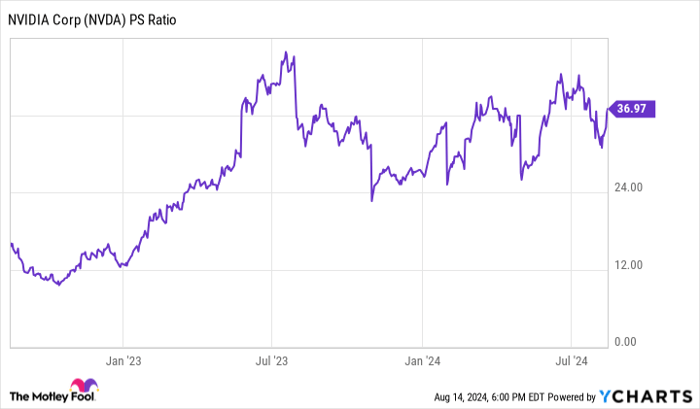
NVDA PS Ratio data by YCharts
The rationale for this shift is the anticipation of a swift surge in Nvidia’s sales. Analysts project Nvidia to double its sales, nearly reaching $120 billion this year. However, this is where apprehensions start to surface.
What if these analysts temper their revenue growth forecasts for Nvidia, or in a dire scenario, begin trimming these estimates? Such actions would cast doubt on the mammoth valuation premium investors have been willing to pay (as depicted by Nvidia’s P/S ratio), potentially prompting another substantial sell-off of the stock.
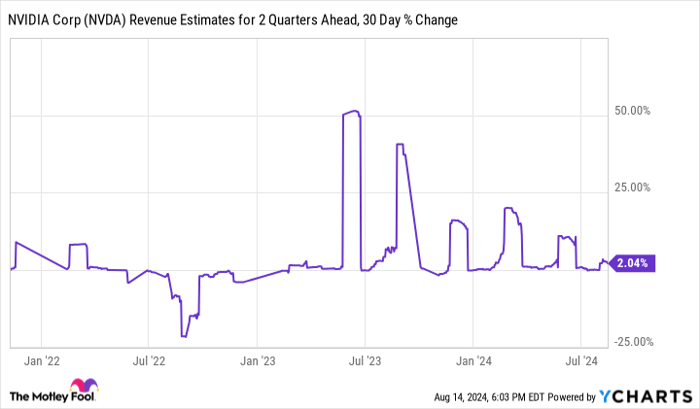
For insights into this possibility, one can scrutinize this chart illustrating the adjustments made by Wall Street analysts to their revenue estimates over the past three years.
NVDA Revenue Estimates for 2 Quarters Ahead, 30 Day % Change data by YCharts
This graph showcases the alterations in analysts’ forecasts of Nvidia’s future revenue (for two quarters ahead) over the last 30 days. Peaks denote substantial increases (favorable for the stock), while troughs signify declines (detrimental for the stock).
As evident, there have been more crests than troughs over the past two years. Nevertheless, the magnitude of these peaks has been dwindling. This signals that with each quarterly disclosure, analysts are approaching closer to aligning with Nvidia’s sales guidance. In essence, the expectations set by Wall Street are gradually converging with reality. In the event this trend persists, these dynamics might eventually reach an equilibrium point, and subsequently possibly reverse — where company guidance might fall below expectations, prompting analysts to revise their revenue predictions, which could lead to a consequent sell-off in the stock market.
The Rise and Fall of Nvidia Stock: A Roller Coaster for Investors
Investors in Nvidia have been witnessing a roller coaster ride in recent times. The once high-flying chipmaker has seen its stock price plummet, leaving stakeholders baffled and jittery. What does this decline mean for those who have placed their bets on this tech giant? Let’s delve deeper into the details to uncover the story behind the valleys on this chart and the falling share price for Nvidia.
Key Insights into Nvidia’s Performance
For nearly two years, Nvidia’s stock has been soaring, paralleling a meteoric rise in both its sales figures and sales projections. However, the euphoria around these impressive numbers has driven the company’s stock valuation to dizzying heights. Consequently, the stock is now exceedingly susceptible to sudden downturns, rendering it a risky investment option. Despite Nvidia’s promising long-term prospects, its current volatility may not align with the risk tolerance of certain investment portfolios.
Is Nvidia Still a Viable Investment?
Before jumping on the Nvidia bandwagon, prudent investors would do well to consider the following ramifications. Notably, the esteemed analysts at Motley Fool Stock Advisor have recently unveiled their handpicked selection of the 10 best stocks for potential investors. Surprisingly, Nvidia did not secure a spot in this elite roster. These chosen stocks are touted to deliver substantial returns in the foreseeable future.
Reflecting on Nvidia’s historical performance, a noteworthy milestone was its inclusion in this exclusive list back on April 15, 2005. Had an investor heeded this recommendation and invested $1,000 at the time, their investment would have ballooned to an impressive $752,835!*
Notably, the Stock Advisor service boasts a track record that has surpassed the returns of the S&P 500 by more than quadruple since its inception in 2002.* If you’re keen to explore the top 10 stock picks and discover potential lucrative opportunities, look no further.
*Stock Advisor returns accurate as of August 12, 2024
5 Stocks Our Experts Predict Could Double In the Next Year
By submitting your email, you'll also get a free pivot & flow membership. A free daily market overview. You can unsubscribe at any time.