Exploring Rivian’s YTD Performance
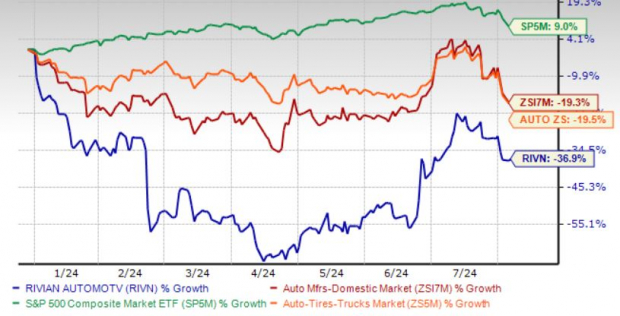
Investors were taken on a wild ride yesterday as Californian electric vehicle trailblazer Rivian Automotive (RIVN) unveiled its second-quarter financial results. Sadly, the report fell short of expectations as revenues missed estimates and losses widened, plunging the stock 6.7% in after-hours trading. This stumble adds to a tough year for Rivian, with shares plummeting 37% since the start of 2024, underperforming the industry, sector, and the S&P 500. Is this a mere bump in the electric road, or a deeper crevice signaling caution to investors? Let’s unpack the latest data to gauge Rivian’s potential following its recent earnings announcement.
Insights from Rivian’s Q2 Report
The Q2 2024 financials showed Rivian grappling with challenges—reporting a loss of $1.21 per share, wider than both the prior year’s figure and market forecasts. On the flip side, revenues saw an uptick compared to a year ago, though they undershot analyst expectations. The company managed to deliver 13,790 vehicles, outpacing its production of 9,612 units despite facing a dip in output due to factory retooling. The per-vehicle gross loss swelled year-on-year, with Rivian losing $32,705 on each delivery.
In a bid to turn the tide, Rivian launched its next-gen R1 series during the quarter, featuring a slew of upgrades. Furthermore, Rivian reaffirmed its 2024 production target of 57,000 units and stood firm on other financial projections. While aiming to reach profitability in Q4 of 2024, the road ahead seems littered with production challenges to overcome.
Long-Term Positivity on the Horizon
Despite the recent setbacks, Rivian’s ambitious partnership with Volkswagen—a mammoth deal incorporating a joint venture and significant investments—presents a silver lining. This collaboration is poised to inject fresh vigor into Rivian’s operations and expedite its production roadmap. Efforts to trim costs, optimize efficiency, and enhance profitability are underway, with promising results expected in the coming quarters. Rivian’s roadmap also includes future models like the R2, slated to hit the market in 2026, bringing potential cost reductions and enhanced competitiveness.
The trajectory looks rosy for Rivian, with sales forecasts for 2024 and 2025 painting a positive picture of escalating growth. With a focus on reducing costs, ramping up production, and streamlining operations, Rivian is heading towards a profitability horizon in the near future.
Immediate Challenges to Navigate
However, Rivian isn’t out of the woods yet. The company has been burning through cash since commencing vehicle production, leading to a significantly reduced cash reserve. Forecasts predict continued cash burn as Rivian pushes for expansion and scale-up efforts, with losses projected for the next couple of years. Additionally, looming concerns about inventory rebuilding, slipping delivery figures, and stretched valuations pose immediate challenges for the electric vehicle maverick.
As investors weigh the risks and rewards, Rivian must navigate through a turbulent market landscape, steering its course amidst financial headwinds and production hurdles.
Rivian: Navigating the Stock Terrain for Investors
The wheels of fortune are in motion at Rivian, as the landscape undergoes subtle shifts. With the VWAGY deal, cost-saving strategies, and a fleet of new products revving up, the horizon appears promising for this automotive player.
However, caution is advised for eager investors eyeing the stock. Despite the positive developments, the company’s cash burn and its high valuation should not be overlooked. This cautionary stance suggests that while existing shareholders might find solace in maintaining their positions, prospective investors are urged to exercise prudence and await a more opportune entry point.
Stock Rating and Outlook:
Rivian is currently perched at a Zacks Rank #3, putting it in the ‘Hold’ zone. This indicates a company in a state of flux, suggesting investors need to tread carefully through the current stock climate.
Past Performance as a Guide:
Looking back at Rivian’s trajectory offers a useful backdrop for understanding its current position. Like echoes from the past reverberating into the present, historical data can serve as a compass for those navigating the uncertainty of the stock market.
Strategic Moves and Future Gaze:
The winds of change are evident in Rivian’s recent actions, from forging crucial partnerships to unveiling innovative products. All these maneuvers are like pieces being moved on a chessboard, with each decision playing a critical role in shaping the company’s future trajectory.
However, investors are advised to keep a weather eye on the cash flow dynamics and the company’s valuation, akin to a vigilant captain steering a ship through choppy waters.
The Investment Landscape:
For those seeking to venture into the Rivian territory, a prudent approach is recommended. Like a seasoned traveler pausing to assess the terrain before taking the next step, potential investors should exercise discretion and wait for a more amenable entry point into the stock.
5 Stocks Our Experts Predict Could Double In the Next Year
By submitting your email, you'll also get a free pivot & flow membership. A free daily market overview. You can unsubscribe at any time.