Every Great Vision Has a Bottleneck
It was one of the most consequential product demonstrations in history – and it helped make the inventor rich while changing the way we live.
At the New York Crystal Palace in 1854, an assistant stood high above the floor holding an axe beside the only rope keeping Elisha Otis from plunging to the ground.
Below them, a crowd waited.
Otis was standing on an open elevator platform suspended over the exhibition hall.
Then he gave the order, the axe fell, and the platform dropped.
But it fell only a few inches.
A safety mechanism Otis had invented caught the platform and held it securely in place.
To be clear, Otis did not invent the elevator. Hoists had been carrying freight and people between floors for centuries.
But he solved the problem that prevented people from trusting them.
In the mid-1800s, elevators relied on ropes that could break, sending their platforms and any passengers plunging to the ground.
Otis devised a spring-loaded safety brake that would engage if the supporting rope failed.
This simple demonstration changed Otis’ fortunes by boosting demand for this new device.
Otis didn’t invent elevators or skyscrapers, but the proliferation of safe elevators allowed plans for “skyscrapers” to flourish.
Credit: zxvisual
A new kind of city was now possible.
And it wasn’t just the fear of an accident that Otis’ invention solved. Practically, before safe passenger elevators, the upper floors of a building were often the least desirable. After all, every additional story meant another flight of stairs.
Otis’ mechanism helped remove that limitation.
Architects could design taller buildings. Businesses and residents could occupy their upper floors. Eventually, the least desirable space in a building became the most prestigious.
That’s the power of the right invention at the right time.
The Companies that Make Grand Visions Possible
History offers plenty of stories that follow this pattern.
The visionary inventor or company announces an ambitious new product or project. The founder appears on magazine covers and (nowadays) in every podcast. His or her name appears in the headlines of every financial media outlet.
But as great as the vision is, someone must solve the practical problems standing in its way.
Someone must supply the specialized materials… manufacture the critical components… build the infrastructure… or remove the bottleneck preventing the technology from reaching its full potential.
The companies that solve these problems may never become household names. But for investors, they can create extraordinary opportunities.
That is precisely the kind of opportunity our technology expert Luke Lango has been focusing on.
In his Innovation Investor service, Luke likes to say that companies are creating wealth at exorbitant rates. He focuses on investing in innovation, the best investment strategy in the market during times of great technological change.
In August, Luke recommended ASE Technology Holding Co., LTD (ASX) to his Innovation Investor readers as a prime example of a company providing a critical component of the AI megatrend.
Before a semiconductor chip can be sold, it must be packaged, physically protected and wired up so it can connect to a circuit board and tested. ASE is the world’s largest company specializing in that step.
As a result, it has become critical for the advanced packaging techniques needed to build today’s AI chips, stacking multiple chips together and connecting them to high-bandwidth memory in incredibly tight, precise configurations. Here is Luke explaining why ASX is positioned to benefit.
Taiwan Semiconductor (TSMC), the world’s leading chip manufacturer and the company that etches most of the world’s advanced AI chips, does not have enough of its own advanced packaging capacity to keep up with demand, so it outsources a meaningful chunk of that overflow work to ASE.
ASE is not just riding AI demand; it is benefiting from a genuine capacity bottleneck in a step of the supply chain that cannot be skipped. That scarcity has given ASE real pricing power: reports indicate the company has raised advanced packaging prices more than 20% this year alone, driven by relentless demand from AI accelerator customers.
That is what Luke looks for – not simply a company participating in a fast-growing trend, but one controlling a critical step that cannot be skipped.
In ASE’s case, that step is advanced chip packaging.
Below is the stock’s performance since Luke’s recommendation.
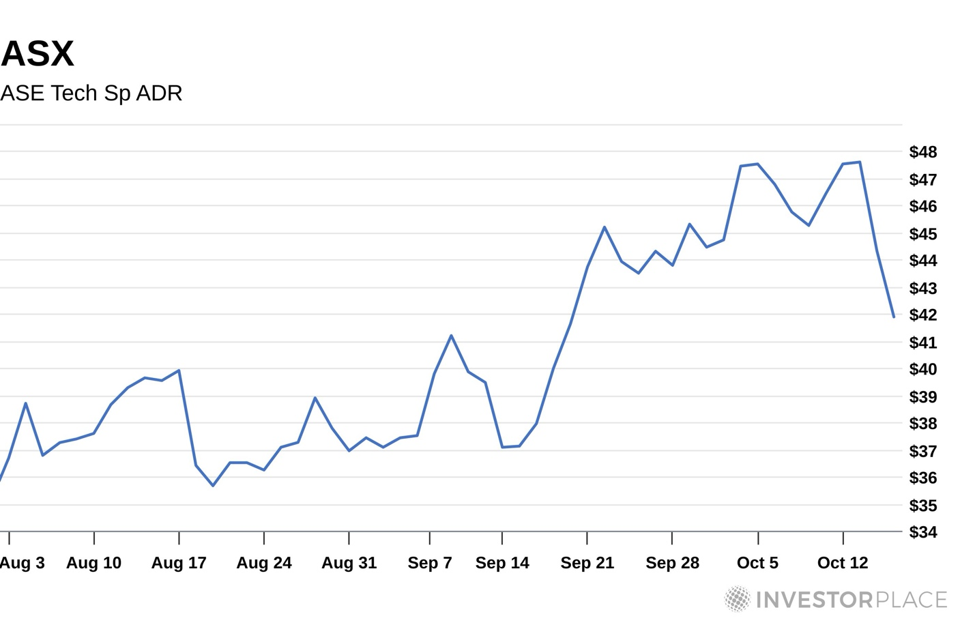
As you can see, the stock has been hit by the same downturn affecting all AI stocks recently.
But here is why Luke is still optimistic:
Management raised its 2026 outlook for its advanced packaging division, which it calls “LEAP,” to more than $3.5 billion in revenue, and it is backing that outlook with capital: 2026 capital spending guidance was raised to $8.5 billion, with additional increases possible, specifically to expand capacity for demand management expects well into 2029 and 2030.
This translates into a projected 25% compounded annual revenue growth through 2030, with meaningful room for EBITDA margin expansion from pricing power, putting compounded EBITDA growth at more than 35%.
Now, Luke has identified three more potential bottlenecks – this time involving Elon Musk’s most ambitious undertaking yet.
The Companies Elon Musk May Soon Need
Luke believes Musk is preparing to bring together Tesla, SpaceX, xAI, X, and the other pieces of his technological empire around one sweeping vision.
Luke calls it “XPANSE.”
It could include orbital AI data centers… an enormous semiconductor complex… and armies of Optimus robots.
But just as skyscrapers could not reach their potential until Otis made elevators safe, Musk’s vision cannot become reality until someone solves the practical problems standing in its way.
Luke has identified three companies that could help.
One specializes in the complex solar arrays Musk could need to power data centers in orbit.
Another produces highly specialized equipment that could become essential to Musk’s semiconductor complex.
And the third controls an important American source of the rare earth materials and powerful magnets required for robots, satellites, and advanced machinery.
These companies will likely never become as famous as Tesla or SpaceX. But a major contract from Musk could completely transform any one of them.
That’s why Luke recently recorded a special presentation revealing Musk’s larger plan – and the three little-known companies he believes are best positioned to help make it possible.
Click here to watch Luke’s presentation and discover all three potential XPANSE suppliers.
Elisha Otis didn’t build the skyscraper.
He removed the obstacle that allowed it to rise.
Luke believes these three companies could play a similar role in Elon Musk’s next technological empire.
Enjoy your weekend,
Luis Hernandez
Editor in Chief, InvestorPlace
5 Stocks Our Experts Predict Could Double In the Next Year
By submitting your email, you'll also get a free pivot & flow membership. A free daily market overview. You can unsubscribe at any time.