
Some of America’s most important breakthroughs begin behind closed doors. The investment opportunities can hide there, too.
Listen to the audio version of this article (generated by AI).
This summer, I found myself in a conference room in Washington, packed with members of Congress, former top military officials, and Ph.D. scientists.
All very serious people.
And we were all there to hear about UFOs.
You read that right.
Now, government agencies and scientists will tell you that they prefer the term UAP (unidentified anomalous phenomena).
That other term tends to carry some… baggage. It makes folks think of little green men and not much else.
Part of the reason I was there was to support my friend Christopher Mellon. Chris is a former Deputy Assistant Secretary of Defense for Intelligence who helped bring the now-famous 2004 “Tic Tac” UFO encounter into the public eye.
Now, I’m not going to tell you I came home believing every theory I heard that day.
But one idea came immediately to mind.
I’ve spent my career looking for new opportunities before they become obvious to Wall Street. And as I listened to the discussion, I kept thinking about the kinds of capabilities associated with these encounters: extraordinary speed, unconventional maneuverability and propulsion systems unlike anything most of us have ever seen.
Then one question kept running through my mind:
What if even a fraction of the capabilities people associate with this stuff is real?
To be precise, what if it can be reproduced? Is development already underway?
Whether those capabilities come from secret military programs, future aerospace breakthroughs, or something we don’t yet understand, there is one thing I know for certain.
The next generation of military and space technology is already under development.
And somebody has to build all of it.
That’s where this gets really interesting for investors.
In today’s Market 360, I’ll show you why next-generation military technology and the new space race are two megatrends that could create a powerful wave of investment opportunities.
I’ll also show you how some of the biggest winners are hiding in plain sight – and how my Stock Grader helped me find a 600% gain here before Wall Street caught on.
I’ll also explain why this kind of stock-picking matters so much right now, as my friend Marc Chaikin and I prepare for our special Midterm Mayhem broadcast on September 29. (You can sign up here now for that free event.)
What’s Being Built Behind the Curtain?
The United States is spending more than $1 trillion on national defense this fiscal year.
That number could keep climbing as Washington pours more money into advanced weapons, artificial intelligence, missile defense, space systems, and the defense industrial base.
But not all of that spending is easy for the public to see.
Some goes toward classified research, weapons development, and intelligence programs. That’s what people mean when they talk about the military’s “black budget.”
In 2026, the Air Force had about $54.6 billion marked as classified spending. For 2027, that figure is projected to climb above $74 billion, with Space Force classified spending alone nearly tripling to $17.3 billion.
And history shows that some remarkable technologies have emerged from this hidden world.
Take, for example, the Defense Advanced Research Projects Agency (DARPA).
The agency was created in 1958 after the Soviet Union shocked the U.S. by launching the Sputnik satellite into space. Its mission was to make sure America would never again be caught off guard by a major technological breakthrough.
Its earliest priorities included space technology, missile defense, and advanced propulsion. Since then, DARPA-backed research has helped advance technologies ranging from the precursor to the internet to GPS navigation and stealth.
Remember, these technologies once sounded like science fiction. Then, they weren’t.
Then there’s Lockheed Martin Corp. (LMT) and its famous Skunk Works division.
Skunk Works was born during World War II and given the unusual freedom to assemble small teams and cut through the bureaucracy that normally slowed military development.
The result: It designed and built the prototype for America’s first jet fighter in just 143 days.
Skunk Works later produced aircraft like the U-2 spy plane and the SR-71 Blackbird.
Long before most Americans knew those aircraft existed, engineers were already figuring out how to build them.
That doesn’t mean every strange object spotted in the sky is some secret military project. But it does mean the technology we see today may not represent the limits of what is already being developed.
And right now, one of the biggest arenas for that kind of innovation is space.
The New Space Race
Earlier this year, NASA carried astronauts around the Moon for the first time in more than 50 years.
But that mission was only one step in a much larger campaign. NASA plans to return to the Moon as early as 2028 and ultimately go to Mars.
At the same time, private companies are building rockets, satellite networks, communications systems, and other infrastructure at a pace that would have been hard to imagine a decade ago.
Companies like SpaceX Technologies Corp. (SPCX) and Blue Origin will play key roles. So will traditional aerospace companies, military contractors, and smaller suppliers that most investors have never heard of.
In short, we are entering a new space race.
And just like the first one, it will require far more than rockets. It will take advanced materials, semiconductors, sensors, communications equipment, propulsion systems, and thousands of specialized components that have to perform under some of the harshest conditions imaginable.
McKinsey estimates the global space economy could grow from about $630 billion in 2023 to $1.8 trillion by 2035.
That’s why I’m not only interested in the company launching the rockets. I’m interested in the companies making sure they can fly in the first place.
Because one of those suppliers has already handed my subscribers a gain of roughly 600%.
And my Stock Grader system helped us find it before Wall Street caught on.
A 600% Gain Could Be Just the Beginning…
That brings me to Carpenter Technology Corp. (CRS).
Carpenter is not a rocket company. It does not launch satellites or build lunar landers.
It specializes in something less flashy but just as essential: high-performance alloys and specialty materials. These are used in aerospace and defense – areas where extreme heat, pressure, vibration, and a whole lot of stress come with the territory.
Carpenter has already produced components for NASA’s Mars Rover. And as military aircraft, spacecraft, and space infrastructure become more advanced, the need for these kinds of specialized materials should only grow.
This is exactly the kind of company I like to find. While everyone else is watching the rocket launch, I’m looking for the companies supplying the materials that make the launch possible.
And thanks to my quantitative Stock Grader system, I had Carpenter on my radar before Wall Street fully caught on.
I added the stock to my Breakthrough Stocks service back in August 2023. Since then, it has gained roughly 600%.
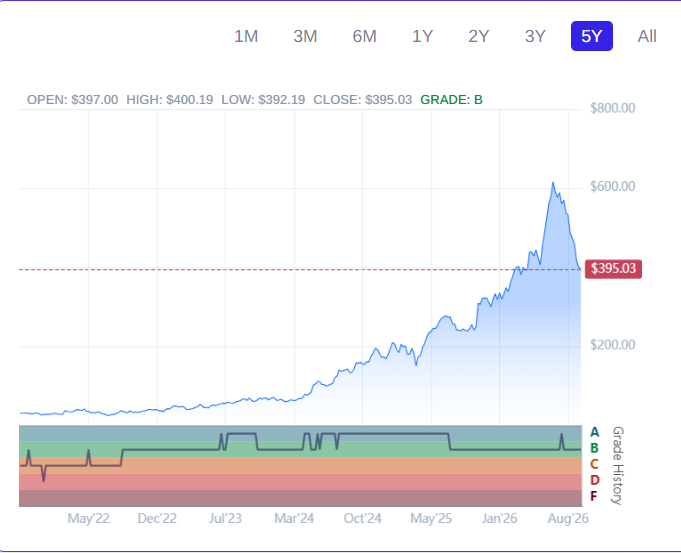
These days, Carpenter has a $20 billion market cap. But it still isn’t a household name.
And with a new generation of military aircraft, spacecraft, and space infrastructure coming down the pipeline, I believe the opportunity is far from over.
Don’t Miss Out on the Next Big Winner…
Carpenter is a great example of why I don’t like chasing whatever stock happens to be getting the most attention.
By the time a major trend becomes obvious, the headline names are usually the ones everyone already knows. But the companies supplying the materials, components, and infrastructure behind that trend can still be hiding in plain sight.
That’s why it pays to have a quantitative system like Stock Grader working for you.
It analyzes more than 6,000 stocks across eight key measures, looking for fundamentally superior companies before the crowd fully catches on.
And right now, finding those stocks could become especially important.
My friend Marc Chaikin and I are watching an unusual market event that could begin before the November 3 midterm elections. And history shows a 92% precedent for it going all the way back to 1925.
We’re going to reveal exactly what we see at our special Midterm Mayhem event on September 29.
And I don’t think investors should wait until Election Day to start paying attention.
That’s why Marc and I will also give you four stocks to put on your radar immediately. Two are stocks we believe investors should consider owning. The other two are stocks we think could be particularly vulnerable and should be avoided.
And I’ll have more to share about an important change coming to Stock Grader that could help us uncover the market’s next big winners before they become obvious to everyone else.
A D.C. UFO conference may be an unusual place to start looking for stocks, but the one I attended this summer reinforced something I’ve learned throughout my career: The biggest breakthroughs – and the companies helping build them – often take shape long before most people think to look up.
Click here to reserve your spot for Midterm Mayhem now.
Sincerely,

Louis Navellier
The Editor hereby discloses that as of the date of this email, the Editor, directly or indirectly, owns the following securities that are the subject of the commentary, analysis, opinions, advice, or recommendations in, or which are otherwise mentioned in, the essay set forth below:
Carpenter Technology Corp. (CRS)
5 Stocks Our Experts Predict Could Double In the Next Year
By submitting your email, you'll also get a free pivot & flow membership. A free daily market overview. You can unsubscribe at any time.