The offshore oil boom offers a clue about where some of the biggest gains could go…
Listen to the audio version of this article (generated by AI).
Editor’s Note: My colleague, InvestorPlace Senior Investment Analyst Luke Lango, has spent months studying what Elon Musk is building across Tesla, SpaceX, xAI, and the rest of his empire.
But Musk can’t build everything himself.
As Luke explains in today’s Smart Money, one of Musk’s latest projects could require an entirely new supply chain, creating opportunities far beyond his own companies.
Luke lays out the larger investment opportunity at a free workshop on Wednesday, September 9, at 8 p.m. Eastern. You can reserve your seat here.
Take it away, Luke…
In 1947, Kerr-McGee Oil Industries went nearly 10 miles off the Louisiana coast, well out of sight of land, and drilled for oil.
It must have sounded borderline ridiculous at the time. After all, the oil business had been built for land drilling.
But it worked.
The well was called Kermac No. 16, and the operation would look almost primitive by comparison with the enormous offshore platforms that now dot the Gulf.
The opportunity was enormous, but Kerr-McGee’s new operation created a whole new set of problems. The energy industry suddenly needed platforms that could stand in the middle of the ocean, boats to haul supplies and crews out to them, and ways to get the oil back to shore.
And as these pioneers pushed deeper into the offshore frontier, their shopping list grew:
- Miles of specialized pipe.
- Bigger and more sophisticated drill bits.
- Pumps and valves built to withstand enormous pressures.
- Underwater pipelines.
- Diving equipment and helicopters.
Kerr-McGee couldn’t make all of that. And neither could Exxon, Shell, Chevron, or the other oil giants that eventually poured billions of dollars into the Gulf.
The companies that sold all that equipment and expertise to oil companies turned into giants themselves. Investors could make a fortune by figuring out which companies those were.
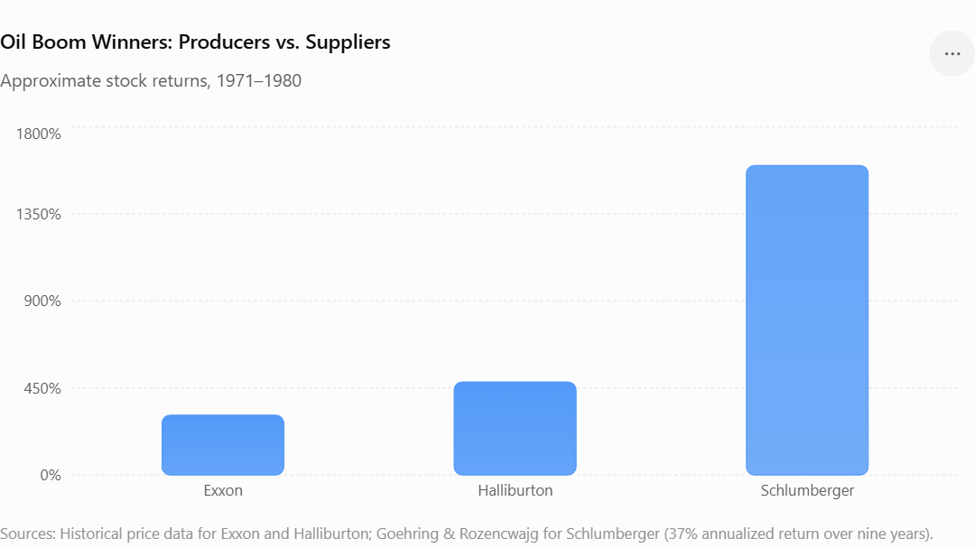
During the oil boom of the 1970s, shares of ExxonMobil Corp. (XOM) rose roughly 300%. That’s a terrific return.
But Halliburton Co. (HAL), which made its money selling oil companies the equipment and services they needed to drill, soared nearly 500% over the same stretch.
And then there was Schlumberger Ltd. (SLB). Its sophisticated oilfield technology and services became indispensable as drillers pushed into harder-to-reach places, including offshore. According to Goehring & Rozencwajg, an investor who bought Schlumberger in 1971 compounded their money at roughly 37% annually over the next nine years. That works out to turning every $1 invested into roughly $17.
The lesson isn’t that Exxon was a bad investment. Far from it. The lesson isn’t that when an industry pushes into a new frontier, the biggest gains can go to the companies selling the pioneers what they need to get there.
I keep coming back to that story lately because Elon Musk is trying something that sounds just about as ridiculous today as drilling for oil out of sight of land must have sounded in 1947.
He wants to move part of the AI industry from Earth into space.
If that works, the Musk empire and its investors will make plenty of money. But once again, I think the biggest gains will be made by the companies that help Musk make it work.
Today, I want to show you what Musk is trying to build, why a recent announcement makes me take it much more seriously, and where I think some of the biggest investment opportunities will emerge if he pulls this off.
Because he can’t build this thing alone.
Why Put AI in Space?
Let’s start with the obvious question: Why would anyone put an AI data center in space?
After all, we’re already spending hundreds of billions of dollars building enormous ones down here.
The answer starts with satellites. Thousands of them orbit Earth today, constantly collecting information: images, weather readings, communications signals, military intelligence, and much more. But much of that information has to be transmitted back to Earth before powerful computers can analyze it.
Imagine putting the computer up there with the satellite instead.
A satellite spots the first signs of a wildfire. Instead of sending thousands of raw images back to Earth and waiting for computers on the ground to analyze them, AI aboard the satellite spots the fire, analyzes it, and sends the warning and a plan to fight it.
A group of military satellites sees something unusual. They analyze it and work together to start drawing up countermeasures before the data ever reaches the ground.
That’s the first step.
But Musk’s ambitions go much further. He wants to put data centers in space.
That’s because the AI Revolution is beginning to run into some very earthly limits.
Data centers consume enormous amounts of electricity, water, and land. And in many places, getting enough new power connected to the grid can take years.
Space changes that equation.
There’s no neighborhood fighting a new data center next door, no local power grid to overwhelm, no acres of real estate to buy, and no municipal water supply to tap. And above the atmosphere, solar panels can collect tremendous amounts of energy without clouds or weather getting in the way.
That doesn’t make putting data centers in space easy. Far from it. As I’ll show you in a moment, it creates an entirely new collection of problems.
But you can see the logic.
If AI eventually requires far more computing power than we’re comfortable squeezing out of the power grids and communities down here, Musk’s answer is essentially putting some of it somewhere else.
And now he’s begun putting real hardware and a real timetable behind that idea.
Elon Just Put a Date on It
Musk and Space Exploration Technologies Corp. (SPCX) are targeting the fourth quarter of 2027 to launch their first Starmind AI satellite, and Nvidia Corp. (NVDA) is supplying the basic computing technology that will go inside it.
That’s important.
A year ago, orbital AI was mostly an idea. Now SpaceX has a target launch date, Nvidia has been engaged, and engineers are working on turning technology that already powers AI here on Earth into something that can operate in space.
Of course, that doesn’t mean thousands of AI data centers will soon be circling Earth.
Musk overpromises all the time. Some of the tech will fail. And putting compute into orbit remains dramatically more expensive than putting it in a warehouse in Northern Virginia.
But that’s also where this gets interesting to investors.
Musk’s burgeoning AI empire will have to spend a fortune solving these problems… and a lot of that money will flow straight to suppliers.
Somebody Has to Make This Stuff Work
Here’s why the offshore-oil story keeps coming back to me. Moving production into the ocean may have produced a lot more oil, but it also created new engineering problems that somebody had to get paid to solve.
Moving serious AI computing into space will do the same thing. You’ve suddenly created an entirely new list of problems: power, heat, radiation, the violence of a rocket launch. If something breaks, nobody is driving a repair truck up there.
And that’s where I start looking for stocks.
Consider Redwire Corp. (RDW). It makes power systems and solar arrays for spacecraft. Start putting increasingly powerful computers into orbit, and power becomes a very big problem very quickly.
Or take Microchip Technology Inc. (MCHP). It makes electronics designed to withstand the radiation and harsh conditions of space. That’s not something Nvidia has to worry much about when its chips are sitting inside a warehouse in West Texas.
Then there’s Rocket Lab Corp. (RKLB). Like its name says, it makes rockets. But it also supplies components that go into satellites.
And Planet Labs PBC (PL) already operates a large network of Earth-imaging satellites — precisely the kind of business where analyzing information in orbit instead of sending every piece of raw data back to Earth could become valuable.
These aren’t recommendations. I’m showing you how I think about this. I follow the problems.
If orbital AI grows, which problems get bigger? And which relatively small suppliers solve those problems – and suddenly find themselves selling a lot more equipment to some very large customers?
That’s the opportunity.
And there’s another reason I look at Musk’s suppliers so closely. I’ve seen this work before.
Over the years, I’ve recommended 33 stocks connected in one way or another to Musk’s businesses that went on to double or better at their highs.
That includes Nvidia, which climbed as much as 6,174% after my recommendation… Micron Technology Inc. (MU), up as much as 3,900%… Palantir Technologies Inc. (PLTR), up as much as 1,242%… and Advanced Micro Devices Inc. (AMD), which went on to climb as much as 29,733%.
Clearly, when Musk starts spending to build something new, I want to know who’s cashing the checks.
And Space Is Only One Piece
I’ve spent the past several months mapping how SpaceX, Tesla Inc. (TSLA), and the other companies Elon Musk has built fit together. And, more importantly for investors, mapping what Musk still has to buy from somebody else.
Because for all the talk about Elon building everything himself, he doesn’t. His empire relies on thousands of suppliers, partners, and other companies.
And as we saw with offshore drilling suppliers, the most interesting opportunities surrounding Musk’s next chapter will be the companies selling him the pieces he cannot build himself.
What I’ve shown you today is one branch of that tree.
On Wednesday, September 9, at 8 p.m. Eastern, I’m going to show you the whole thing. And we’re doing it as a workshop rather than a normal presentation.
After you register here, you’ll get my Vertical AI Masterplan Worksheet. Then we’ll fill it in together as I show you the different pieces of Musk’s AI empire, where I see the critical bottlenecks, and which companies I believe could get paid to solve them.
My colleagues Louis Navellier and Eric Fry will be joining me. They approach investing very differently than I do, which is exactly why I wanted them there.
And I’ll give you the name and ticker of one stock for free during the workshop. No purchase necessary. Just show up and write it down.
There’s another reason I want to do this now: September 24. That’s a date I’ve circled on my calendar after spending months digging through Musk’s plans and SpaceX’s filings.
I’m not going to tell you here exactly what I think happens after that date. That’s a big part of what I’m going to explain at the workshop (reserve your spot here).
And I’m certainly not telling you something is guaranteed to happen on September 24. This is Elon Musk we’re talking about.
But I believe that date could remove an important obstacle standing between Musk and the final step in the AI masterplan he’s been assembling.
And that brings me right back to 1947.
Kerr-McGee made the headlines. It was the pioneer that breached the frontier.
But as offshore drilling grew into an enormous industry, some of the biggest fortunes were made by the companies selling the pioneers what they needed to keep pushing farther out. Companies like Halliburton.
New frontiers create shopping lists.
Musk is putting together his right now, and investors should want to know who’s on it.
That’s what I want to show you on September 9.
Reserve your seat here.
Sincerely,
Luke Lango
Senior Investment Analyst, InvestorPlace
P.S. When you register, you will also have the chance to join my VIP list. As a thank-you, I will send you a special report that previews the research I am presenting on September 9 – how Elon Musk’s empire actually fits together and where I think the opportunity is building. It is free, but you have to register for the event first. Claim your spot here.
5 Stocks Our Experts Predict Could Double In the Next Year
By submitting your email, you'll also get a free pivot & flow membership. A free daily market overview. You can unsubscribe at any time.