Get the latest insights on Bitcoin, Ether and altcoins, along with a round-up of key cryptocurrencymarket news
Here’s a quick recap of the crypto landscape for Wednesday (August 19) as of 10:00 p.m. UTC.
Bitcoin price update
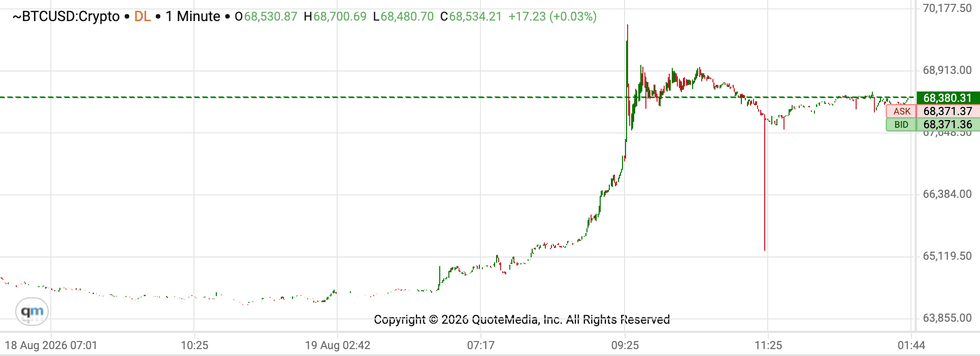
Bitcoin (BTC) was priced at US$68,411.90, up by 5.7 percent over the past 24 hours.
The crypto markets surged alongside equities this afternoon following an announcement by the Treasury that it will at least double the size of its long-dated bond buyback operations starting Sept. 9. The news eased yields immediately and prompted traders to shift back toward stocks, gold and crypto, with Bitcoin breaking above its 200-day moving average.
Lacie Zhang, a research analyst at Bitget Wallet, says BTC may be entering a bottoming process but is likely to remain within a broad US$55 – US$80K range through year-end, with compressed volatility and slowing long-term-holder distribution reducing the likelihood of another sharp move in either direction.
“Spot volumes are subdued versus prior peaks, consistent with post-2025 deleveraging and an orderly recovery. If US$60,000 – US$62,000 support holds, the setup offers asymmetric upside; confirmation of a durable bottom still requires sustained volume and less fear,” Zhang wrote in a commentary piece shared with INN.
However, Standard Chartered analyst Geoff Kendrick clocks the key technical level at US$65,500, with a break above that threshold potentially confirming that the cycle low is already in. “Investors should now be positioning for a move ot USD $100,000 by year-end 2026,” he wrote in a note shared with Cointelegraph.
Bitcoin price chart
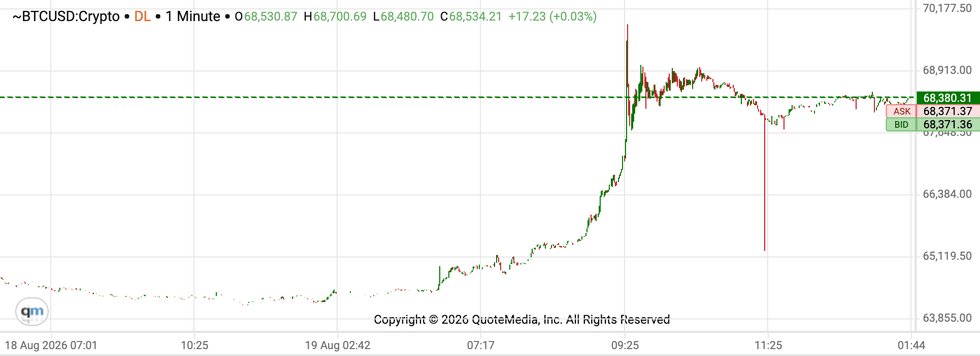
Chart via the Investing News Network.
Bitcoin price performance, August 19, 2026.
Ether and altcoin price update
- Ethereum (ETH) was priced at US$2,102.93, trading 9.9 percent higher over the last 24 hours.
- XRP (XRP) was priced at US$1.07, trading 6.6 percent higher over the past 24 hours.
- Solana (SOL) was trading at US$82.32, trading 6.7 percent higher over the past 24 hours.
Today’s crypto news to know
Read on for a round-up of the biggest cryptomarket news
- SEC proposes capital-raising rules for crypto startups
- South Korea blocks Polymarket access
- Compound Foundation earmarks US$52 million for investment
- Kalshi files for two new perpetual futures contracts
- Interstice Digital releases Cross-Chain Swap Engine
SEC proposes capital-raising rules for crypto startups
The US Securities and Exchange Commission (SEC) has proposed a customized regulatory framework to grant crypto companies exemptions from traditional securities laws.
The proposed “Regulation Crypto Assets” establishes clear pathways for digital asset entrepreneurs to raise capital. SEC Chair Paul Atkins stated the framework prevents a future rogue regulator from unwinding industry progress.
“Given the progress made in Congress to date on market structure legislation, let me be clear up front: legislation remains indispensable to enacting “future-proofed” rules of the road that are durable enough to protect the work we are undertaking today from being unwound by a future rogue regulator. The SEC has and will continue to support Congress in delivering the CLARITY Act to President Trump’s desk,” Atkins said in an SEC statement.
The proposal includes a startup exemption allowing companies to issue up to US$5 million in tokens over a four-year period. It also features a fundraising exemption permitting offerings up to US$75 million annually, provided issuers supply audited financial statements and meet regular reporting requirements.
The plan introduces an investment contract safe harbor that excludes crypto assets from securities classifications once project founders terminate essential managerial efforts.
Industry leaders, including Blockchain Association CEO Summer Mersinger, praised the move as a crucial step toward establishing the clear rules digital asset markets desperately need.
“Regulation of Crypto Assets is an important step toward the clear, fit-for-purpose rules digital asset markets in the United States have needed for years. We appreciate Chairman Atkins’ leadership and the work of the Commissioners and SEC staff to develop a tailored approach that supports innovation, capital formation, and investor protection,” Mersinger said.
South Korea blocks Polymarket access
The Korea Media and Communications Standards Commission voted to block domestic access to Polymarket, classifying the prediction market platform as an illegal gambling environment.
Regulators determined Polymarket violates South Korea’s Criminal Act by facilitating gambling venues and encouraging winner-takes-all financial speculation.
Polymarket defended its operations by highlighting its non-custodial smart contracts, removal of Korean-language services, and refusal to accept the Korean won. Regulators rejected these technical arguments, pointing out that Polymarket actively creates markets, sets trading rules, and collects fees on South Korea-specific topics.
The access block follows an intense July review requested by local police and gambling authorities. Authorities subsequently launched active investigations into domestic Polymarket users for participating in suspected illegal gambling activities.
South Korea joins more than 30 global jurisdictions that currently restrict access to Polymarket.
In the US, the New York City Council launched a separate investigation into major prediction markets for allegedly targeting minors with deceptive marketing practices.
Compound Foundation earmarks US$52 million for investment
Holders of COMP, the Compound protocol’s governance token, voted this week to approve a US$52 million development initiative aimed at building institutional-grade infrastructure and integrating real-world assets (RWAs) onto the platform.
The funding comes from Compound’s DAO, the collective of COMP holders who vote on how the protocol is run; approved proposals are then carried out by the Compound Foundation, the body that actually spends the funds and hires staff.
Of the US$52 million, US$14 million is available immediately, while the remaining US$38 million is tied to specific development milestones.
The Foundation appointed a new leadership team headed by Executive Director Aaron Schnarch, former head of Coinbase Custody who managed the launch of Paxos’s Global Dollar Network alongside Robinhood, Kraken, and Anchorage Digital. The team brings expertise from traditional finance and institutional crypto firms, including HSBC, Broadridge, Anchorage Digital, NEAR, Maple Finance,and Maker/Sky, rather than DeFi-native backgrounds.
The move comes as Compound, one of DeFi’s original lending protocols, tries to reverse a steep decline. Its total value locked has fallen from a US$12 billion peak in 2021 to roughly US$1.2 billion today, while rival protocols have grown. Compound’s move is part of a broader shift across DeFi, where protocols are increasingly courting institutional capital as retail trading activity has cooled.
Kalshi files for two new perpetual futures contracts
Prediction-market platform Kalshi filed with the CFTC on Tuesday seeking approval for two new perpetual futures contracts, one tracking the MerQube U.S. Large Cap Index, which tracks the 500 largest US-listed companies, and one tracking the spot price of copper.
Perpetual futures let traders bet on an asset’s price with borrowed money and no expiration date, and they’ve long been popular on offshore crypto exchanges but were unavailable on regulated US platforms until the CFTC approved Kalshi’s first perp, on Bitcoin, back in May. CME Group, the dominant US futures exchange, sued the CFTC, arguing the agency approved Kalshi’s Bitcoin perp too hastily and that perps should legally be classified as swaps, a stricter category under the 2010 Dodd-Frank Act, rather than ordinary futures. The CFTC has defended its decision and continues treating perps as futures, but until CME’s lawsuit is resolved, that classification remains legally contested.
Interstice Digital releases Cross-Chain Swap Engine
Interstice Digital, a US-based digital asset infrastructure company, released a new tool called the Cross-Chain Swap Engine, which lets users swap tokenized assets between Canton, Ethereum, Solana and Robinhood Chain.
FalconX, a company providing trading and liquidity services to institutional crypto investors, supplies the liquidity that makes those swaps possible.
Blockchains are typically isolated, preventing seamless asset transfers between networks. Canton, which reportedly processes over US$9 trillion a month in tokenized real-world-asset activity, focuses on regulated institutional finance, making it historically difficult to link with public chains like Ethereum or Solana, where most retail and general trading occurs. This engine bridges that gap.
Interstice yes to disclose which specific tokens are supported. The launch is another sign that DeFi’s infrastructure providers, whether building lending protocols or the plumbing between blockchains, are increasingly building for institutions rather than retail users.
Don’t forget to follow us @INN_Technology for real-time news updates!
Securities Disclosure: I, Giann Liguid, hold no direct investment interest in any company mentioned in this article.
Securities Disclosure: I, Meagen Seatter, hold no direct investment interest in any company mentioned in this article.
5 Stocks Our Experts Predict Could Double In the Next Year
By submitting your email, you'll also get a free pivot & flow membership. A free daily market overview. You can unsubscribe at any time.