Get the latest insights on Bitcoin, Ether and altcoins, along with a round-up of key cryptocurrencymarket news
Here’s a quick recap of the crypto landscape for Wednesday (August 12) as of 10:00 p.m. UTC.
Bitcoin price update
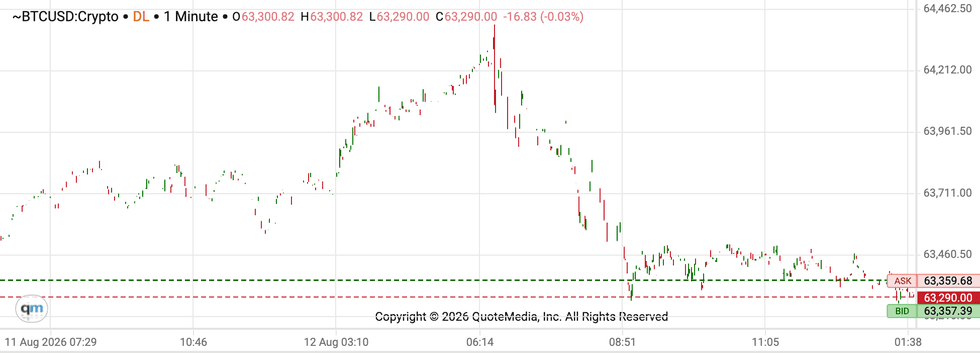
Bitcoin (BTC) was priced at US$63,345.27, down by 0.4 percent over the past 24 hours.
Bitcoin price chart
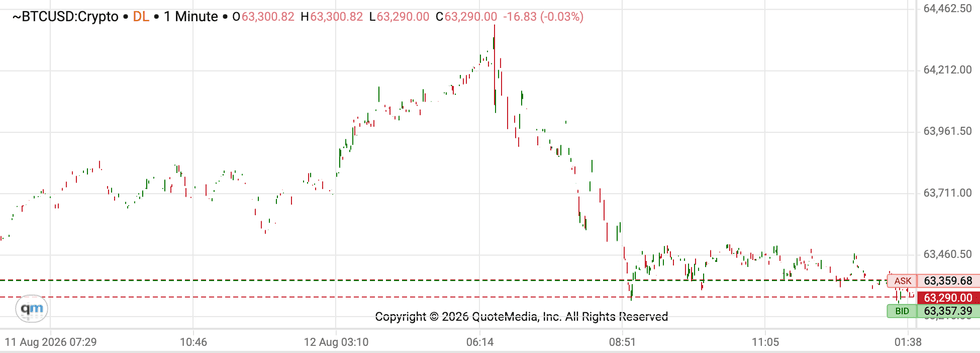
Chart via the Investing News Network.
Bitcoin price performance, August 12, 2026.
Ether and altcoin price update
- Ethereum (ETH) was priced at US$1,877.38, trading 1.2 percent higher over the last 24 hours.
- XRP (XRP) was priced at US$1.01, trading 0.8 percent lower over the past 24 hours.
- Solana (SOL) was trading at US$75.65, trading 0.9 percent higher over the past 24 hours.
Today’s crypto news to know
Read on for a round-up of the biggest cryptomarket news
- Coinbase secures approval for international tokenization platform
- SEC schedules vote on registration exemption for crypto startups
- Bank of England testing program enters Phase 2
- Bank of Russia approves retail crypto trading for Bitcoin, Ether, USDT
- CFTC invokes emergency authority to protect Kalshi Trading
- Kraken broadens trading program
Coinbase secures approval for international tokenization platform
Coinbase Global (NASDAQ:COIN) has secured financial services permission from Abu Dhabi Global Market’s (ADGM) Financial Services Regulatory Authority to build an international platform for blockchain-based versions of shares.
Under Financial Services Regulatory Authority supervision, tokens will be backed by underlying equity shares.
“Coinbase’s establishment of its international tokenisation hub in ADGM is a strong endorsement of Abu Dhabi’s growing role in shaping the future of global finance,” Arvind Ramamurthy, chief market development officer at ADGM.
“It reflects the strength of ADGM’s progressive, robust and internationally aligned regulatory framework, which continues to provide leading global institutions with the confidence to develop responsible, blockchain-enabled financial services at scale. As tokenization becomes an increasingly important part of capital markets infrastructure, ADGM remains committed to supporting innovation that enhances market access, transparency and investor confidence, while upholding the highest standards of regulatory oversight,” he added.
This launch is part of Coinbase’s broader commitment to the United Arab Emirates. Through its investments in Abu Dhabi and Dubai, Coinbase is establishing two of its most ambitious global businesses outside the US: a hub for tokenized securities and onchain capital markets, and a global hub for derivatives. Together, they reflect the company’s confidence in the UAE as a home for the next generation of financial infrastructure.
Coinbase has not yet disclosed a launch date or specific equities.
SEC schedules vote on registration exemption for crypto startups
The Securities and Exchange Commission (SEC) scheduled an open meeting for Friday (August 14) to consider new rules enabling crypto projects to raise capital without registering securities.
SEC Chair Paul Atkins is spearheading the Regulation Crypto Assets framework, proposing a startup exemption that grants developers up to four years of regulatory runway to achieve network decentralization. The proposed rule provides an escape hatch from SEC jurisdiction once project founders cease active management of their protocols.
The agency initiated formal rulemaking after the Senate entered its August recess without advancing the CLARITY Act.
TD Cowen analyst Jaret Seiberg identified the proposal as the first in a series of rulemakings intended to establish durable regulatory certainty for digital assets. A finalized administrative rule creates binding legal precedent that outlasts individual commission chairs, unlike non-binding staff guidance on staking, airdrops and mining.
The SEC is simultaneously developing a joint asset taxonomy with the Commodity Futures Trading Commission (CFTC) to delineate regulatory boundaries between commodities and securities.
“The SEC’s proposed innovation exemption is valuable because it signals that regulators are taking tangible steps to create a practical framework for how tokenization should function in real markets,” explained Vladimir Tikhomirov, co-founder of DeFi infrastructure company Algebra in an emailed statement.
“But even if these efforts are successful, I would argue that this is where the bigger challenge only begins.”
Tikhomirov argues that, in order to advance tokenization, infrastructure must be built to accommodate the specific regulatory and operational requirements of traditional financial assets:
“Tokenized stocks are not simply an extension of crypto infrastructure: one cannot simply take these assets, put them on blockchain rails and expect them to work the same way as typical cryptocurrencies do. Traditional securities come with their own ownership rules, trading restrictions and compliance requirements, and issuing a token on-chain does nothing to replicate any of those. Any infrastructure supporting these assets, therefore, needs to accommodate these factors.
“The same applies to the idea of 24/7 trading. Round-the-clock access sounds attractive, but equity markets have defined trading hours for a reason. Once the underlying market closes, price discovery and liquidity become much more complex. Without reliable mechanisms for external pricing and liquidity management, continuous trading risks creating inefficiencies instead of improving market access in any marked way.
“For tokenization to truly advance, it is necessary to build infrastructure that understands the characteristics of each financial instrument instead of trying to force them blindly on-chain. That means integrating external pricing data, accounting for market hours, supporting KYC and access controls and providing safeguards for exceptional situations.
“TradFi markets can certainly benefit greatly from innovations introduced by DeFi, such as (automated market makers) and blockchain-based settlement, but that doesn’t mean they should copy those things wholesale. They will only be able to deliver value when properly adapted to the operational and regulatory demands of these markets.”
Bank of England testing program enters Phase 2
On Tuesday (August 11), tech and financial firms participating in the Bank of England’s testing program, known as the Digital Pound Lab, announced the launch of Phase 2 of their trial. The Bank of England is testing whether stablecoins and a potential official government digital currency can work smoothly together in international trade.
The trial simulates a trade scenario for small and medium-sized businesses.
In the test, an overseas exporter receives an advance payment using a private stablecoin, while a British importer settles the bill using simulated digital British pounds. The goal is to see if combining these digital payment systems can reduce transaction delays and make it easier for smaller businesses to get paid quickly when shipping goods overseas.
This is strictly a technical experiment. No actual funds or live customers are involved, and the Bank of England has emphasized that this test does not mean it has decided to launch an official digital pound.
Bank of Russia approves retail crypto trading for Bitcoin, Ether, USDT
The Bank of Russia published a draft directive on Tuesday establishing its first framework to allow non-qualified retail investors to trade digital assets through licensed brokers and exchanges.
The central bank capped non-qualified investor purchases at 300,000 rubles per year across all intermediaries. Regulators approved only three digital assets for public exchange trading: Bitcoin, Ether and Tether’s USDT.
Under new federal digital currency legislation, coins must demonstrate high liquidity, substantial market capitalization, strong average daily volume and a five year foreign pricing history to gain public trading access.
The central bank excluded XRP from the approved list despite its market size.
Qualified accredited investors face no annual purchase limits and can trade any cryptocurrency available on exchange or over-the-counter markets. All Russian investors must pass a mandatory risk assessment test before executing any digital asset transactions. Central Bank Governor Elvira Nabiullina signed the draft directive, which accepts public comments through August 24 and takes effect 10 days after official publication.
CFTC invokes emergency authority to protect Kalshi Trading
The CFTC invoked its emergency authority to order prediction market platform KalshiEX to maintain continuous trading operations. The federal regulator intervened after Kalshi issued a formal market emergency notification following a lawsuit from New York Attorney General Letitia James. James filed a petition in state court seeking an immediate national shutdown of Kalshi’s event contracts and demanding over us$36 billion in statutory damages.
CFTC Chair Michael Selig rejected New York’s attempt to apply state gaming laws to centralized, interstate financial derivatives venues. The CFTC has now initiated legal action against nine states to protect federal jurisdiction over event contract exchanges under the Commodity Exchange Act. President Donald Trump directly backed the CFTC’s intervention, criticizing state officials who attempt to shutter prediction markets.
New York’s eight-count complaint classifies Kalshi as an unlicensed gambling operation. Kalshi sought emergency intervention after federal courts in New York, Michigan and Washington state denied its requests for preliminary injunctions against local regulators.
Kraken broadens trading program
On Wednesday, Kraken announced the addition of the S&P 500 (INDEXSP:.INX) to its funded trading service, Kraken Prop, allowing users to trade a perpetual index contract based on the S&P 500.
This follows an earlier launch of the Nasdaq-100 (INDEXNASDAQ:NDX) on the same platform.
Traders pay an evaluation fee to participate in a simulated trading challenge.
If they pass by demonstrating proper risk management, Kraken provides them with simulated account funding up to US$200,000 and allows successful traders to keep 80 to 90 percent of their profits.
Unlike standard stock futures, this index contract operates 24/7 as a perpetual product without expiration dates, rollovers or forced market closes over weekends.
This launch is part of Kraken’s plan to expand beyond crypto assets into traditional financial assets, with commodities planned as the next addition to the program.
Don’t forget to follow us @INN_Technology for real-time news updates!
Securities Disclosure: I, Giann Liguid, hold no direct investment interest in any company mentioned in this article.
Securities Disclosure: I, Meagen Seatter, hold no direct investment interest in any company mentioned in this article.
Editorial Disclosure: The Investing News Network does not guarantee the accuracy or thoroughness of the information reported in the interviews it conducts. The opinions expressed in these interviews do not reflect the opinions of the Investing News Network and do not constitute investment advice. All readers are encouraged to perform their own due diligence.
5 Stocks Our Experts Predict Could Double In the Next Year
By submitting your email, you'll also get a free pivot & flow membership. A free daily market overview. You can unsubscribe at any time.