U.S. stocks opened lower as investors weigh up renewed Middle East tensions, rising oil prices and the prospect that higher energy costs could complicate the Federal Reserve’s inflation fight.
The U.S. and Iran exchanged fresh strikes over the weekend and continue to dispute control of the Strait of Hormuz. As a result, have jumped 4% at the start of the week, reviving concerns over energy-driven inflation and the prospect of a more hawkish Federal Reserve.
Higher oil prices are also feeding into Treasury yields as investors reassess the inflation outlook, pushing the to 4.57%, its highest level in July.
The renewed inflation concerns come ahead of a crucial week on Wall Street, with U.S. data due tomorrow and Federal Reserve Chair Kevin Warsh’s first congressional testimony as Fed Chair also scheduled for Tuesday.
While markets assign just a 31.5% probability of a July , the chances of a September increase stand above 68%.
This week also marks the start of the U.S. earnings season, adding another layer of complexity for investors. Earnings growth is expected to be around 24% in the second quarter. However, with expectations already elevated, guidance could prove just as important as the headline numbers, particularly if companies begin to flag higher costs or a softer outlook.
There are also fresh questions surrounding the AI trade. Strong revenue growth from Taiwan Semiconductor Manufacturing (NYSE:) failed to lift chip stocks, while the sharp sell-off in SK Hynix (NASDAQ:) suggests investors are becoming increasingly concerned that AI-related valuations have become stretched. As earnings season begins, simply meeting expectations may no longer be enough to drive further gains.
Corporate Movers
SK Hynix debuted on the on Friday, rising almost 13%. However, profit-taking and renewed concerns over AI valuations saw the stock fall 14% in Seoul trading, with its ADRs set to open around 9% lower.
Memory and semiconductor stocks are also under pressure as investors continue to question the sustainability of the AI rally. SanDisk is down 5.5%, while Micron Technology (NASDAQ:) is also set to open around 5% lower. The is down 2% in pre-market trading.
Energy stocks are moving higher after oil prices jumped following fresh U.S.-Iran strikes over the weekend.
S&P 500 Forecast – Technical Analysis

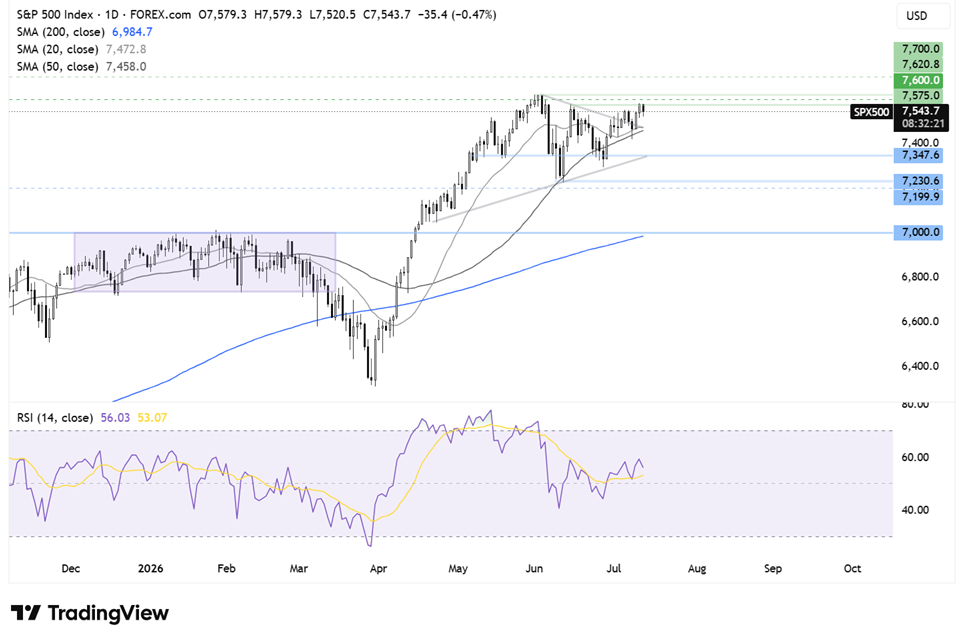
The has broken out of its symmetrical triangle pattern and rallied to 7,575, the June 15 high.
Buyers will look for a move above this resistance level to bring the record high at 7,615 into focus.
While the wider trend remains constructive, momentum is beginning to moderate after the recent rally.
Support can be seen at 7,450, the 50 SMA, followed by 7,350, the horizontal support level, and the rising trendline support.
FX Markets – Dollar Softens
The is edging lower despite higher Treasury yields, although yields have pulled back from their session highs. Markets are digesting the latest developments in the Middle East ahead of tomorrow’s U.S. CPI report.
is rising towards 1.1430, supported by hawkish ECB expectations ahead of speeches from several ECB policymakers.
is little changed around 1.3400 amid the softer U.S. dollar. So far, there has been limited spillover into the FX market from rising geopolitical tensions and higher oil prices. The UK economic calendar is relatively quiet, although Bank of England Governor Andrew Bailey is due to speak tomorrow. Meanwhile, Andy Burnham is expected to be confirmed as the UK’s next Prime Minister in the coming days.
Oil Rises as U.S.-Iran Hostilities Escalate
Oil prices are rising around 4% on Monday amid renewed concerns over global crude supplies after the U.S. and Iran exchanged further military strikes and issued conflicting statements regarding transit through the Strait of Hormuz.
While President Trump said the Strait remains open to commercial traffic, Iran declared that it had been closed.
According to ship-tracking data from Kpler, just six vessels transited the Strait on Sunday, the lowest number in five weeks.
Even so, with crude still trading below $80 per barrel, the market appears to view the latest escalation as another setback within an already fragile truce rather than the complete collapse of the ceasefire.
However, any further escalation that raises doubts over the future of the U.S.-Iran agreement to reopen the Strait and end the conflict could push oil prices significantly higher.
5 Stocks Our Experts Predict Could Double In the Next Year
By submitting your email, you'll also get a free pivot & flow membership. A free daily market overview. You can unsubscribe at any time.