The market’s next big move may not come from the stocks everyone is chasing today…
Listen to the audio version of this article (generated by AI).
One of the easiest investing mistakes to make is assuming yesterday’s winners will also be tomorrow’s.
According to legendary investor Louis Navellier, that instinct – what psychologists call “recency bias” – causes investors to chase stocks long after much of the easy money has already been made.
In today’s essay, Louis explains why he believes the better approach is to look beyond recent price action and instead focus on where institutional money is quietly moving next. As part of this, he shares a real-world example of his Precursor Intelligence system spotting trouble in one popular AI stock while identifying opportunity in another that most investors were overlooking.
Louis also expands on these ideas in a new presentation, where he explains why July 23 could be an important date for the market, and reveals several stocks his system is tracking today. You can watch it right here.
If Louis is right, the market’s next big winners are already taking shape – they just aren’t the stocks everyone is talking about yet.
I’ll let him take it from here.
Have a good weekend,
Jeff Remsburg
Imagine watching an NBA basketball game, and LeBron James is just lighting it up. He’s made six shots in a row. The game is close. And James is clearly lining up to take another jump shot.
What are the odds he makes it?
In basketball, players and coaches often talk about the “hot hand.” The idea is simple: If someone has made several shots in a row, folks believe he has a greater chance of making the next one.
Sometimes, that instinct may be right.
But often, our brains take what just happened and assume it will keep happening.
That is a simple example of Recency Bias.
And even if you don’t know the technical term, you have almost certainly experienced it.
Take your annual performance review at work. Odds are your supervisor remembers a lot of the work you’ve done over the past month. But they may not remember as many of your accomplishments from nine months ago.
As a result, you’re more likely to be judged by the last month than the last year.
This same bias can influence your decisions as an investor. And it can have a big impact on your portfolio.
The human brain is a marvelous tool for creating art, music, language, and engineering feats.
But it can be a terrible tool for investing.
The more you know about the workings of your own mind, the “bugs” inside it, and how they work against investment performance, the more you can develop strategies to reduce their negative effects.
Let me help you with that.
In today’s issue, I’ll show you how Recency Bias can blind investors to the next big market move. Then, I’ll explain how my Precursor Intelligence system helps me look past what a stock has done lately and focus on the signals that could point to where institutional money is headed next.
The Danger of Rearview-Mirror Investing
In investing, Recency Bias occurs when a stock has momentum, either up or down.
If a stock has been going up for the past six months, folks naturally believe it is likely to keep going up.
The inverse also happens. If a stock hasn’t gone up in six months, it seems unlikely to turn around any time soon.
On a wider level, if it has been years since the last bear market, investors are more likely to believe one isn’t coming soon.
You can see this everywhere in today’s market.
A stock runs for a few months, and investors assume it will keep running. A stock pulls back, and they assume the story is broken. A sector falls out of the headlines, and they assume the opportunity is gone.
That is rearview-mirror investing.
And it can be costly.
When AI Chases the Rearview Mirror
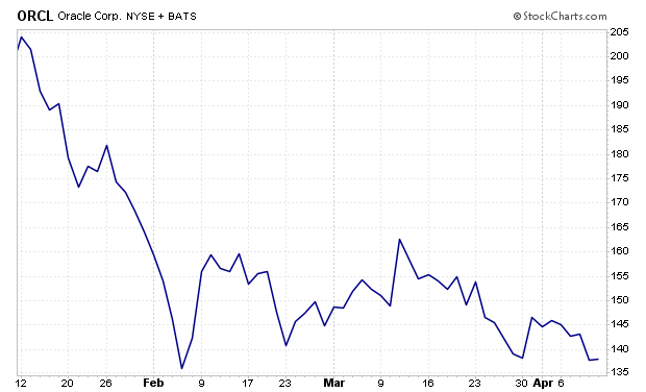
Take Oracle Corp. (ORCL), for example.
Earlier this year, Money.com reported on Danelfin, an AI stock-picking platform that says it identifies stocks likely to outperform over the next 90 days. At the time, Danelfin’s top 10 stocks included Oracle, along with other well-known names like Meta Platforms Inc. (META) and Roblox Corp. (RBLX).
On the surface, that made sense.
Oracle had become one of Wall Street’s favorite AI infrastructure plays. Investors had watched the stock rise, and many assumed the recent momentum would continue.
That is Recency Bias at work.
But my P.I. system was telling me something different.
It was flashing warning signs that the ownership structure was shifting. In other words, the big institutional investors were starting to move out while the crowd was moving in.
Ninety days later, Oracle was down 32%.
Not only that, but Meta was down 12%, and Roblox was down 25%.
That is why recent performance is not enough.
A stock can look strong on the surface while the deeper signals are already starting to weaken.
The reverse can also happen.
Last December, most investors were not putting GE Vernova Inc. (GEV), a company that builds the power infrastructure AI data centers need, on their list of hot AI stocks. They were focused on the obvious names – software companies, chipmakers, and the usual Big Tech leaders.
But P.I. was reading a different signal. My system showed that institutional investors were quietly accumulating GE Vernova. Since then, GE Vernova has climbed roughly 70%.
That’s the power of looking beyond what just happened. Recency Bias keeps investors focused on yesterday’s winners. My P.I. system is designed to help me spot where the big money may be moving next.
A stock can look boring, overlooked, or temporarily out of favor right before institutional money starts moving in.
That is why I developed my stock-grading system in the first place.
Instead of eyeballing a stock chart and guessing what comes next, my system runs the numbers. It analyzes thousands and thousands of data points, including fundamentals and quantitative signals.
And now, with Precursor Intelligence, I’m able to go even deeper.
P.I. is designed to help me identify the early signs that often show up before a major move. It helps me look beyond what has already happened and focus on what could happen next.
That’s the key. Because if you wait until everyone else sees the same opportunity, you may already be too late. By the time the crowd piles in, the easy money may already be gone. And in some cases, the big money may already be heading for the exits.
But you don’t have to let your future be governed by Recency Bias.
All you need is the right tools. And that’s why I built P.I.
Put My System to Work for You
My system isn’t emotional. It doesn’t get impatient. It doesn’t get greedy. And it doesn’t assume a stock will keep rising just because it has been rising lately.
It simply looks for the same kinds of precursor signals that have appeared before many of the great stock moves of my career.
And with second-quarter earnings season about to kick into high gear, I believe this kind of insight could become even more important.
In my new presentation, I explain why July 23 could become a pivotal day for the market and why I’m watching it so closely.
I also show you how P.I. works and reveal several stocks my system says could be next in line as institutional money makes its next move.
Click here to watch now.
Sincerely,
Louis Navellier
The Editor hereby discloses that as of the date of this email, the Editor, directly or indirectly, owns the following securities that are the subject of the commentary, analysis, opinions, advice, or recommendations in, or which are otherwise mentioned in, the essay set forth below:
GE Vernova Inc. (GEV)
Jeff Remsburg also owns GEV
5 Stocks Our Experts Predict Could Double In the Next Year
By submitting your email, you'll also get a free pivot & flow membership. A free daily market overview. You can unsubscribe at any time.