
Cerebras Systems CBRS is tied to a clear change in AI infrastructure: the move from training-heavy demand toward faster, lower-latency inference.
That shift has made speed a commercial feature. For Cerebras, the question is whether demand for fast tokens can scale without stretching capacity, supply chains or margins too far.
Why Cerebras is Levered to Inference Demand
Cerebras’ wafer-scale architecture is built to reduce chip-to-chip communication, a major bottleneck in conventional accelerator clusters. Its WSE-3 processor powers CS-3 systems designed for training and inference through an integrated hardware and software stack.
The company is aligned with interactive AI use cases where response time matters. Coding tools, agents and customer-facing applications depend on fast token generation, not just model size.OpenAI is the biggest proof point. The companies’ agreement covers 750 megawatts of committed inference compute capacity and is valued at more than $20 billion over several years.
However, Cerebras is facing stiff competition in the AI infrastructure market from the likes of NVIDIA NVDA and Advanced Micro Devices AMD. NVIDIA is dominating the AI GPU market through its Blackwell, Hopper, DGX/NVL systems that are used for AI training and inference. AMD’s MI300 and MI350 accelerator families are competing with CBRS in hyperscale AI infrastructure and enterprise AI clusters. .
CBRS Benefits From Cloud and Marketplace Reach
Cerebras is no longer relying only on large direct enterprise deployments. Its go-to-market approach now includes cloud providers, software platforms, marketplaces and self-service developer access. CBRS’ partnerships with OpenAI and Amazon AMZN are noteworthy developments.
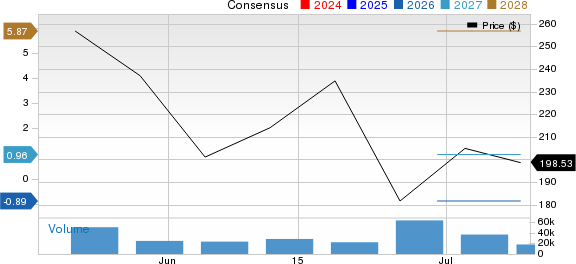
Cerebras Systems Inc. Price and Consensus

Cerebras Systems Inc. price-consensus-chart | Cerebras Systems Inc. Quote
OpenAI is the biggest validation point for Cerebras’ speed positioning. The company has an agreement for 750 megawatts of high-speed inference compute over the next several years, valued at more than $20 billion. The relationship also gives Cerebras exposure to frontier-model workloads. Management has said the collaboration gives the company direct insight into where advanced model development is moving.
Amazon’s cloud-arm Amazon Web Services (AWS) adds a distribution angle. Cerebras and AWS plan a disaggregated inference approach in which AWS Trainium 3 handles prefill and Cerebras CS-3 handles decode.
Marketplace and developer channels broaden the funnel. Cerebras solutions are available through AWS Marketplace, Microsoft Marketplace, IBM watsonx Model Gateway, Vercel AI Gateway, OpenRouter and Hugging Face. Those channels can help CBRS reach startups, AI-native companies and enterprises that already build inside existing cloud workflows. Self-service inference APIs may also turn early experimentation into larger deployments.
Cerebras is Seeing a Mix Shift to Services
The business model is moving in the same direction as the product story. In the first quarter of 2026, core revenues rose 92% year over year to $191.3 million. Core hardware revenues increased 60% to $111.6 million. Core cloud and services revenues climbed 167% to $79.8 million, suggesting faster growth in more services.
A larger services mix could improve visibility over time because customers can consume inference by token, reserve dedicated capacity or use cloud access for production workloads.
The transition is still early. Hardware remains the larger core revenue contributor, and cloud infrastructure requires capital, leases and operating discipline before recurring demand can fully show through.
What Could Slow the CBRS Trend Story
The main risk is execution. Cerebras has major demand signals, but it must turn those commitments into delivered capacity across data centers, systems and service levels. The OpenAI agreement raises the stakes. Failure to meet deployment milestones or service requirements could affect portions of the arrangement, and the related working capital loan adds financial risk under certain termination scenarios.
Customer concentration is another concern. A small group of large customers, including OpenAI, AWS, G42 and MBZUAI, is expected to carry a meaningful share of the growth story.
Infrastructure intensity also limits flexibility. Data center availability is a key growth constraint, while manufacturing scale, power access, lease commitments and deployment timing all have to align with demand forecasts.
Conclusion
The bottom line is that CBRS offers direct exposure to faster AI inference, but the stock still carries a prove-it profile. The demand backdrop is attractive, yet capacity delivery and economics remain central to the debate.
Cerebras currently carries a Zacks Rank #3 (Hold). You can see the complete list of today’s Zacks #1 Rank (Strong Buy) stocks here.
Research Chief Names “Single Best Pick to Double”
From thousands of stocks, 5 Zacks experts each have chosen their favorite to skyrocket +100% or more in months to come. From those 5, Director of Research Sheraz Mian hand-picks one to have the most explosive upside of all.
This company targets millennial and Gen Z audiences, generating nearly $1 billion in revenue last quarter alone. A recent pullback makes now an ideal time to jump aboard. Of course, all our elite picks aren’t winners but this one could far surpass earlier Zacks’ Stocks Set to Double like Nano-X Imaging which shot up +129.6% in little more than 9 months.
Free: See Our Top Stock And 4 Runners Up
Cerebras Systems Inc. (CBRS) : Free Stock Analysis Report
Amazon.com, Inc. (AMZN) : Free Stock Analysis Report
Advanced Micro Devices, Inc. (AMD) : Free Stock Analysis Report
NVIDIA Corporation (NVDA) : Free Stock Analysis Report
This article originally published on Zacks Investment Research (zacks.com).
5 Stocks Our Experts Predict Could Double In the Next Year
By submitting your email, you'll also get a free pivot & flow membership. A free daily market overview. You can unsubscribe at any time.


