Listen to the audio version of this article (generated by AI).
Tom Yeung here with your Sunday Digest.
In the days following its IPO, Space Exploration Technologies Corp. (SPCX) surged 25%, rewarding early investors and turning its owner, Elon Musk, into a trillionaire. The following week the stock sank below $160, sending most investors into the red and forcing Musk back into the “lowly” hundreds-billionaire class.
SpaceX isn’t alone in its volatility. That same week, shares of Micron Technology Inc. (MU) gapped down 15% on a broader tech selloff before shooting straight back up on blowout earnings.
As InvestorPlace Senior Analyst Louis Navellier noted in a recent Market 360 issue, the AI market has been all over the place lately.
Now, this sometimes happens during late-stage rallies. Traders know that certain stocks are overbought, so they sell out at the first sign of trouble. A tiny dip can trigger a panic.
But as I mentioned in last Sunday’s Digest, this volatility is also a byproduct of artificial intelligence. Millions of trading algorithms, advisors, and investors are increasingly relying on the same AI-powered tools. And it’s creating a new kind of “trading convergence” that causes people to jump in and out of stocks at the same time.
It can lead to massive losses of wealth when trades go wrong.
That’s why Louis rarely chases the crowd. Instead, he’s looking for signs that typically happen before AI systems catch wind, with the help of his system called Precursor Intelligence (P.I.). It helps him find companies with improving fundamentals and accelerating money flow before every AI tool jumps on board. You can click here to hear him talk more about it.
Last week, I showcased three of these top picks: Texas Instruments Inc. (TXN), Monolithic Power Systems Inc. (MPWR), and Oncology Institute Inc. (TOI).
This week, I’d like to add two more.
Stock to Buy #1: The AI Dark Horse
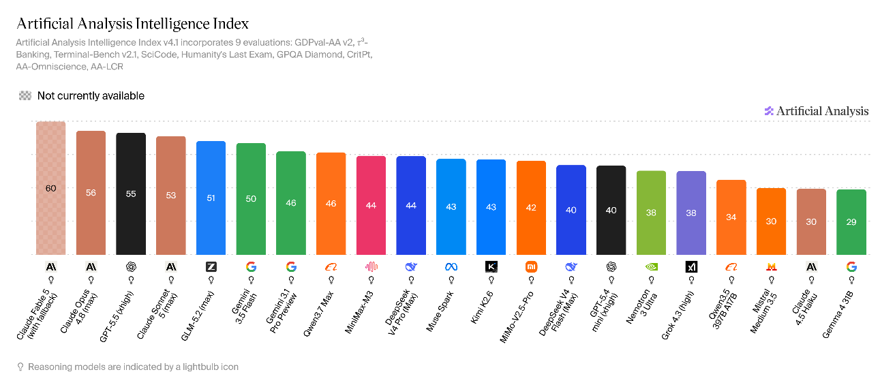
Over the past two months, shares of Alphabet Inc. (GOOGL) have lagged the broader AI market. Its top-rated Gemini model is now the fifth best, as graded by Artificial Analysis, an AI benchmarking firm. It will soon fall to sixth place when OpenAI’s latest GPT-5.6 version finishes its testing. Alphabet’s shares have slipped 10% since their mid-May peak.
Gemini (dark green) is starting to look rather average
Yet, Louis’ system believes this bearishness is overdone. The company earns an “A” grade for its “follow the money” score and has the receipts to back it up. The company is one of the fastest-growing companies in our universe of stocks, and it’s the only hyperscale AI data center firm expected to remain cashflow positive in every quarter this year.
I believe this assessment is right on several counts, which I outlined last month. Alphabet has a dominant search business, efficient data center chips, and momentum against OpenAI. Together, this suggests its fair stock value is somewhere in the mid-$400 range; it’s now trading around $355.
And a recent AI model launch by Chinese startup Z.ai only reinforces that conviction.
On June 13, Z.ai launched a large language model (LLM) called GLM-5.2, which Artificial Analysis determined is better than Alphabet’s two flagship models. And after test-riding the new LLM, I believe this is a surprisingly good development for Alphabet because the system is entirely open-source. Users can download GLM-5.2 for free, read through its source code, and take anything they like for their own use.
In other words, Alphabet can take the model for itself.
That should prove a windfall for the search giant, which was previously fighting two separate battles:
- Low-cost models for individual users for Google Search and Android, and
- High-end models to attract corporate users onto its Google Cloud Platform.
GLM-5.2 helps fight that first, since it’s good enough for daily use and surprisingly cheap to run. You don’t need a cutting-edge model to give directions to the nearest golf course… and you certainly don’t need one to set a 7 a.m. phone alarm. You only need something that’s dependable enough not to wake you up at 3 a.m. or send you to the wrong place.
That means Google can focus on that second arena, where it is already doing quite well. The company doubled the number of $100 million to $1 billion deals in its most recent quarter. And now that it can focus its efforts on high-end AI models, it will likely continue to pull ahead of rivals in the coming quarters.
And so, I continue to see further upside in Alphabet. Shares are already up 27% since I flagged them last November (even with the recent drawdown), and they still have more room to climb.
Stock to Buy #2: The Return of U.S. Drug Development
Last week, I wrote about the U.S. government suddenly becoming pro-pharma again.
In April, Health and Human Services (HHS) Secretary Robert F. Kennedy Jr. admitted to Congress that “China is now eating our lunch” in drug development and promised to make changes.
Since then, agencies overseen by RFK Jr. have made an almost 180-degree turn. In June, one group unanimously recommended its first vaccine of the current administration, and a separate one launched a project called Operation TrialBlazer to fast-track clinical research.
I recommended Oncology Institute Inc. (TOI) as a stock to buy.
This week, I’d like to add one more healthcare firm to this list:
Moderna Inc. (MRNA).
You will likely know Moderna for its development of the Covid-19 vaccine, a therapy that only took 10 weeks to develop and another 10 months to reach approval. You will also probably know that Moderna’s stock price fell over 94% between 2021 and 2025 after vaccine demand fell off and mRNA vaccines became a culture war lightning rod.
It hasn’t been easy for the drugmaker. In President Trump’s first year back in office, the HHS terminated Moderna’s pandemic bird-flu contract, stopped recommending Covid-19 shots for healthy children, cut $500 million in mRNA vaccine funding, and removed all 17 members of the Centers for Disease Control and Prevention (CDC) vaccine advisory committee. Moderna was forced to cut projects and funnel its remaining cash into fewer, higher-priority clinical trials.
But the drugmaker seems to be back. On June 18, Food and Drug Administration advisors backed Moderna’s mRNA flu vaccine, capping a 20% rally in the stock. At roughly the same time, MRNA moved from a “C” grade in Louis’ system to a “B” on unusually high smart money buying.
The fundamental story has only since improved. On June 25, the company gave exciting details at its annual Science Day that suggest far faster growth for its oncology drugs, known as “cancer vaccines.” These are programmable therapies that can be tailored to individuals or targeted more broadly at common cancer markers for off-the-shelf use.
The most promising of Moderna’s tailored drugs, known as intismeran autogene, is currently undergoing Phase 3 trials for treating skin cancer. Results will be published by the end of this year, and analysts expect over $3.5 billion in annual revenues by 2035. The same therapy is also being tested on kidney cancers, lung cancers, and more.
The company is also working on several off-the-shelf therapies that are showing early promise. At least one of these should become a blockbuster, according to analysts at Morningstar, and could lay the groundwork for “multiplex” therapies. This is where one drug seeks out multiple targets at once, increasing the likelihood of success.
Most importantly, Washington’s mood around drug development is changing. RFK Jr. himself has said that China “went from running 3% of clinical trials to running 30%” and that “we are losing scientists, we’re losing our IPs… and we’re going to lose our biosecurity.”
And if the federal government wants to flood the zone with money to develop more drugs, then Moderna is the most obvious candidate for it. Programmable mRNA vaccines are incredibly fast to develop, and this drugmaker has plenty in partial development that are ready to resume.
Walking Apart from the Crowd
You’ll notice that Alphabet and Moderna are not exactly the most popular names among retail investors. Google is often seen as too large to grow further, while the politicization of vaccines has turned a generation of investors off Moderna entirely.
Here’s why that matters: AI systems are exceptional at pricing what’s already in the numbers. They can “see” everything that’s happened in the past five-plus decades and often know precisely what investors are doing today. They’re also relatively good at extrapolating if the future looks anything like the past.
What AI does not do so well is predict changes. And the reality is that Alphabet and Moderna both run platforms that can adapt quickly. Alphabet can absorb a free, open-source model like GLM-5.2 and turn it into a dozen cheap consumer products overnight. Moderna’s programmable mRNA lets it point the same underlying technology at everything from the flu to skin cancer.
That’s the real opportunity in a market ruled by trading convergence. The more investors lean on the same tools that only see today’s data, the more they underprice the companies whose best chapters haven’t been written yet.
That’s exactly what Louis built Precursor Intelligence to do. He’s looking to pinpoint companies with strong fundamentals and accelerating money flow.
Louis just recorded a presentation walking investors through that system, and how it’s predicting a major rally in stocks beyond AI. So, if you’d like to get ahead of the next wave instead of getting swept up in it, I urge you to watch Louis’ free broadcast here.
All of us here at InvestorPlace wish you a happy Fourth of July.
Until next week,
Thomas Yeung, CFA
Market Analyst, InvestorPlace
5 Stocks Our Experts Predict Could Double In the Next Year
By submitting your email, you'll also get a free pivot & flow membership. A free daily market overview. You can unsubscribe at any time.