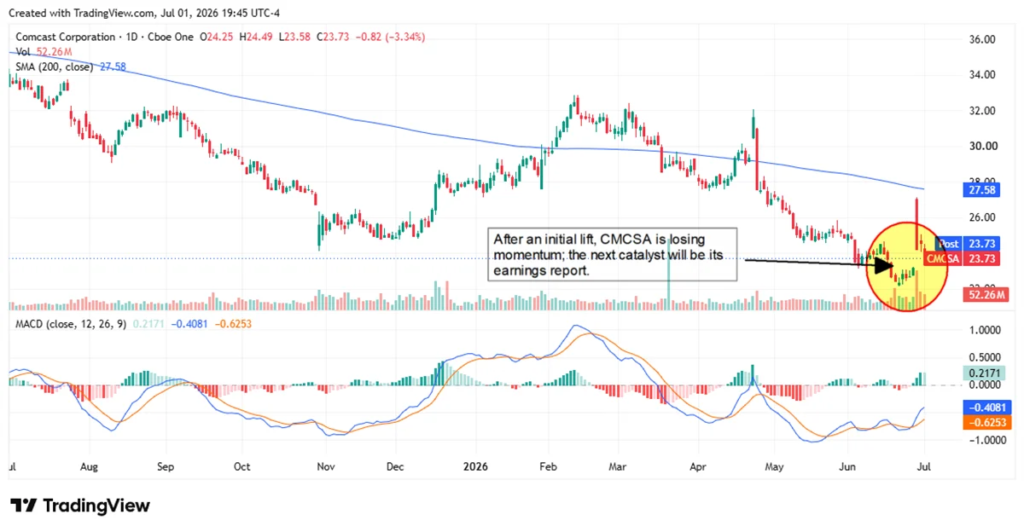
Comcast (NASDAQ:) dipped into a familiar playbook this week. But after an initial pop, CMCSA is drifting back to its pre-announcement levels.
This isn’t a sell-the-news moment. It’s traders doing what they do, which is making a quick profit on news that doesn’t really do much for Comcast’s business.
The announcement was a spinoff of its NBCUniversal, Peacock, Universal Studios, and Sky business units into a second new public company. Comcast will retain a minority ownership stake but plans to unwind it over time. The move makes sense. Content creation in the streaming space is a competitive, cash-intensive business. Although Comcast was still posting stable revenue and earnings, the idea is that this move will unlock more value.
A New Chapter in an Old Playbook
Investors familiar with Comcast may think they’ve been here before. They have. Recently. In late 2025, the company announced it was spinning off several of its cable bundle channels, such as CNBC and USA Network, into a new company, Versant (NASDAQ:).
VSNT began trading publicly in mid-December, and the early returns have been poor. The stock is down a little over 20%. That may be evidence that Comcast was wise to jettison that business. But that doesn’t mean a leaner, more focused business will deliver the growth investors may expect.
Aside from being a more streamlined stock, do analysts have a reason to re-rate Comcast? Since the announcement, the Comcast analyst forecasts on MarketBeat have rendered a split decision. Rosenblatt Securities upgraded CMCSA from Neutral to Buy and raised its price target from $24 to $31. Deutsche Bank also upgraded the stock from a Hold to a Buy, but lowered its price target to $32 from $34.
Next Up…Earnings
Investors won’t have to wait long to learn about the company’s next steps. Comcast is expected to deliver its Q2 2026 earnings report on July 23. While information about the company’s strategy is important, the more vital question may be when investors can expect to see a return on that investment, as it relates to margins and earnings.
They may be waiting a little while. In its prior earnings report, the company reported that residential broadband net losses improved 117K year-over-year to (65K) , and the company had added 435K wireless lines. It was the best quarterly result on record.
However, it also showed that the broadband market is mature. Without a new catalyst, what should investors realistically expect?
The Technical Picture Shows Slowing Momentum
Over a long period of time, a stock chart tells a story. After a spike in 2020, CMCSA has been in a steady decline. The Versant spinoff and now this new transaction have done nothing to reverse the slide.
In the short term, though, charts can indicate momentum. In this case, any momentum Comcast had is already starting to fade.
Know What You Own
None of this is to suggest that CMCSA isn’t worth owning. For starters, the company is attractively valued with a forward price-to-earnings (P/E) ratio of 6.8x. That’s not only a significant discount to the broader market, but it’s also a discount to its own historical average.
But investors have to know what they own. In the case of Comcast, that amounts to a utility stock. It has a legacy business that tends to deliver sticky revenue. Plus, the company has a near monopoly in the areas in which it operates.
But it’s not a high-growth business. Even though broadband is something most consumers won’t give up, Comcast’s pricing power is limited by growing competition from satellite offerings. Consumers may not have many alternatives, but they have enough to keep Comcast’s prices in check.
That matters for how investors should size a position. Comcast isn’t fighting for market share the way a growth stock would. It’s managing decline at the margins while defending pricing power where it still has it. The spinoffs, Versant and now the NBCUniversal transaction are best read as portfolio triage rather than a turnaround story.
Management is narrowing its focus to the parts of the business that still throw off predictable cash, which is a defensible strategy for a mature operator, but it’s not one that typically re-rates a stock higher. Investors chasing the next catalyst may be disappointed. Investors looking for income backed by a durable, if slow-growing, business have more reason to stick around.
One reason for investors to stick around would be a safe dividend that yields 5.6% as of the market close on July 1. Plus, the company has increased the dividend for 18 consecutive years. There’s a place for CMCSA in some portfolios, but it shouldn’t be confused with a growth stock.
5 Stocks Our Experts Predict Could Double In the Next Year
By submitting your email, you'll also get a free pivot & flow membership. A free daily market overview. You can unsubscribe at any time.