Oracle’s ORCL rapidly expanding contract backlog is enhancing visibility into its long-term revenue growth. The company ended fiscal 2026 with a record $638 billion in Remaining Performance Obligations (RPO), including an $85 billion sequential increase, reflecting strong customer demand for its AI cloud infrastructure and enterprise applications. Much of the backlog stems from large AI infrastructure contracts, where customers have either prepaid for GPUs or supplied their own hardware, reducing Oracle’s capital requirements while securing future business.
Oracle is already converting these commitments into revenues. Fiscal fourth-quarter Cloud Infrastructure revenues surged 93% year over year, while total cloud revenues grew 47%, highlighting strong execution against its expanding order book. The company also reported that approximately 98% of its AI data center capacity is already contracted, with utilization nearing full capacity, underscoring sustained enterprise demand for Oracle Cloud Infrastructure.
To support this growing backlog, Oracle continues to expand its AI data center footprint, adding significant new capacity to fulfill contracted customer demand while leveraging customer prepayments to fund infrastructure investments. This capital-efficient approach enables the company to scale rapidly without placing excessive pressure on its balance sheet.
Management has maintained its fiscal 2027 revenue target of $90 billion and expects continued robust cloud revenue growth, supported by its record contract pipeline. As Oracle accelerates customers’ migration to cloud-based services and expands AI infrastructure, its growing backlog provides greater revenue visibility, strengthens recurring revenue streams and reduces uncertainty around future growth, reinforcing the company’s long-term cloud growth strategy.
How Oracle’s Growing Backlog Measures Up to Cloud Rivals
Snowflake SNOW competes with Oracle through rapidly expanding RPO, driven by AI adoption and stronger enterprise bookings. SNOW emphasizes governed AI, consumption-led growth and disciplined renewals to strengthen future revenue visibility. While Oracle benefits from larger multiyear cloud infrastructure contracts, SNOW excels in AI-enabled customer expansion and agile data platform adoption, supporting sustained backlog growth.
Microsoft MSFT challenges Oracle with one of the industry’s largest commercial RPO bases, backed by Azure, Microsoft 365 and AI services. MSFT combines long-duration contracts with usage-based cloud monetization, reinforcing revenue visibility. Although Oracle is gaining through infrastructure backlog, MSFT benefits from broader enterprise reach, stronger cross-selling and diversified recurring revenues, supported by expanding commercial commitments.
ORCL’s Price Performance, Valuation & Estimates
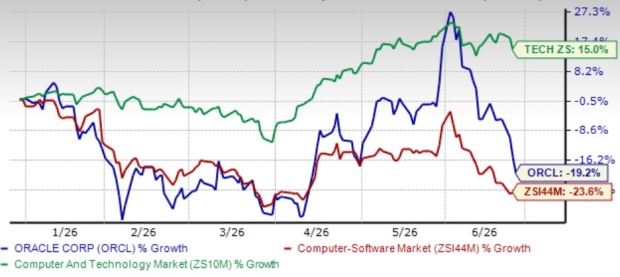
Shares of Oracle have declined 19.2% in the year-to-date period, underperforming the Zacks Computer and Technology sector’s growth of 15%. However, the Zacks Computer – Software industry has fallen 23.6% during the same period.
ORCL’s YTD Price Performance
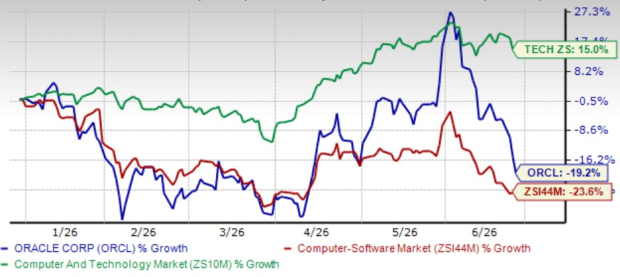
Image Source: Zacks Investment Research
From a valuation standpoint, ORCL stock is currently trading at a forward 12-month P/S ratio of 4.97X, which is lower than the industry average of 5.99X. Oracle has a Value Score of C.
ORCL’s Valuation

Image Source: Zacks Investment Research
The Zacks Consensus Estimate for ORCL’s fiscal 2027 earnings is pegged at $8.03 per share, increased by 4 cents over the past 30 days. The earnings estimate suggests 5.24% growth over the figure reported in fiscal 2026.

Image Source: Zacks Investment Research
ORCL currently carries a Zacks Rank #3 (Hold). You can see the complete list of today’s Zacks #1 Rank (Strong Buy) stocks here.
Beyond Nvidia: AI’s Second Wave Is Here
The AI revolution has already minted millionaires. But the stocks everyone knows about aren’t likely to keep delivering the biggest profits. AI’s second wave is moving from infrastructure to implementation and these companies are at the forefront of this transition, positioned to become what Amazon and Google were to the internet era.
Oracle Corporation (ORCL) : Free Stock Analysis Report
Microsoft Corporation (MSFT) : Free Stock Analysis Report
Snowflake Inc. (SNOW) : Free Stock Analysis Report
This article originally published on Zacks Investment Research (zacks.com).
5 Stocks Our Experts Predict Could Double In the Next Year
By submitting your email, you'll also get a free pivot & flow membership. A free daily market overview. You can unsubscribe at any time.